
NVIDIA · GeForce
GeForce RTX 2080
A Turing graphics card with 8 GB of GDDR6 memory and ray tracing hardware, offered with faster Founders Edition clocks.
Model history · 2 models, 2016–2018
- 2016GeForce GTX 1080Compare
- 2018GeForce RTX 2080
- Memory
- 8 GB
- Shaders
- 2,944
- Boost clock
- 1,710 MHz or 1,800 MHz
- Bandwidth
- 448 GB/s
- Power
- 215 W or 225 W
What reviewers say
Founders Edition reviews praise strong performance above the GTX 1080 and an improved cooler, though conventional games often run close to the GTX 1080 Ti. The high launch price and unproven ray tracing and DLSS game support are common concerns. TechRadar is more positive about value; demanding 4K games still need settings reduced.
From pcgamer.com, techradar.com and pcworld.com
Specifications
Report a wrong or missing specPerformance
- Chip maker
- NVIDIA
- Architecture
- Turing
- Shader cores
- 2,944
- Boost clock
- 1,710 MHz or 1,800 MHz
- Architecture
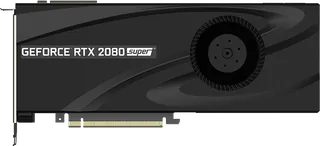
- Main figures follow NVIDIA's reference specification. Founders Edition raises boost clock and board power. Photo shows MSI's stock-clocked RTX 2080 AERO 8G partner board, which uses a blower rather than the Founders Edition's dual axial fans.
- Ray tracing
- Dedicated first generation RT Cores
- AI cores
- Dedicated Tensor Cores
- Upscaling and frame generation
- NVIDIA DLSS Super Resolution; no DLSS Frame Generation
- Base clock
- 1515 MHz for both reference and Founders Edition
Memory
- Video memory
- 8 GB GDDR6
- Memory bus
- 256-bit
- Memory bandwidth
- 448 GB/s
- Memory detail
- 14 Gbps GDDR6
Connections and power
- Board power
- 215 W or 225 W
- Interface
- PCIe 3.0
- Display outputs
- Founders Edition supports DisplayPort 1.4, HDMI 2.0b and USB-C/VirtualLink; up to 4 displays; HDCP 2.2. MSI AERO 8G has 3 × DisplayPort 1.4a, 1 × HDMI 2.0b and 1 × USB-C.
- Maximum resolution
- 7680 × 4320
- Power connector
- 1 × 6-pin and 1 × 8-pin
- Recommended power supply
- 650 W
- Slot width
- 2 slots (Founders Edition)
- Size (reference card)
- 266.74 × 115.7 mm (Founders Edition); 268 × 114 × 41 mm and 879 g (pictured MSI AERO 8G partner board)
- Video encode and decode
- Turing NVENC encoder
Versions
| Version | Memory | Shaders | Boost clock | Memory bus | Bandwidth | Board power |
|---|---|---|---|---|---|---|
| Reference specification | 8 GB GDDR6 | 2,944 | 1,710 MHz | 256-bit | 448 GB/s | 215 W |
| Founders Edition | 8 GB GDDR6 | 2,944 | 1,800 MHz | 256-bit | 448 GB/s | 225 W |
Pros and cons
Pros
- Hardware ray tracing and DLSS Super Resolution
- 448 GB/s memory bandwidth
- Two-way NVLink support
Cons
- 8 GB of video memory
- No DLSS Frame Generation
- Requires 6-pin and 8-pin power connectors
Closest rivals
Model | Memory | Shaders | Boost clock | Bandwidth | Power | Released |
|---|---|---|---|---|---|---|
| 8 GB | 2,560 | 1,905 MHz or 1,980 MHz | 448 GB/s or – | 225 W or – | Jul 2019 | |
| 8 GB | 3,072 | 1,815 MHz | 496 GB/s | 250 W | Jul 2019 | |
| 8 GB | 2,560 | 1,770 MHz | 448 GB/s | 215 W | Jul 2019 |

Previous model: GeForce GTX 1080.
Sources
- nvidia.com/content/nvidiaGDC/zz/en_ZZ/geforce/graphics-cards/rtx-2080.html
- storage-asset.msi.com/datasheet/vga/global/GeForce-RTX-2080-AERO-8G.pdf
- nvidianews.nvidia.com/news/10-years-in-the-making-nvidia-brings-real-time-ray-t…
- nvidia.com/en-gb/geforce/graphics-cards/compare
Photo: storage-asset.msi.com