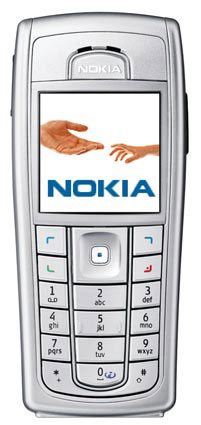
Nokia 6230i is a Series 40 GSM phone with a 1.3-megapixel camera, a 208 × 208-pixel colour screen and 32 MB of internal storage. It supports Bluetooth, EDGE, MMC cards and USB mass-storage transfer, with MP3/AAC/M4A playback and FM radio.
GSMArena, Mobile-review and iXBT welcome the sharper colour display, broad connectivity and multimedia features, while finding the camera average and the memory card's position beneath the battery inconvenient. GSMArena praises the improved keypad and USB mass-storage transfer, but criticises predictive text and Outlook contact ordering. Mobile-review finds the covers firmer than early 6230 samples and the Bluetooth connection improved, though some menus are slower. iXBT reports several software faults on its tested handset and sees little reason for an existing 6230 owner to upgrade; Mobile-review also favours waiting for a larger change. These observations concern the tested 2005 hardware and software.
Active-matrix TFT LCD with 65,536 colours and animated 3D menu graphics, archived exact Nokia specification page. No maker-published physical diagonal or native refresh rate assigned.
Performance
Storage
32 MB
Memory
32 MB internal memory, with approximately 27 MB available for video, audio, images and other documents, exact Nokia specification page. English issue 3 guide distinguishes contacts/messages/organiser/Java shared memory from gallery-file memory. No total RAM inferred from these pools.
Storage type
MMC expansion up to 512 MB in exact Nokia specifications; maker recommends approved compatible cards. An MMC is included in the sales package, with capacity dependent on region. Slot lies beneath the battery; English guide requires removing the battery to install it. SD cards are explicitly incompatible.
Cameras
Main camera
1.3 MP
Ultra wide camera
None
Telephoto camera
None
Optical zoom
None
Main camera
1.3-megapixel rear camera producing 1280 × 1024-pixel images, exact Nokia specification and English guide. Maker launch describes 3× digital zoom; digital enlargement is not optical zoom. Guide includes standard/portrait/night modes, self-timer, image quality and size controls.
Video recording
176 × 144-pixel QCIF recording with H.263 video and AMR audio; up to one hour depending on available phone/MMC memory, exact Nokia launch sheet and specifications. Streaming and playback support 3GPP, H.263, MPEG-4 and AMR; services depend on network and content support.
Battery and charging
Battery
900 mAh
Wireless charging
None
Battery life detail
Removable BL-5C lithium-ion battery, 900 mAh in original Nokia launch data sheet and shared service guide. Regional maker specification claims up to 3–5 h talk and 150–300 h standby, dependent on network and use; launch sheet says up to 5 h and 12 days. Contemporary retail reviews describe an 850 mAh cell, so the original maker figure does not establish every shipped battery revision.
Wired charging
English issue 3 guide gives approximately 1 h 30 min for BL-5C with ACP-12 while in standby. Proprietary charging socket; USB file transfer does not imply USB charging.
Design
Type
Standard
Weight
99 g
Thickness
20 mm
Height × width
103 × 44 mm
Weight detail
99 g including BL-5C battery, 103 × 44 × 20 mm and 76 cc, exact archived Nokia specification page.
Materials
Replaceable covers; original guide documents replacing the front cover and keypad. Optional cover gallery images show accessory finishes and do not establish every regional sales package.
Colours
Original maker launch sheet lists Silver Grey and Black and White in-box colours. Optional beige, black, dark-blue and red covers are pictured as original manufacturer compositions in Mobile-review’s released-model test. Included finishes and accessories vary by region.
Buttons
Five-way navigation with separate central select key, configurable left/right selection keys, numeric keypad, side volume/push-to-talk keys and top power/profile key, exact guide and Nokia specifications.
Water resistance detail
Original English guide explicitly states the phone is not water-resistant; no IP rating assigned.
Speakers
Integrated hands-free speaker, MP3/AAC/M4A stereo music playback and FM stereo radio with Visual Radio. A connected compatible headset acts as the FM antenna. Interactive Visual Radio depends on broadcaster, network and service availability.
Software
Operating system
Proprietary software
Software at launch
Nokia Series 40 with Java MIDP 2.0 and Bluetooth API, exact Nokia specifications.
Software features
Email using SMTP, POP3 and IMAP4; MMS OMA 1.2 up to 300 kB depending on network; concatenated SMS; predictive text; calendar, notes, wallet, voice memo up to 60 min, calculator, stopwatch and Java software. XHTML browser displays some HTML pages. Regional games differ. Archived services, software downloads and network features are not claimed to remain available today.
Release detail
Nokia announced 6230i on 1 March 2005 and explicitly called it the successor to 6230, with second-quarter shipments planned. GSMArena's full 12 April 2005 review says it had entered the market days earlier; Mobile-review's 26 April retail test also confirms availability. No exact maker first-sale month established, so year precision retained rather than reusing the announcement day. Product/support resources are archived English UAE maker pages; model-specific downloads in that archive may no longer work.
In the box
Original Nokia launch sheet lists 6230i phone, BL-5C battery, ACP-12 travel charger, user guide, CD-ROM, MMC and HDS-3 stereo headset. Regional packages and MMC capacities vary.
Connectivity
Mobile network
EGSM 900 / GSM 1800 / GSM 1900, automatic band switching, exact Nokia specifications. EDGE class 10 (4+1, 3+2), up to 236.8 kbit/s; GPRS class 10; HSCSD up to 43.2 kbit/s. Push to talk uses cellular data and requires a compatible operator service. GSM/EDGE support does not establish UMTS/3G capability.
SIM
Mini-SIM behind removable battery, exact English guide.
Bluetooth
Bluetooth 1.1, English issue 3 guide; Hands-free, Headset, Object Push, File Transfer, Dial-up Networking, SIM Access and Serial Port profiles. Infrared also supported. No stereo A2DP inferred from Bluetooth connectivity or stereo music playback.
USB
USB via Pop-Port. English guide permits the inserted MMC to act as a storage device for a compatible PC, or use with PC Suite; the storage-device mode applies to the card. No USB connector type or charging power inferred from the word USB.
Storage options
Storage
32 MB
Pros and cons
Pros
+Bluetooth, infrared and USB mass-storage transfer