Photography Blog and Cameralabs praise the stabilisation, accessible controls and detailed low-ISO photographs, while finding noise prominent at higher sensitivities. Their dust-removal experiences differ; Photography Blog found its samples remained clean, whereas Cameralabs saw dust marks. Photography Blog also notes the loud shutter, while Cameralabs found the kit lens soft in the corners at wide angle.
Interlace-scan CCD with primary-colour filter; 10.8 million total pixels; anti-static coating and sensor vibration for dust reduction
Image formats
JPEG, RAW and RAW+JPEG; Sony UK lists 3880 × 2600 RAW and 3872 × 2592 maximum JPEG. Sony Japan's launch table gives 3872 × 2592 recording pixels without a separate RAW row.
ISO detail
Standard ISO 100–1600; Auto ISO 100–800; Lo80 and Hi200 are separate Zone Matching settings
Image processor
BIONZ
Lens and shooting
Lens mount
Sony A-mount
Stabilisation
Sensor shift
Maximum continuous burst
3 fps
Lens detail
Interchangeable A-mount; compatible Sony, Minolta and Konica Minolta lenses; kit-lens specifications are separate from the camera body
Autofocus
TTL phase detection; nine points with centre cross sensor; single-shot, continuous, automatic AF, direct manual focus and manual focus; selectable Eye-Start AF
Shutter
Electronically controlled vertical-traverse focal-plane shutter; 30 seconds to 1/4000 second plus Bulb; flash sync 1/160 second with stabilisation off or 1/125 with it on
Burst detail
Up to 3 fps under Sony's L Fine JPEG, manual-focus and faster-than-1/250-second conditions. JPEG can continue until the card fills with sufficiently fast media; buffer claim is six RAW or three RAW+JPEG photographs.
Stabilisation detail
Super SteadyShot CCD-shift mechanism; Sony claims approximately 2–3.5 stops depending on lens and shooting conditions; Minolta AF Macro Zoom 3X-1X F1.7-2.8 is excluded from the launch compatibility claim
Flash
Built-in manually raised flash; guide number 12 at ISO 100 in metres; ADI/P-TTL metering; compatible external Alpha flash support
Exposure controls
Program, aperture priority, shutter priority and manual; six scene modes; 40-segment honeycomb, centre-weighted and spot metering; D-Range Optimizer is unavailable for RAW and RAW+JPEG
Screen and viewfinder
Viewfinder
Optical
Screen size
2.5″
Screen dots
230,000
Display detail
Clear Photo LCD Plus TFT; 230,000 dots count display subpixels; shooting information rotates when the body is turned
Viewfinder detail
Fixed eye-level roof-mirror system; 95% coverage; 0.83× magnification with a 50 mm lens focused at infinity
Connections and design
Battery life (maker's claim)
750 photographs
Body weight
545 g
Release detail
Sony Japan specifies 21 July 2006 for the body and both initial lens kits; Sony's US release gives July 2006 without a day.
Recording media
CompactFlash Type I/II and Microdrive; Memory Stick Duo and PRO Duo through supplied CF-slot adaptor
Ports
USB 2.0 Hi-Speed, switchable NTSC/PAL video output, remote-release terminal and DC input
Battery life detail
NP-FM55H; approximately 750 photographs under CIPA conditions with flash used for half of the shots
Approximately 545 g without battery, recording media, lens or body accessories
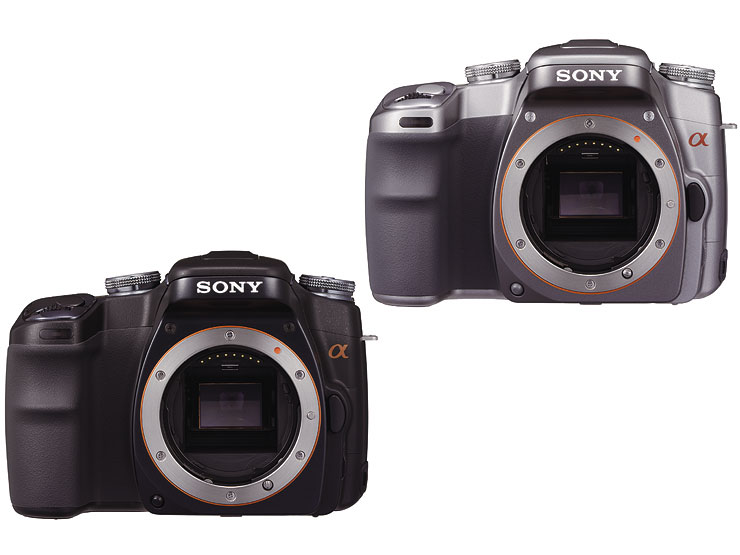
Colours
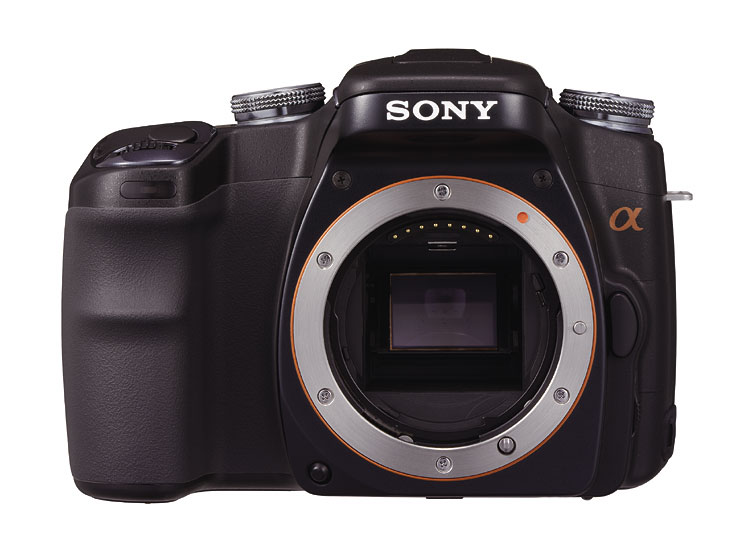
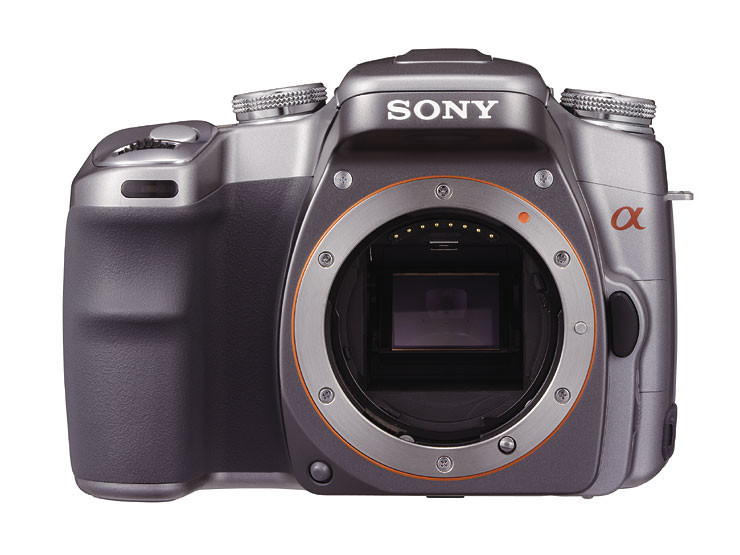
Black or silver
In the box
NP-FM55H battery, BC-VM10 charger, video and USB cables, power cord, shoulder strap, Memory Stick Duo CF adaptor, body and accessory-shoe caps, software CD
Video
Video detail
Still-image camera; no movie recording or live-view framing (Photography Blog and Cameralabs)
Pros and cons
Pros
+Sensor-shift stabilisation built into the body
+RAW recording and manual exposure controls
+Optical viewfinder and interchangeable A-mount lenses
Cons
−No video recording or live-view framing
−Three frames per second maximum continuous shooting