Olympus · PEN
PEN E-P7
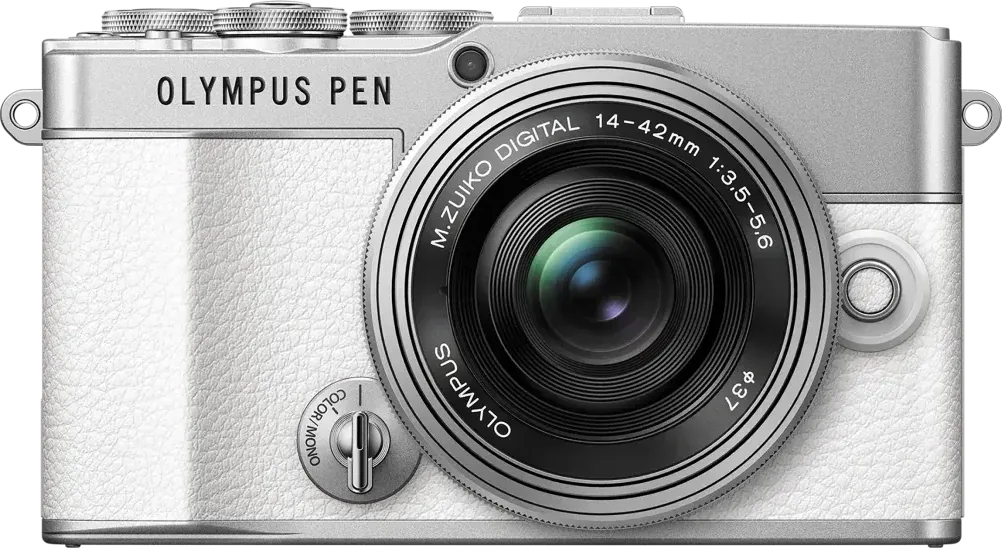
A 20.3-megapixel Micro Four Thirds mirrorless camera with five-axis stabilisation, a flip-down touchscreen and a front colour/monochrome profile switch.
- Type
- Mirrorless
- Sensor
- Four Thirds
- Megapixels
- 20.3
- Lens
- Micro Four Thirds
- Video
- 3840 × 2160 at 30 fps
- Body weight
- 289 g
What reviewers say
Both praise the attractive JPEGs, creative profiles and useful manual controls. Photography Blog likes the compact travel design and value, while Amateur Photographer finds the plastic body and small rear buttons disappointing for its price. Both note the absent viewfinder; Amateur Photographer also finds the flip-down screen awkward for tripod-mounted video and the default noise reduction strong.
Specifications
Report a wrong or missing specImage and sensor
- Camera type
- Mirrorless
- Sensor format
- Four Thirds
- Sensor type
- Live MOS
- Sensor dimensions
- 17.3 × 13 mm
- Effective resolution
- 20.3 MP
- Largest image
- 5184 × 3888
- RAW recording
- Yes
- Standard ISO range
- 200–25600
- Sensor detail
- Approximately 21.8 total megapixels; UK image area 17.3×13 mm, while Japan specifies 17.4×13 mm
- Image formats
- JPEG, 12-bit losslessly compressed ORF RAW and simultaneous RAW+JPEG; maximum ordinary still size 5184×3888
- ISO detail
- Manual ISO 200–25600 with expanded LOW approximately ISO 100; Auto normally LOW–6400
- Image processor
- TruePic VIII
Lens and shooting
- Lens mount
- Micro Four Thirds
- Stabilisation
- Sensor shift
- Maximum continuous burst
- 15 fps
- Autofocus
- 121-point contrast detection with single, nine-point group or all-area selection; face and near-eye detection, continuous tracking and manual-focus peaking
- Shutter
- Mechanical 1/4000–60 seconds; electronic 1/16000–60 seconds; electronic first curtain 1/320–60 seconds, switching to mechanical first curtain at faster speeds; Bulb, Live Time and Live Composite
- Burst detail
- Electronic high approximately 15 fps with focus fixed at the first frame, reported by Amateur Photographer; electronic low 6.3 fps. Mechanical high 8.7 fps and low 5 fps; continuous autofocus requires the low-speed setting. Maker electronic-high buffer 42 RAW or 49 large-fine JPEG with specified KIOXIA UHS-II card
- Stabilisation detail
- Five-axis sensor shift, rated up to 4.5 CIPA stops with M.Zuiko Digital ED 14–42mm F3.5–5.6 EZ at 42 mm; movie M-IS1 adds electronic correction with a field-of-view crop, M-IS2 uses sensor stabilisation alone
- Flash
- Built-in flash, guide number 7.6 at ISO 200; hot shoe; mechanical flash synchronisation up to 1/250 second
- Exposure controls
- P/A/S/M and Advanced Photo modes including Live Composite, Live Time, HDR, multiple exposure, digital keystone correction, exposure and focus bracketing; front colour/monochrome switch accesses customisable image profiles
Video
- Highest video resolution
- 3840 × 2160 at 30 fps
- Video detail
- MOV H.264; 4K 30/25/24p approximately 102 Mbps, Full HD up to 60p and 720p high-speed recording at 120 fps; maximum clip approximately 29 minutes
- Audio
- Built-in stereo microphone, 16-bit 48 kHz linear PCM, recording-level and wind-noise controls; no microphone or headphone socket, confirmed by Photography Blog
Screen and viewfinder
- Viewfinder
- None
- Screen size
- 3″
- Screen dots
- 1,037,000
- Touchscreen
- Yes
- Tilting screen
- Yes
- Display detail
- Tilts approximately 80° up and 180° down for forward-facing selfie mode beneath the body
Connections and design
- Wi-Fi
- Yes
- Bluetooth
- Yes
- Battery life (maker's claim)
- 360 photographs
- Body weight
- 289 g
- Release detail
- Maker European press release, republished in full by Photography Blog, states mid-June 2021 availability; Japan body and 14–42mm EZ kit on sale 25 June. Month precision retained for the earlier European release
- Recording media
- One SD slot; SDHC and SDXC with UHS-I/UHS-II support
- Ports
- USB 2.0 Micro-B, micro-HDMI Type D and hot shoe; no wired remote-release socket
- Wireless connections
- Wi-Fi IEEE 802.11b/g/n and Bluetooth 4.2 Low Energy; smartphone transfer, remote shooting and smartphone GPS tagging through OI.Share
- Battery life detail
- BLS-50 rechargeable battery; approximately 360 CIPA photographs with stabilisation on; video 80 minutes under standard JEITA conditions or 140 minutes without zoom operations, repeatedly recording maximum-length clips under maker conditions
- Charging
- In-camera USB charging with camera switched off; F-5AC USB adapter supplied; external battery charger optional
- Dimensions
- 118.3×68.5×38.1 mm, excluding protrusions
- Weight detail
- Approximately 289 g body only; 337 g with supplied battery and memory card. Amateur Photographer's introduction labels the loaded weight body-only, unlike the maker table
- Materials
- Predominantly plastic body with metal control dials, reported by Amateur Photographer; Photography Blog reports no weather sealing
- Colours
- Silver with black covering or silver with white covering
- In the box
- Body, BLS-50 battery, USB cable, shoulder strap, F-5AC USB adapter and documentation; regional plug variants apply
Pros and cons
Pros
- Five-axis sensor stabilisation
- Twin control dials and customisable colour profiles
- In-camera USB charging
Cons
- No electronic viewfinder
- No microphone or headphone socket
- Selfie screen obstructed by a tripod
Closest rivals
Model | Type | Sensor | Megapixels | Lens | Video | Body weight | Released |
|---|---|---|---|---|---|---|---|
| Mirrorless | Four Thirds | 20.33 | Micro Four Thirds | 4992 × 3744 at 29.97 fps | 647 g | Jun 2021 | |
| Mirrorless | Four Thirds | 20.4 | Micro Four Thirds | 4096 × 2160 at 24 fps | 366 g | Nov 2022 | |
| Mirrorless | Four Thirds | 20.3 | Micro Four Thirds | 3840 × 2160 at 30 fps | 303 g | Jul 2020 |


Sources
- explore.omsystem.com/gb/en/e-p7
- jp.omsystem.com/product/dslr/pen/ep7/spec.html
- jp.omsystem.com/product/dslr/pen/ep7/index.html
- photographyblog.com/news/olympus_pen_e_p7
- amateurphotographer.com/review/olympus-pen-e-p7-review
- photographyblog.com/reviews/olympus_e_p7_review
Photo: emea.explore.omsystem.com
