Photo 1 of 3
Panasonic LUMIX G100 · Photo source
Panasonic · LUMIX G
LUMIX G100
A small 20.3-megapixel Micro Four Thirds camera with a vari-angle touchscreen, electronic viewfinder and three-microphone OZO Audio system.
- Type
- Mirrorless
- Sensor
- Four Thirds
- Megapixels
- 20.3
- Lens
- Micro Four Thirds
- Video
- 3840 × 2160 at 30 fps
- Body weight
- 303 g
What reviewers say
Both reviews praise compact handling, the viewfinder and adaptable microphones, while noting stabilisation crops and no headphone socket. Photography Blog finds strong stills and Full HD video but wandering autofocus and compromised 4K vlogging. Digital Camera World's pre-production test is more positive about face tracking and stabilisation, while also warning about tight framing and low-light video quality.
Specifications
Report a wrong or missing specImage and sensor
- Camera type
- Mirrorless
- Sensor format
- Four Thirds
- Sensor type
- Live MOS
- Effective resolution
- 20.3 MP
- Largest image
- 5184 × 3888
- RAW recording
- Yes
- Standard ISO range
- 200–25600
- Sensor detail
- 20.3 million effective and 21.77 million total pixels; 4:3 Live MOS primary-colour sensor without low-pass filter. Physical millimetre dimensions not published in the read maker table and omitted
- Image formats
- JPEG and RAW; 4K Photo extracts lower-resolution JPEG frames from video bursts
- ISO detail
- Standard ISO 200–25600, expanded ISO 100
Lens and shooting
- Lens mount
- Micro Four Thirds
- Stabilisation
- Optical lens stabilisation
- Maximum continuous burst
- 10 fps
- Autofocus
- Contrast AF, face/eye detection, tracking and 49-area selection; AFS/AFF/AFC/MF modes
- Shutter
- Electronic front curtain up to 1/500 second; electronic shutter up to 1/16000 second. Flash synchronisation 1/50 second or slower
- Burst detail
- Native electronic 10 fps; electronic first curtain 6 fps AFS/MF or 5 fps AFF/AFC. Maker RAW buffer at least 20 frames under its test conditions; video-derived 4K Photo is separate
- Stabilisation detail
- Optical stabilisation depends on the attached lens; no sensor-shift Body I.S. Video electronic stabilisation combines with compatible optical lenses, marketed as 5-axis Hybrid I.S. rather than lens-plus-sensor stabilisation; 4K correction and crop differ. High electronic setting narrows the view further
- Flash
- Built-in TTL pop-up flash; maker guide number 5.1 at ISO 200 or 3.6 at ISO 100
Video
- Highest video resolution
- 3840 × 2160 at 30 fps
- Video detail
- Internal UHD 3840×2160 at maker-labelled 30p or 24p, 100 Mbps H.264 MP4; 4K single-session limit ten minutes. Full HD 60p limited to twenty minutes, other listed ordinary Full HD modes 29 minutes 59 seconds. V-Log L supported; HDMI output prevents simultaneous internal recording. Recording frequencies vary by region
- Audio
- Three integrated microphones with OZO Audio by Nokia, including front/back/surround/tracking/automatic modes; stereo recording, 3.5 mm external microphone input and monaural speaker. No headphone monitoring socket
Screen and viewfinder
- Viewfinder
- Electronic
- Screen size
- 3″
- Screen dots
- 1,840,000
- Touchscreen
- Yes
- Tilting screen
- Yes
- Display detail
- Free-angle 3-inch 3:2 capacitive touchscreen, approximately 1.84 million dots and 100% coverage
- Viewfinder detail
- Colour LCD electronic viewfinder, approximately 3.68 million dots equivalent, 100% coverage and 0.73× 35 mm-equivalent magnification under maker conditions; not the later G100D OLED viewfinder
Connections and design
- Wi-Fi
- Yes
- Bluetooth
- Yes
- Battery life (maker's claim)
- 270 photographs
- Body weight
- 303 g
- Release detail
- Maker North America announcement confirms end-of-July2020 sale, matching Photography Blog's UK availability wording; Japan maker specifies 20August2020, a later regional launch. Digital Camera World explicitly tested a pre-production sample and awaited production lab tests; its findings are attributed rather than treated as final production validation. Original G100 remains separate from G100D
- Recording media
- One SD/SDHC/SDXC slot, UHS-I U3 compatible
- Ports
- USB 2.0 Micro-B, micro-HDMI Type D and 3.5 mm microphone input; tripod grip connects through USB
- Wireless connections
- Wi-Fi 2.4 GHz IEEE802.11b/g/n and Bluetooth Low Energy 4.2
- Battery life detail
- CIPA approximately 270 LCD or 250 EVF photographs with supplied battery and H-FS12032 lens. One-second power-save EVF 900-shot figure conditional, not headline
- Charging
- USB battery charging; optional AC adapter and appropriate DC coupler for external power
- Dimensions
- Approximately 115.6 × 82.5 × 54.2 mm excluding protrusions
- Weight detail
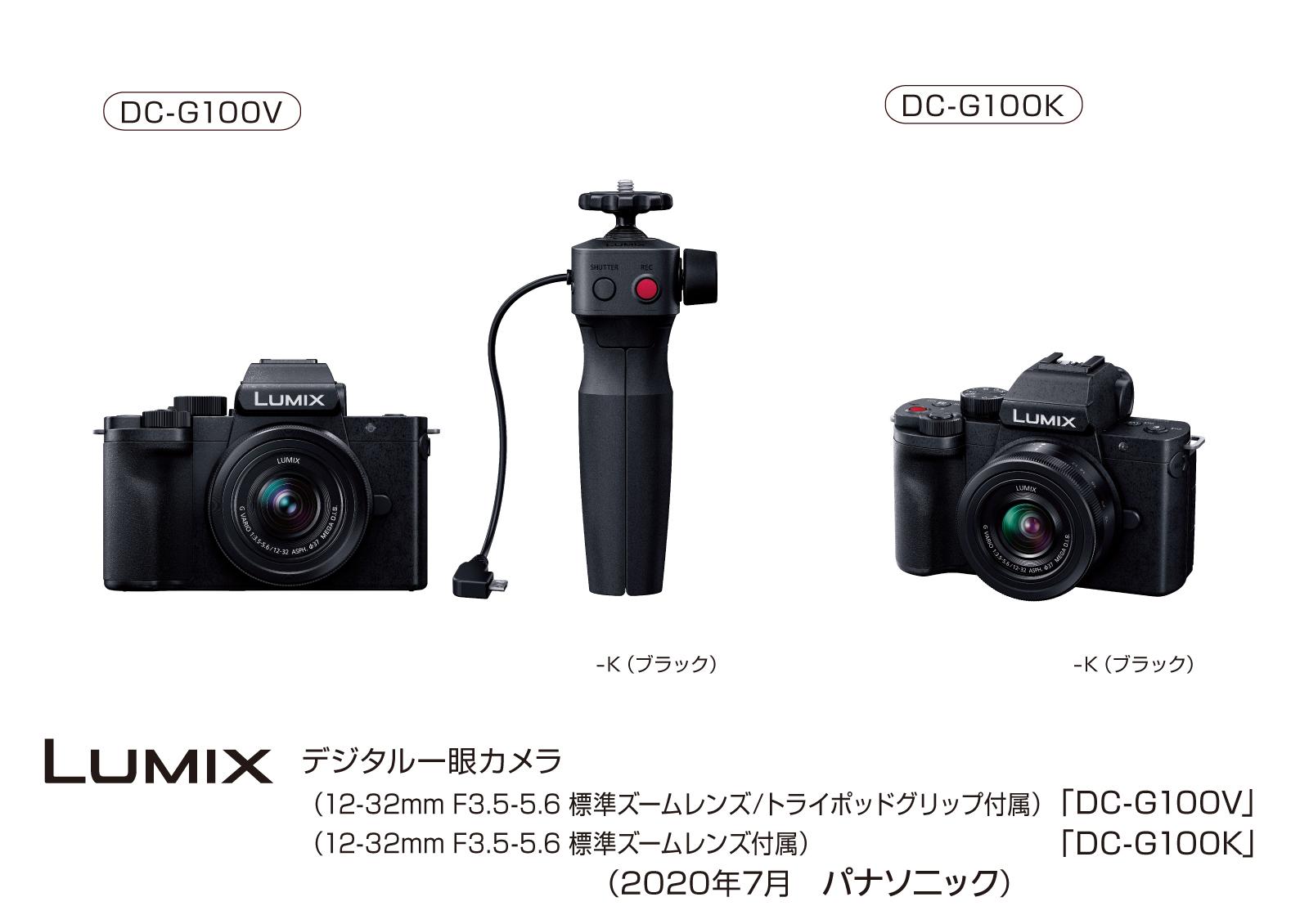
- Approximately 303 g body only, 345 g with battery/card or 412 g with 12–32mm kit lens/battery/card. Photo shows the maker's 12–32mm kit; lens is not included in body specifications
Pros and cons
Pros
- Body weighs 303 g without battery
- Vari-angle touchscreen and electronic viewfinder
- Directional microphone modes for video
Cons
- No sensor-shift stabilisation
- 4K clips limited to ten minutes
- Micro-USB connection and no headphone socket
Closest rivals
Model | Type | Sensor | Megapixels | Lens | Video | Body weight | Released |
|---|---|---|---|---|---|---|---|
| Mirrorless | Four Thirds | 20.3 | Micro Four Thirds | 3840 × 2160 at 30 fps | 335 g | Aug 2020 | |
| Mirrorless | Four Thirds | 20.3 | Micro Four Thirds | 3840 × 2160 at 30 fps | 289 g | Jun 2021 | |
| Mirrorless | Four Thirds | 20.4 | Micro Four Thirds | 4096 × 2160 at 24 fps | 366 g | Nov 2022 |


Sources
- help.na.panasonic.com/answers/features-and-specifications-lumix-g-series-dc-g100
- help.na.panasonic.com/wp-content/uploads/2023/10/DC-G100_DVQP2173ZB_ENG.pdf
- na.panasonic.com/news/panasonic-launches-the-lumix-g100-its-newest-mirrorless-c…
- news.panasonic.com/jp/press/jn200714-1
- panasonic.jp/dc/products/DC-G100K.html
- photographyblog.com/reviews/panasonic_lumix_g100_review
- digitalcameraworld.com/reviews/panasonic-lumix-g100-review
Photo: panasonicjp.scene7.com
- Panasonic LUMIX G100 — camera with mounted lens and open selfie screen held on a shooting grip outdoors: Panasonic official launch press photograph, complete supplied canvas: g100.webp
- Panasonic LUMIX G100 — complete supplied camera kit configurations with mounted lenses and shooting grip: Panasonic official launch press photograph, complete supplied canvas: l-jn200714-1-1.jpg