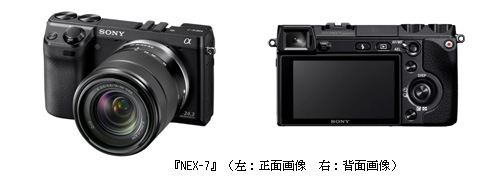
Photo 1 of 2
Sony Alpha NEX-7 · Photo source
Sony · Alpha
Alpha NEX-7
Sony's NEX-7 pairs a 24.3 MP APS-C sensor with an OLED electronic viewfinder, three control dials, built-in flash and Full HD progressive video.
- Type
- Mirrorless
- Sensor
- APS-C
- Megapixels
- 24.3
- Lens
- Sony E-mount
- Video
- 1920 × 1080 at 60 fps
- Body weight
- 291 g
What reviewers say
PhotographyBlog and CameraLabs praised the electronic viewfinder, configurable controls and detailed photographs, but both found autofocus weaker in low light. PhotographyBlog was more enthusiastic about high-ISO results; CameraLabs saw noise affecting detail earlier and preferred the NEX-5N for cleaner high-ISO images. Their launch reviews also criticised the limited selection of native lenses available at the time.
From photographyblog.com, cameralabs.com, cameralabs.com and cameralabs.com
Specifications
Report a wrong or missing specImage and sensor
- Camera type
- Mirrorless
- Sensor format
- APS-C
- Sensor type
- Exmor APS HD CMOS
- Sensor dimensions
- 23.5 × 15.6 mm
- Effective resolution
- 24.3 MP
- Largest image
- 6000 × 4000
- RAW recording
- Yes
- Standard ISO range
- 100–16000
- Sensor detail
- 24.7 million total pixels; charge-protection coating and ultrasonic vibration for dust reduction
- Image formats
- JPEG, RAW and RAW+JPEG; ARW 2.3; MPO for 3D Sweep Panorama
- ISO detail
- Standard ISO 100–16000; Auto ISO 100–1600
- Image processor
- BIONZ
Lens and shooting
- Lens mount
- Sony E-mount
- Stabilisation
- Optical lens stabilisation
- Maximum continuous burst
- 10 fps
- Lens detail
- Sony E-mount; NEX-7K includes a black E 18–55mm F3.5–5.6 OSS lens; optional adapters support other mounts
- Autofocus
- Contrast detection with 25 points; single or continuous AF, direct manual focus and manual focus; object tracking and focus peaking
- Shutter
- Vertical-traverse focal-plane shutter with switchable electronic first curtain; 30 seconds to 1/4000 second plus Bulb; flash sync 1/160 second
- Burst detail
- Approximately 10 fps Speed Priority Continuous with focus and exposure fixed at the first frame; approximately 3 fps normal continuous advance. Sony lists buffers of 17 Fine JPEG, 18 Standard JPEG, 13 RAW or 11 RAW+JPEG images under its stated conditions.
- Stabilisation detail
- No sensor-shift stabilisation (PhotographyBlog and CameraLabs); optical correction requires a compatible OSS lens
- Flash
- Built-in pop-up flash; guide number 6 at ISO 100 in metres; approximately four-second recycle time; Auto-lock Accessory Shoe for compatible external flashes
- Exposure controls
- Intelligent Auto and PASM; Tri-Dial Navi uses two top control dials and the rear wheel; Picture Effects, Sweep Panorama, DRO, Auto HDR and multi-exposure low-light modes
Video
- Highest video resolution
- 1920 × 1080 at 60 fps
- Video detail
- Japanese model records AVCHD 2.0 Full HD at 60p up to 28 Mbps, 60i or 24p; PAL models offer 50p/25p (PhotographyBlog and CameraLabs). Manual exposure and continuous autofocus during recording. MP4 offers 1440 × 1080 or VGA; interlaced field rates are separate from full-frame rates.
- Audio
- Built-in stereo microphone, wind-noise reduction and external microphone input (PhotographyBlog and CameraLabs); Dolby Digital or AAC-LC audio
Screen and viewfinder
- Viewfinder
- Electronic
- Screen size
- 3″
- Screen dots
- 921,600
- Touchscreen
- No
- Tilting screen
- Yes
- Display detail
- TruBlack wide TFT; tilts approximately 90° up and 45° down; no touchscreen (PhotographyBlog and CameraLabs)
- Viewfinder detail
- 0.5-type XGA OLED Tru-Finder with 2,359,296 dots, approximately 100% coverage and 1.09× magnification with a 50mm lens at infinity; eye sensor, histogram and level display
Connections and design
- Battery life (maker's claim)
- 430 photographs
- Body weight
- 291 g
- Release detail
- Sony's revised Japanese announcement gives 27 January 2012 for NEX-7 and NEX-7K. The camera was announced in August 2011; Sony Hong Kong subsequently postponed the planned November 2011 launch because of Thai flooding. The recorded date is the manufacturer-confirmed Japanese sale date, not a universal first-shipment claim.
- Recording media
- Memory Stick PRO Duo and PRO-HG Duo; SD, SDHC and SDXC
- Ports
- USB 2.0 Hi-Speed, Mini HDMI Type C, Auto-lock Accessory Shoe and external microphone input
- Battery life detail
- NP-FW50; Sony specifies approximately 430 CIPA photographs using the LCD or 350 using the viewfinder. CameraLabs gives a lower 335-shot general figure; the manufacturer's explicitly separated claims are retained.
- Charging
- Supplied BC-VW1 external charger; optional AC-PW20AM power supply
- Dimensions
- Approximately 119.9 × 66.9 × 42.6 mm (width × height × depth); 25.3 mm thinnest section excludes grip and mount
- Weight detail
- Approximately 291 g camera only; 350 g including battery and Memory Stick PRO Duo; lens excluded
- Materials
- Magnesium-alloy front and top covers; rubber grip
- Colours
- Black
- In the box
- NP-FW50 battery, BC-VW1 charger, shoulder strap, cleaning cloth, body cap, accessory-shoe cap, eyepiece cup, USB cable and software CD; kit includes the specified lens
Pros and cons
Pros
- Built-in OLED viewfinder and pop-up flash
- Three control dials and customisable buttons
- RAW recording and manual-focus peaking
Cons
- No sensor-shift stabilisation
- Screen is tilting rather than fully articulated
Closest rivals
Model | Type | Sensor | Megapixels | Lens | Video | Body weight | Released |
|---|---|---|---|---|---|---|---|
| Mirrorless | APS-C | 16.1 | Sony E-mount | 1920 × 1080 at 60 fps | 218 g | Oct 2012 | |
| Mirrorless | APS-C | 16.1 | Sony E-mount | 1920 × 1080 at 60 fps | 287 g | Nov 2012 | |
| Mirrorless | APS-C | 16.1 | Sony E-mount | 1920 × 1080 at 30 fps | 255 g | Jun 2012 |


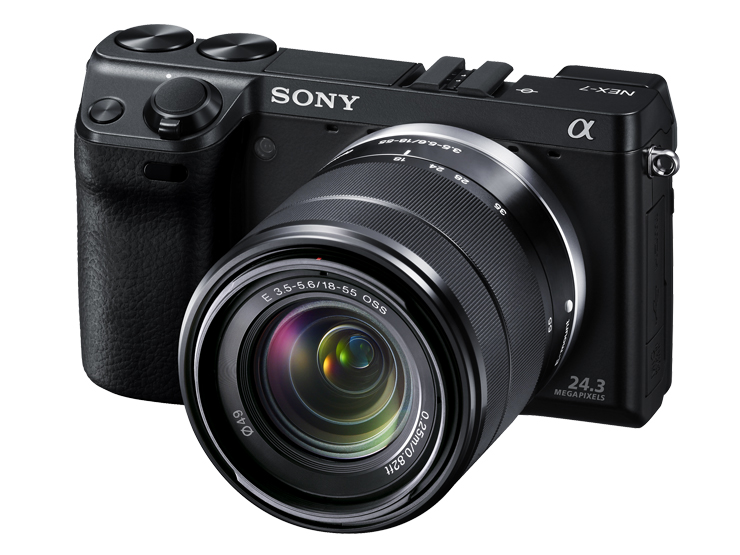
Sources
- sony.jp/CorporateCruise/Press/201108/11-0824C
- sony.com.hk/press/pdf/2011102001_e.pdf
- photographyblog.com/reviews/sony_nex_7_review
- cameralabs.com/sony_alpha_nex_7
Photo: sony.jp
- Sony NEX-7 front with attached lens and rear, in the complete supplied launch photograph: sony.jp/CorporateCruise/Press/201108/11-0824C/images/img_001.jpg