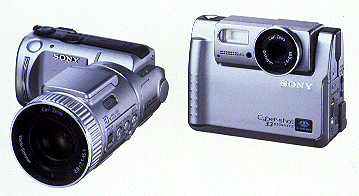
A swivelling fixed-lens digital camera with a 5× Carl Zeiss zoom, TIFF recording and an external flash connector.
Type
Bridge
Sensor
1/1.8-type
Megapixels
2.62
Lens
38–190 mm equivalent
Video
320 × 240
Body weight
424 g
What reviewers say
DPReview and digitalkamera.de praised detailed, colourful photographs, the zoom lens and manual focusing, but found operation slow and the supplied storage small. Both liked the swivelling design. DPReview particularly valued the hybrid screen, while digitalkamera.de found its reflective mode ineffective and direct sunlight troublesome. The latter also criticised exposure metering and questioned the price against higher-resolution rivals.
Sony Super HAD 1/1.8-type interlaced CCD with primary-colour filter; 3.34 million total and 2.62 million effective photosites; 12-bit A/D conversion
Image formats
JPEG, uncompressed TIFF and two-colour GIF text images; native output 1856 × 1392. The larger 2240 × 1680 mode uses Sony SRC interpolation and does not contain 3.7 million independently captured pixels
Lens and shooting
Built-in lens
38–190 mm equivalent
Maximum aperture
f/2.8–3.3
Optical zoom
5×
Lens detail
Carl Zeiss Vario-Sonnar; actual 7.1–35.5 mm, 38–190 mm equivalent; f/2.8–3.3 maximum aperture; seven groups and ten elements including two aspherical elements; 52 mm filter thread; 2× digital enlargement separately from 5× optical zoom
Autofocus
Autofocus from 0.25 m, macro autofocus from 0.02 m; manual focus ring with automatic 2× magnification of the display
Shutter
Shutter-priority settings from 8 seconds to 1/1000 second in 19 steps
Flash
Built-in pop-up flash with Auto, red-eye reduction, forced and disabled settings; recommended range 0.3–2.5 m. Dedicated connector supports optional Sony HVL-F1000 external flash
Exposure controls
Automatic exposure with ±2 EV compensation; aperture-priority settings from f/2.8 to f/8, shutter priority, twilight, twilight-plus, landscape and panfocus modes; spot metering and Auto, Indoor, Outdoor and One-push white balance
Video
Highest video resolution
320 × 240
Video detail
MPEG-1 with sound; 320 × 240 HQ or presentation modes up to 15 seconds per clip, or 160 × 112 video-mail mode up to one minute. Maker launch sheet does not publish native frame rate
Audio
Movie sound and voice annotations for still images
Screen and viewfinder
Viewfinder
None
Screen size
2″
Screen dots
123,000
Tilting screen
Yes
Display detail
Hybrid reflective/backlit TFT LCD; lens/body joint rotates up 90° or down 50°, allowing the screen and lens to face different directions. Tilting refers to this body joint, rather than a hinged LCD
Connections and design
Body weight
424 g
Release detail
Sony Japan's 26 April 2000 announcement states 1 June 2000 first sale. The maker explicitly describes the DSC-F505V as successor to DSC-F505K; no international date is inferred from the Japanese launch
Recording media
Memory Stick; supplied 8 MB card
Ports
USB via special connector; NTSC/PAL composite AV output with mono audio; dedicated external flash connector
Battery life detail
Supplied NP-FS11 InfoLithium battery; Sony claims up to 70 minutes or 1,300 photographs in continuous shooting conditions, not a modern CIPA still-image rating; remaining operating time shown in minutes
Charging
Supplied AC-VF10 AC adapter/charger
Dimensions
Approximately 107.2 × 62.2 × 135.9 mm (width × height × depth)
Weight detail
Approximately 424 g camera only; 475 g including NP-FS11 battery, Memory Stick, wrist strap and lens cap
In the box
Japanese kit includes 8 MB Memory Stick, USB cable, software CD-ROM, NP-FS11 battery, AV cable, AC-VF10 adapter, power cable, wrist strap and lens cap
Pros and cons
Pros
+38–190 mm equivalent Carl Zeiss zoom
+Manual focus ring with magnified focus assistance
+Uncompressed TIFF still-image recording
Cons
−No separate viewfinder or RAW capture
−Interpolation needed for the 3.7-megapixel output mode