Sony · Cyber-shot
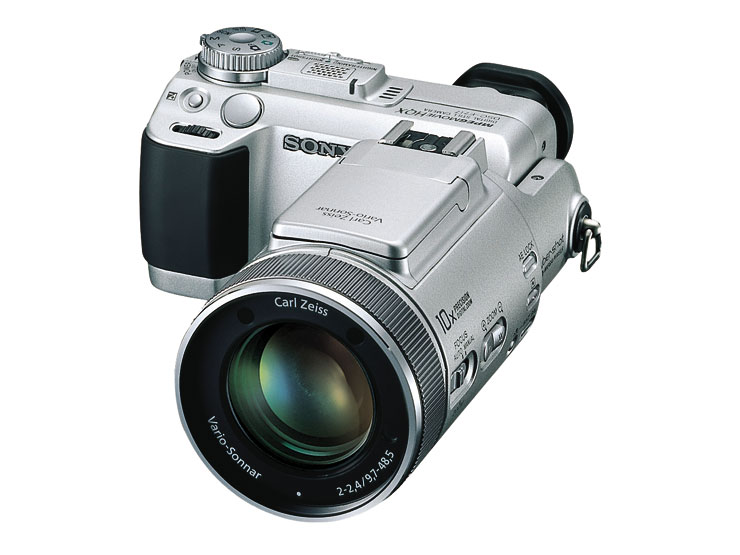
Cyber-shot DSC-F717
A swivelling bridge camera with a bright 5× zoom, selectable autofocus areas, live histogram and external flash shoe.
- Type
- Bridge
- Sensor
- 2/3-type
- Megapixels
- 5
- Lens
- 38–190 mm equivalent
- Video
- 320 × 240
- Body weight
- 586 g
What reviewers say
DPReview and digitalkamera.de praised detailed images, improved colour, the bright lens, handling and battery life. Both welcomed the histogram, zoom ring and flash shoe but criticised limited storage and image-processing controls. DPReview noted sharpening halos and weak indoor white balance; digitalkamera.de found TIFF recording slow and USB transfer less impressive than its USB 2.0 label suggested.
From dpreview.com and digitalkamera.de
Specifications
Report a wrong or missing specImage and sensor
- Camera type
- Bridge
- Sensor format
- 2/3-type
- Sensor type
- CCD
- Effective resolution
- 5 MP
- Largest image
- 2560 × 1920
- RAW recording
- No
- Standard ISO range
- 100–800
- Sensor detail
- 2/3-type Super HAD CCD with primary-colour filter; maker rounded effective and total sensor counts are 5.0 and 5.2 million. The native 2560 × 1920 image contains approximately 4.92 million pixels; the original press table prints 2590 in error, resolved by the maker operating manual
- Image formats
- Fine or Standard JPEG, uncompressed TIFF with accompanying JPEG and GIF Clip Motion; no RAW format
Lens and shooting
- Built-in lens
- 38–190 mm equivalent
- Maximum aperture
- f/2–2.4
- Optical zoom
- 5×
- Lens detail
- Carl Zeiss Vario-Sonnar; actual 9.7–48.5 mm, 38–190 mm equivalent; f/2–2.4 maximum aperture; 58 mm filter thread; electronic ring controls zoom in autofocus mode or manual focus
- Autofocus
- Three-area automatic selection or five manually selectable autofocus areas, with Hologram AF assistance; focus from 0.5 m wide or 0.9 m telephoto, wide-angle macro from 0.02 m
- Shutter
- Sony Japan specifies 30–1/2000 second in automatic/program modes and 30–1/1000 second in shutter priority or manual modes; DPReview notes program mode limits slower exposures to 1/30 second
- Burst detail
- Three full-resolution frames per burst; maker advanced manual specifies approximately 0.5 second intervals. DPReview measured 2.5 fps for three JPEGs with a subsequent write pause; no sustained rate is used as a headline
- Flash
- Automatic pop-up flash, hot shoe and ACC connector; external flashes operate with manual exposure settings
- Exposure controls
- Automatic, program, aperture priority, shutter priority and manual exposure; ±2 EV in 1/3 EV steps; multi-pattern, centre-weighted and spot metering; live histogram; NightShot infrared photography and NightFraming composition followed by normal-colour flash capture
Video
- Highest video resolution
- 320 × 240
- Video detail
- MPEG-1 with sound; 320 × 240 HQX or standard video, and 160 × 112 video-mail mode, limited by storage capacity. DPReview documents 16 fps HQX and 8 fps standard modes; maker launch table does not publish frame rate
- Audio
- Movie audio and still-image voice annotations
Screen and viewfinder
- Viewfinder
- Electronic
- Screen size
- 1.8″
- Screen dots
- 123,000
- Tilting screen
- Yes
- Display detail
- 1.8-inch TFT LCD with 123,000 dots and maker-stated 100% coverage; 180,000-dot electronic viewfinder. Lens/body joint rotates up 77° or down 36°; tilting describes this joint rather than an independently hinged LCD
Connections and design
- Battery life (maker's claim)
- 410 photographs
- Body weight
- 586 g
- Release detail
- Sony Japan's 3 September 2002 announcement specifies 12 October 2002 sale; this is the documented Japanese date, without assuming the same international first day
- Recording media
- Memory Stick; supplied 32 MB card. The later Sony advanced manual also lists Memory Stick PRO MSX-256, MSX-512 and MSX-1G recording capacities; launch reviews describe the contemporary 128 MB limit
- Ports
- Mini-B USB 2.0, NTSC/PAL composite AV output, DC input and ACC connector; DPReview measured USB transfer at approximately 1.2 MB/s
- Battery life detail
- NP-FM50 InfoLithium; maker standard claim approximately 410 photographs or 205 minutes, using Fine quality, LCD on, alternating full zoom, flash every other shot, power cycling every ten shots and a photograph every 30 seconds. The separate 3,000-image/210-minute continuous VGA LCD-off flash-off claim is not the headline rating
- Dimensions
- Approximately 119.5 × 68.9 × 151 mm (width × height × depth), excluding protrusions
- Weight detail
- Approximately 586 g camera only; maker specifies 696 g with battery, Memory Stick, shoulder strap and lens cap. DPReview gives a different 659 g loaded figure; main weight follows the maker body-only specification
- In the box
- Japanese kit includes 32 MB Memory Stick, NP-FM50 battery, AC adapter, USB and AV cables, lens cap, shoulder strap and software CD
Pros and cons
Pros
- 38–190 mm equivalent f/2–2.4 zoom
- Live histogram and five selectable autofocus areas
- Swivelling body and electronic viewfinder
Cons
- JPEG and TIFF recording without RAW
- Burst capture limited to three frames
- Supplied 32 MB Memory Stick limits full-size image storage
Closest rivals
Model | Type | Sensor | Megapixels | Lens | Video | Body weight | Released |
|---|---|---|---|---|---|---|---|
| Bridge | 2/3-type | 5.02 | 38–190 mm equivalent | 320 × 240 | 594 g | Oct 2001 | |
| Bridge | 2/3-type | 8 | 28–200 mm equivalent | 640 × 480 at 30 fps | 832 g | Dec 2003 | |
| Bridge | 1/1.8-type | 2.62 | 38–190 mm equivalent | 320 × 240 | 424 g | Jun 2000 |


Sources
- sony.co.uk/electronics/support/compact-cameras-dscf-series/dsc-f717/specificati…
- sony.jp/CorporateCruise/Press/200209/02-0903
- sony.jp/ServiceArea/impdf/pdf/3078046021.pdf
- dpreview.com/reviews/0095482916/sonydscf717
- digitalkamera.de/Testbericht/Testbericht_Sony_DSC-F717/1553.aspx
Photo: sony.jp