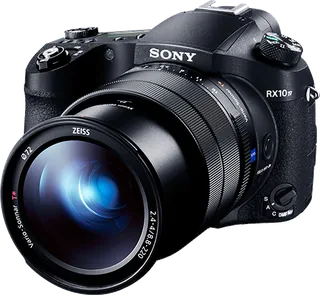
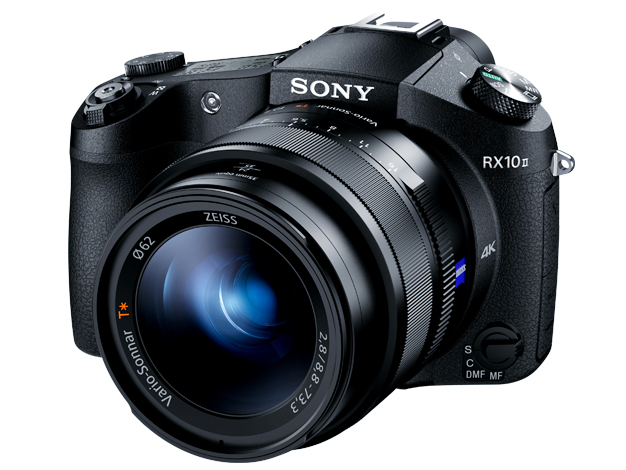
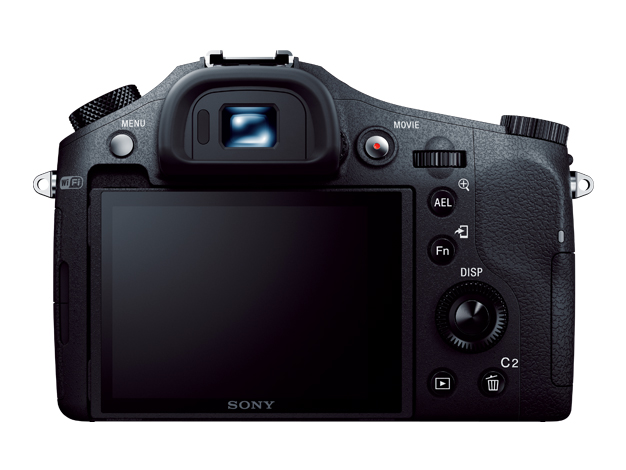
Both reviews praised the constant-aperture lens, image quality, build and video capabilities, while finding the price hard to justify. Photography Blog criticised restrictive memory-card requirements and high-ISO detail loss. Expert Reviews particularly liked lower-speed slow motion and comfortable controls, but found the absent touchscreen limiting for video autofocus.
1.0-type optical format; physical dimensions 13.2 × 8.8 mm; stacked processing circuitry and attached DRAM memory
Image formats
JPEG and RAW (Sony ARW 2.3); XAVC S, AVCHD 2.0 and MP4 movies
ISO detail
Standard single-frame ISO 100–12800; extended ISO 64/80; multi-shot noise reduction reaches ISO 25600
Image processor
BIONZ X
Lens and shooting
Built-in lens
24–200 mm equivalent
Maximum aperture
f/2.8
Optical zoom
8.3×
Stabilisation
Optical lens stabilisation
Maximum continuous burst
14 fps
Lens detail
ZEISS Vario-Sonnar T*; actual 8.8–73.3 mm; 24–200 mm equivalent for 3:2 stills; three-stop ND filter
Autofocus
Contrast-detection AF with 25-area wide mode; single-shot AF, continuous AF, direct manual focus and manual focus; Eye AF and Lock-on AF
Shutter
Mechanical manual mode permits Bulb and 30 seconds to 1/3200 second at f/8 or smaller; maximum speed at f/2.8 is 1/1600 second. Electronic shutter reaches 1/32000 second.
Burst detail
Sony specifies approximately 14 fps Speed Priority Continuous with focus and exposure fixed at the first frame, or approximately 5 fps normal continuous shooting. Photography Blog's 16 fps claim conflicts with Sony's specification; Sony's figure is used.
Stabilisation detail
Optical still-image stabilisation; Intelligent Active movie mode adds electronic correction
Flash
Built-in flash and Multi Interface Shoe for compatible accessories
Video
Highest video resolution
3840 × 2160 at 30 fps
Video detail
NTSC/Japanese XAVC S 4K up to 3840 × 2160 at 30p or 24p; PAL mode up to 25p (Expert Reviews). Up to 100 Mbps; approximately 29-minute recording limit. Full HD up to 120p NTSC or 100p PAL. Separate HFR captures 240/480/960 fps NTSC or 250/500/1000 fps PAL for approximately two or four seconds, using reduced-resolution sensor readout encoded as Full HD; focus and exposure fixed, no audio.
Audio
Stereo recording; LPCM, Dolby Digital or AAC by recording format; microphone input and headphone monitoring
Screen and viewfinder
Viewfinder
Electronic
Screen size
3″
Screen dots
1,228,800
Touchscreen
No
Tilting screen
Yes
Display detail
LCD tilts approximately 107° upwards and 42° downwards; no touchscreen (Photography Blog); backlit top settings display
Viewfinder detail
0.39-type OLED with 2,359,296 dots, 100% coverage and approximately 0.70× equivalent magnification
Connections and design
Wi-Fi
Yes
Battery life (maker's claim)
400 photographs
Body weight
770 g
Release detail
Sony's US announcement specifies July 2015 retail availability; Sony Japan specifies 7 August. Earlier models remained in the expanded RX range; no direct replacement inferred.
Recording media
SD, SDHC, SDXC and Memory Stick variants; 100 Mbps XAVC S requires UHS-I U3 SDXC
Ports
Multi/Micro USB with USB 2.0, Micro HDMI, Multi Interface Shoe, 3.5 mm microphone input and headphone output
Wireless connections
Wi-Fi 802.11b/g/n at 2.4 GHz and NFC One-touch remote and sharing
Battery life detail
NP-FW50; CIPA maker claim approximately 400 photographs using LCD or 360 using viewfinder
Charging
USB charging and power supply during shooting or playback
Dimensions
Approximately 129 × 88.1 × 120.6 mm from lens front to viewfinder; 102.2 mm depth from lens front to monitor
Weight detail
Sony specifies approximately 770 g body only and 813 g with battery and media
Colours
Black
Pros and cons
Pros
+Constant f/2.8 lens and built-in ND filter
+RAW recording and manual exposure controls
+Microphone input, headphone output and accessory shoe