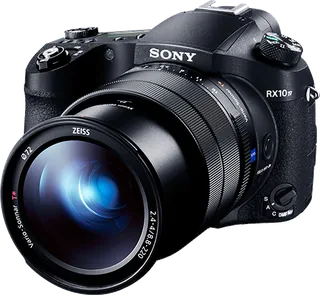
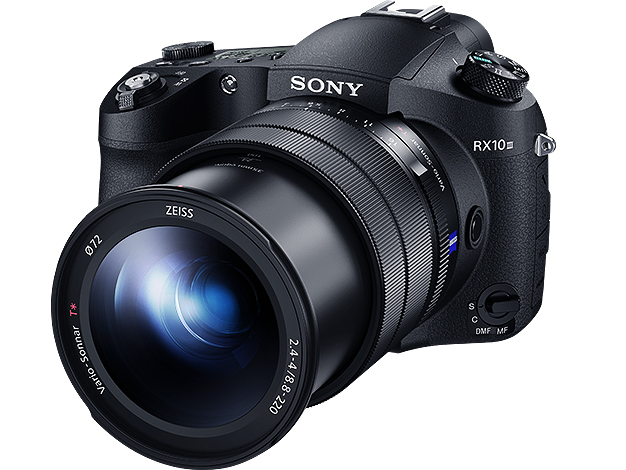
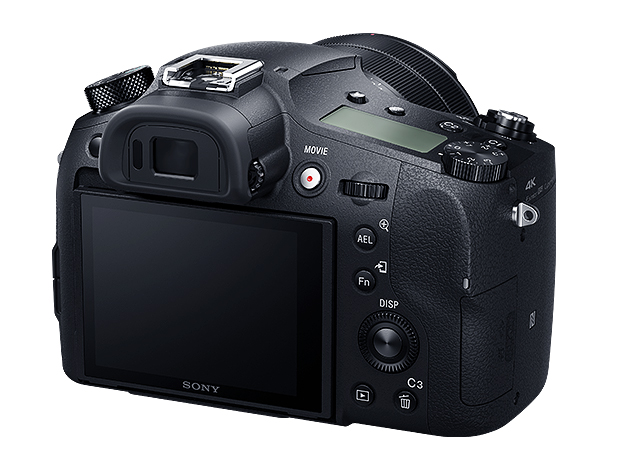
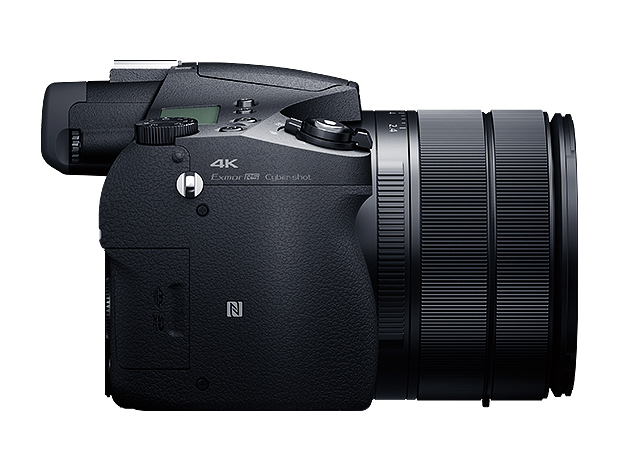
Both reviews praised the long zoom, image quality, solid build and viewfinder, while noting bulk and cost. Photography Blog found telephoto autofocus hesitant and menus convoluted, but did not greatly miss touch controls. Digital Camera World criticised slow zooming and small buttons, and noticed slight softness at wide-angle frame edges.
1.0-type optical format; physical dimensions 13.2 × 8.8 mm; stacked processing circuitry and attached DRAM memory
Image formats
JPEG and RAW (Sony ARW 2.3); XAVC S, AVCHD 2.0 and MP4 movies
ISO detail
Standard single-frame ISO 100–12800; extended ISO 64/80; multi-shot noise reduction reaches ISO 25600
Image processor
BIONZ X
Lens and shooting
Built-in lens
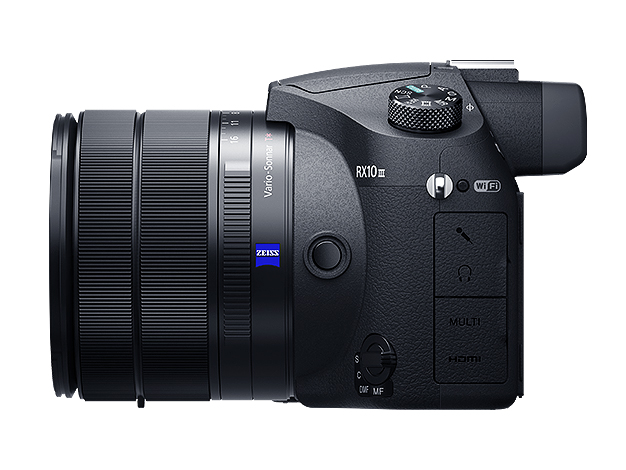
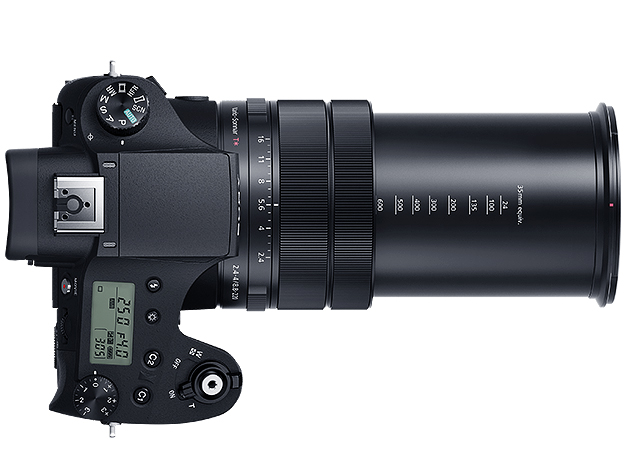
24–600 mm equivalent
Maximum aperture
f/2.4–4
Optical zoom
25×
Stabilisation
Optical lens stabilisation
Maximum continuous burst
14 fps
Lens detail
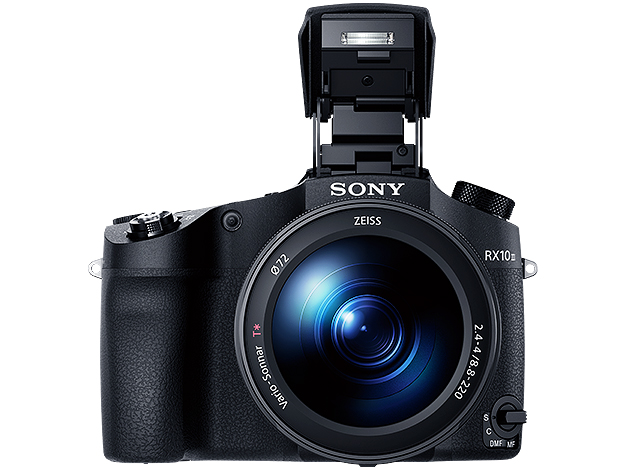
ZEISS Vario-Sonnar T*; actual 8.8–220 mm; 18 elements in 13 groups, including six aspherical elements; nine-blade aperture; no built-in ND filter (Photography Blog)
Autofocus
Contrast-detection AF with 25-area wide mode; single-shot AF, continuous AF, direct manual focus and manual focus; Eye AF and Lock-on AF
Shutter
Mechanical manual mode permits Bulb and 30 seconds to 1/2000 second at f/8 or smaller; maximum speed wide open is 1/1000 second. Electronic shutter reaches 1/32000 second.
Burst detail
Approximately 14 fps Speed Priority Continuous with focus and exposure fixed at the first frame, or approximately 5 fps normal continuous shooting
Stabilisation detail
Optical still-image stabilisation; maker claim up to 4.5 stops at 600 mm equivalent under CIPA conditions. Intelligent Active movie mode adds electronic correction.
Flash
Built-in flash and Multi Interface Shoe for compatible accessories
Video
Highest video resolution
3840 × 2160 at 30 fps
Video detail
Japanese/NTSC XAVC S 4K up to 3840 × 2160 at 30p or 24p, up to 100 Mbps, with full-pixel readout without binning; approximately 29-minute recording limit. Full HD up to 120p. Separate HFR captures 240/480/960 fps using reduced-resolution sensor readout encoded as Full HD; no audio.
Audio
Stereo recording; LPCM, Dolby Digital or AAC by recording format; microphone input and headphone monitoring
Screen and viewfinder
Viewfinder
Electronic
Screen size
3″
Screen dots
1,228,800
Touchscreen
No
Tilting screen
Yes
Display detail
LCD tilts approximately 107° upwards and 42° downwards; no touchscreen (Photography Blog); backlit top settings display
Viewfinder detail
0.39-type OLED with 2,359,296 dots, 100% coverage and approximately 0.70× equivalent magnification
Connections and design
Wi-Fi
Yes
Battery life (maker's claim)
420 photographs
Body weight
1051 g
Release detail
Sony announced May 2016 retail availability in North America, without a day; Japan went on sale on 20 May. Earlier RX10 models continued alongside it; no direct replacement inferred.
Recording media
SD, SDHC, SDXC and Memory Stick variants; XAVC S requires Class 10 or faster SDHC/SDXC, and 100 Mbps requires UHS-I U3
Ports
Multi/Micro USB with USB 2.0, Micro HDMI, Multi Interface Shoe, 3.5 mm microphone input and headphone output
Wireless connections
Wi-Fi 802.11b/g/n at 2.4 GHz and NFC One-touch remote and sharing
Battery life detail
NP-FW50; CIPA maker claim approximately 420 photographs using LCD or 370 using viewfinder
Charging
USB charging and power supply during shooting or playback
Dimensions
Approximately 132.5 × 94 × 145 mm from lens front to viewfinder; 127.4 mm depth from lens front to monitor
Weight detail
Approximately 1051 g body only or 1095 g with battery and media