Apple AppleColor High-Resolution RGB Monitor vs Apple Multiple Scan 14 Display
Better figure, where one is clearly better
| AppleAppleColor High-Resolution RGB Monitor | AppleMultiple Scan 14 Display | |
|---|---|---|
| Overview | ||
| Released | 1987 | 1995 |
| Display | ||
| Screen size | 12.8″ | 12.4″ |
| Panel | CRT (Apple support specifies a nominal 13-inch Trinitron tube and 12.8-inch viewable diagonal; owner and service manuals instead call it 13-inch viewable. Service Source gives 0.26 mm aperture grille pitch, while TIL2165 and TIL8439 give 0.25 mm. Analogue CRT has no fixed native pixel matrix.) | CRT (Nominal 14-inch spherical shadow-mask tube with 12.4-inch viewable diagonal and 0.28 mm dot pitch; Service Source describes P22-derived phosphor and polished surface treatment. Analogue CRT has no fixed native pixel matrix.) |
| Pixel pitch | – | Maker 0.28 mm dot pitch |
| Colour modes | Owner guide lists 256 colours with Macintosh Display Card 4•8 and 16.7 million with 8•24 or 8•24 GC; not an independent monitor colour-depth limit | – |
| Supported signal modes | Maker documents support 640 × 480 at 66.7 Hz, 35 kHz horizontal scan and a 30.24 MHz pixel clock. These describe the supported analogue signal, not a native fixed matrix. Factory-adjusted active image area is 235 × 176 mm with a dark surrounding border; colour depth depends on the video card. | Current maker support lists 640 × 480 at 60 or 66.7 Hz and 800 × 600 at 60 or 72 Hz. Original model M3935LL/A does not support 832 × 624; Service Source documents a November 1995 upgrade programme to Revision B supporting 832 × 624 at 75 Hz on eligible computers. October 1995 Apple Facts already lists that mode, qualified by computer support; it is not assigned to the original revision. These are analogue signal modes, not native resolution or refresh. Original scan range 31.5–48.1 kHz horizontal and 60–72 Hz vertical. |
| Calibration | Maker TIL8439 states luminance of 20 footlamberts at the brightness-control detent and 25 footlamberts fully open; no conversion to an unpublished cd/m² figure. A thin horizontal grille-support line in the lower third is normal for this Trinitron tube according to the owner and service guides. | – |
| Connections | ||
| Video inputs | DA-15 | DA-15 |
| USB-C charging | None | None |
| Speakers | No | Yes |
| Other connections | Macintosh DA-15 analogue RGB input with composite negative-going TTL sync and detachable video cable; this is not a PC VGA connector. Compatible Macintosh video circuitry or video card is required. No integrated speakers or audio ports. | Attached Macintosh DA-15 video cable; exact-model EveryMac specifies DB-15 and the two-row connector is visible in Ben Boldt's exact-model photograph. Service Source describes a 15-pin miniature D-type cable with separate sync; VGA/SVGA signal compatibility does not add a second physical VGA connector. |
| Audio out | – | Front headphone jack; Service Source identifies one audio input and one pass-through headphone/speaker output. Headphone insertion mutes the internal speakers. |
| Speaker detail | – | Integrated front stereo speakers; Service Source publishes minimum 500 mW per speaker with 0.707 V RMS input and response ±3 dB from 100 Hz to 20 kHz. Maker description and Apple Facts confirm audio despite EveryMac's conflicting no-audio table entry. |
| Design | ||
| Stand adjusts | – | Tilt, swivel |
| Weight with stand | 15.5 kg | 11.3 kg |
| Tilt | – | Removable tilt-and-swivel base included; numerical adjustment range unpublished |
| Swivel | – | Removable tilt-and-swivel base included; numerical adjustment range unpublished |
| Height adjustment | Owner guide supplies a height-adjustment bar that raises the front by one-quarter or one-half inch. Tilt-and-swivel Universal Monitor Stand is a separately sold accessory and is not counted as the included stand. | – |
| Size with stand | Service Source gives body height 281 mm, width 344 mm and depth 385 mm; current support archive instead gives 11 × 13.5 × 16 inches. Optional monitor stand dimensions are not substituted. | Apple Facts publishes 37.8 × 36.5 × 38.6 cm and 14.9 × 14.4 × 15.2 inches (height × width × depth), matching current support's inches. Service Source instead gives 378 × 365 × 380 mm with a differing set of inch values; maker conflicts retained. |
| Weight detail | Service Source gives 15.5 kg (34 lb), with TIL2165 also specifying 34 lb including video and power cables. Owner guide instead publishes 20 kg (44 lb) including cables; this maker conflict is retained without attributing it to an undocumented revision. | Apple Facts publishes 11.3 kg (25 lb); current support also gives 25 lb. Service Source pairs 25 lb with 13 kg, a conflicting maker metric figure retained here rather than converted or silently selected. |
| Controls | Power and manual degauss buttons on the rear; brightness with centre detent and contrast on the right side. Automatic degauss at power-up; maker specifies 20-minute warm-up to meet all specifications. | Front power, brightness and contrast controls; horizontal/vertical shift and size controls behind the door. Automatic power-on degauss; maker describes a full degauss after power-off for at least 20 minutes. |
| Power and support | ||
| Power use | Current support, TIL2165 and owner guide give 160 W maximum; Service Source instead lists 90 W without the same maximum qualification | Maker 80 W maximum; Energy Star low-power mode supported, exact idle consumption unpublished |
| Power supply | Current support and Service Source specify 85–270 V AC, 47–63 Hz. Owner guide gives 90–270 V AC, 47–63 Hz; TIL2165 instead gives 85–270 V AC, 50–60 Hz. These are mains ratings, not display refresh. | Current maker support gives regional input ranges 90–132 or 198–264 V AC, 47–63 Hz; Service Source describes 90–132 V AC. Mains frequency is not display refresh. |
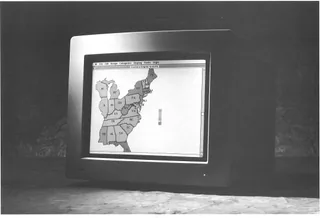
| Software | Apple support dates introduction March 1987; March 2 1987 maker price list explicitly schedules M0401 availability in May, rather than immediate March retail. Actual first retail month remains unverified, so year 1987 is retained. AppleColor High-Resolution RGB for Macintosh is distinct from the earlier AppleColor RGB monitor for Apple IIgs; no hardware or release figures are borrowed from that display. No inferred direct successor. | System software 7.1 or later; supported modes depend on Macintosh video hardware and adapters. Current maker archive dates introduction 15 August 1995, while EveryMac gives 7 August; actual first retail day/month remains unverified, so year 1995 retained. Service Source distinguishes original and Revision B hardware; no assumed direct predecessor or successor. Photograph is Apple's exact model illustration from October 1995 Apple Facts; physical revision not identified by that image. |
| Certifications | – | Maker states MPR II and EPA Energy Star compliance |
More comparisons
- Apple AppleColor High-Resolution RGB Monitor vs Apple Studio Display (2026)
- Apple AppleColor High-Resolution RGB Monitor vs Apple Studio Display XDR
- Apple Multiple Scan 14 Display vs Apple Multiple Scan 720 Display
- Apple Multiple Scan 14 Display vs Apple Multiple Scan 15 Display
- Apple Apple Color Plus 14-inch Display vs Apple Multiple Scan 14 Display
- Apple Apple AudioVision 14 Display vs Apple Multiple Scan 14 Display
- Apple Multiple Scan 14 Display vs Apple Multiple Scan 1705 Display
- Apple Multiple Scan 14 Display vs Apple Multiple Scan 17 Display
- Apple Multiple Scan 14 Display vs Apple Multiple Scan 20 Display
- Apple AppleColor High-Resolution RGB Monitor vs Apple Multiple Scan 15 Display
- Apple AppleColor High-Resolution RGB Monitor vs Apple Apple Color Plus 14-inch Display
- Apple AppleColor High-Resolution RGB Monitor vs Apple Apple AudioVision 14 Display
- Apple AppleColor High-Resolution RGB Monitor vs Apple Macintosh Portrait Display