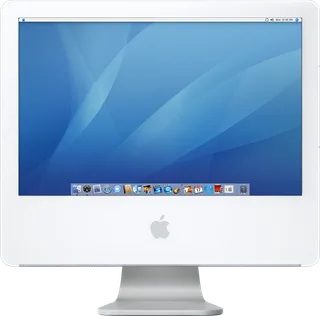
Apple iMac G5 (17-inch, 2004) vs Apple iMac (Retina 4K, 21.5-inch, 2019)
Better figure, where one is clearly better
| AppleiMac G5 (17-inch, 2004) | AppleiMac (Retina 4K, 21.5-inch, 2019) | |
|---|---|---|
| Overview | ||
| Released | September 2004 | March 2019 |
| Performance | ||
| Processor | IBM PowerPC G5 1.6 GHz (iMac 2004) or IBM PowerPC G5 1.8 GHz (iMac 2004) | Intel Core i3-8100, Intel Core i7-8700 or Intel Core i5-8500 |
| CPU cores | 1 | 4 or 6 |
| CPU threads | – | 4, 6 or 12 |
| Graphics | NVIDIA GeForce FX 5200 Ultra (64 MB) | Radeon Pro 555X (2 GB GDDR5), Radeon Pro 560X (4 GB GDDR5) or Radeon Pro Vega 20 (4 GB HBM2) |
| Memory | 256 MB or 2 GB | 8 GB, 16 GB or 32 GB (better) |
| Storage | 80 GB to 160 GB | 256 GB to 1 TB (better) |
| CPU | 1.6 GHz PowerPC G5 with 533 MHz frontside bus and Combo drive, or 1.8 GHz with 600 MHz bus and SuperDrive; both have 512 KB on-chip L2 cache. Generic maker-clock chip records retain the single-core identity cross-checked with exact EveryMac sources; a silicon revision is not inferred. | 3.6 GHz quad-core Core i3 without Turbo Boost, or 3.0 GHz six-core Core i5 with Turbo Boost up to 4.1 GHz; both configurable to 3.2 GHz six-core Core i7 with Turbo Boost up to 4.6 GHz |
| GPU | NVIDIA GeForce FX 5200 Ultra with 64 MB dedicated DDR video memory and AGP 8x support. | Radeon Pro 555X with 2 GB GDDR5 in the lower base; Radeon Pro 560X with 4 GB GDDR5 in the upper base, configurable to Radeon Pro Vega 20 with 4 GB HBM2 |
| Memory type | 256 MB PC3200 (400 MHz) DDR SDRAM standard, expandable to 2 GB in two slots. Configurations conservatively list the published base and maker maximum. | 8 GB standard, configurable to 16/32 GB; lower base uses 2400 MHz DDR4 and upper base 2666 MHz DDR4. Memory is not readily user-accessible. |
| Storage type | 80 GB 7200 rpm Serial ATA hard drive; The maker launch lists a 160 GB build-to-order option. The 1.6 GHz model uses a slot-loading Combo DVD-ROM/CD-RW; the 1.8 GHz model uses SuperDrive DVD-R/CD-RW with 4x DVD-R writing. The launch press's generic 250 GB option is not paired with the 17-inch model without exact support. | The current Apple sheet lists 256 GB SSD or 1 TB Fusion Drive for both bases, and these are the configurations shown. Apple made SSD storage standard in August 2020. Launch reviews describe a 1 TB hard drive in the lower base and 1 TB Fusion Drive in the upper base, with larger SSD options (Macworld and TechRadar); these historical options are not flattened into the current matrix. |
| Display | ||
| Screen size | 17″ | 21.5″ |
| Resolution | 1440 × 900 | 4096 × 2304 (better) |
| Panel | – | IPS LCD |
| Brightness | 200 nits | 500 nits (better) |
| Display type | Widescreen TFT active-matrix LCD with millions of colours and typical 350:1 contrast. Panel technology and refresh rate are not published in the exact maker sheet. | LED-backlit Retina 4K display; IPS panel confirmed by EveryMac; Apple does not publish native refresh rate in this model’s specification sheet |
| Display features | Typical viewing angles: 120° horizontal and 90° vertical. | Wide colour (P3); supports one billion colours |
| Connections | ||
| Ports | 3 × USB-A, Ethernet, headphone jack | 2 × Thunderbolt 3, 4 × USB-A, SD card slot, Ethernet, headphone jack |
| Ethernet | 0.1 Gb/s | 1 Gb/s (better) |
| External displays | – | Up to 2 |
| Wi-Fi | – | 802.11ac |
| Bluetooth | – | 4.2 |
| Camera | – | FaceTime HD |
| Back ports | Three USB 2.0 ports on the computer, up to 480 Mbps, plus two USB 1.1 ports on the keyboard; two FireWire 400 ports with 8 W shared power, Mini-VGA, 10/100BASE-T Ethernet, 56K V.92 modem, headphone/optical digital audio output and audio line-in. AirPort Extreme 802.11g card and internal Bluetooth module are optional, rather than standard. | Four USB-A ports; two Thunderbolt 3 USB-C ports with DisplayPort, Thunderbolt up to 40 Gb/s and USB 3.1 Gen 2 up to 10 Gb/s; SDXC, Gigabit Ethernet and 3.5 mm headphone jack; Kensington lock slot. Thunderbolt 2, HDMI, DVI and VGA require separately sold adapters. |
| External displays | Mini-VGA provides video mirroring on a VGA display or S-video/composite television through optional adapters. Output resolutions: 640 × 480 at 60 Hz, 800 × 600 at 75 Hz or 1024 × 768 at 75 Hz. | Built-in display at full native resolution alongside one 5120 × 2880 display at 60 Hz with one billion colours, two 3840 × 2160 displays at 60 Hz with one billion colours, or two 4096 × 2304 displays at 60 Hz with millions of colours |
| Speakers | Built-in stereo speakers, internal 12 W digital amplifier and built-in microphone. | Stereo speakers |
| Microphones | – | Built-in microphone |
| Keyboard and mouse | Apple Keyboard, Apple Mouse and modem cable. | Rechargeable Magic Keyboard and Magic Mouse 2; optional Magic Keyboard with Numeric Keypad and Magic Trackpad 2 |
| Design and power | ||
| Type | All-in-one | All-in-one |
| Weight | 8.4 kg | 5.48 kg (better) |
| Width × depth × height | 426 × 173 × 430 mm | 528 × 175 × 450 mm |
| Operating system | macOS | macOS |
| Size and weight detail | Published metric size and reference weight; weight varies by configuration and manufacturing process. | Dimensions include the stand; current Apple sheet lists 5.48 kg and warns that weight varies by configuration. Launch reviews tested heavier hard-drive/Fusion configurations. A built-in VESA mount version was also available. |
| Power supply | 100–120 V AC or 100–240 V AC depending on country of purchase, 47–63 Hz, single phase; maximum continuous power 180 W. | 100–240 V AC, 50–60 Hz, single phase |
| Materials | – | Recyclable aluminium enclosure; arsenic-free glass and mercury-free LED backlight |
| In the box | Launch Mac OS X 10.3 Panther, iLife ’04 and bundled productivity software, with Classic environment support. The retained specification lists the later iLife ’05 bundle. Apple announced the model on 31 August 2004 and stated worldwide shipping would begin in mid-September; the release field therefore retains September month precision. | iMac, Magic Keyboard, Magic Mouse 2, power lead and Lightning to USB cable |

More comparisons
- Apple iMac 24″ (M4) vs Apple iMac (Retina 4K, 21.5-inch, 2019)
- Apple iMac (Retina 4K, 21.5-inch, 2019) vs Apple Mac mini (M4 or M4 Pro)
- Apple iMac 24″ (M4) vs Apple iMac G5 (17-inch, 2004)
- Apple iMac 24″ (M3) vs Apple iMac (Retina 4K, 21.5-inch, 2019)
- Apple iMac 24″ (M3) vs Apple iMac G5 (17-inch, 2004)
- Apple iMac 24″ (M1) vs Apple iMac (Retina 4K, 21.5-inch, 2019)
- Apple iMac 24″ (M1) vs Apple iMac G5 (17-inch, 2004)
- Apple iMac (Retina 4K, 21.5-inch, 2019) vs Apple iMac (Retina 5K, 27-inch, 2020)
- Apple iMac G5 (17-inch, 2004) vs Apple iMac (Retina 5K, 27-inch, 2020)
- Apple iMac (Retina 4K, 21.5-inch, 2017) vs Apple iMac (Retina 4K, 21.5-inch, 2019)
- Apple iMac (Retina 4K, 21.5-inch, 2019) vs Apple iMac (Retina 5K, 27-inch, 2019)
- Apple iMac (21.5-inch, 2017) vs Apple iMac (Retina 4K, 21.5-inch, 2019)
- Apple iMac (21.5-inch, Mid 2011) vs Apple iMac (Retina 4K, 21.5-inch, 2019)
- Apple iMac (21.5-inch, Mid 2010) vs Apple iMac (Retina 4K, 21.5-inch, 2019)
- Apple iMac (20-inch, Early 2008) vs Apple iMac (Retina 4K, 21.5-inch, 2019)
- Apple iMac Pro (2017) vs Apple iMac (Retina 4K, 21.5-inch, 2019)