Apple Mac mini (2005) vs Apple Mac mini (Late 2006)
Better figure, where one is clearly better
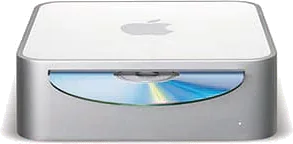
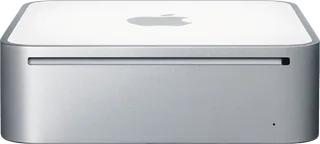
| AppleMac mini (2005) | AppleMac mini (Late 2006) | |
|---|---|---|
| Overview | ||
| Released | January 2005 | September 2006 |
| Performance | ||
| Processor | PowerPC G4 7447A (1.25 GHz) or PowerPC G4 7447A (1.42 GHz) | Intel Core Duo T2300 or Intel Core Duo T2400 |
| CPU cores | 1 | 2 |
| Graphics | ATI Radeon 9200 | Intel GMA950 |
| Memory | 256 MB, 512 MB or 1 GB | 512 MB, 1 GB or 2 GB (better) |
| Storage | 40 GB to 80 GB | 60 GB to 160 GB (better) |
| CPU | 1.25 or 1.42 GHz PowerPC G4 with Velocity Engine, 512 KB L2 cache and 167 MHz system bus; EveryMac identifies the single-core 7447A processor, cross-checked with the Freescale fact sheet hosted by NXP | 1.66 GHz Intel Core Duo T2300 or 1.83 GHz Core Duo T2400, both dual-core, with 2 MB L2 cache and 667 MHz frontside bus; exact identities cross-checked with EveryMac |
| GPU | ATI Radeon 9200 with 32 MB dedicated DDR SDRAM and AGP 4X support | Intel GMA950 shares 64 MB DDR2 with main memory; maker footnote specifies minimum 80 MB graphics/setup usage, leaving 432 MB available from a standard 512 MB configuration |
| Memory type | One slot for 333 MHz PC2700 DDR SDRAM, up to 1 GB. Original January models had 256 MB standard; Apple raised standard memory to 512 MB on 26 July 2005. Configurations include original and later memory options. | 512 MB standard as two modules of 667 MHz DDR2 SDRAM (PC2-5300); factory options 1 or 2 GB and maximum 2 GB |
| Storage type | 1.25 GHz model has a 40 GB Ultra ATA hard drive, configurable to 80 GB; 1.42 GHz models have 80 GB. Combo drive reads DVDs and burns CDs; optional 4x SuperDrive writes DVDs. July 2005 added a standard SuperDrive model at 1.42 GHz. | 1.66 GHz model has a 60 GB 5400 rpm SATA hard drive, configurable to 80, 120 or 160 GB; 1.83 GHz model has 80 GB, configurable to 120 or 160 GB. Lower model Combo drive reads DVDs and burns CDs; higher model 8x SuperDrive burns DVDs with 2.4x double-layer support. |
| Display | ||
| Screen | None built in | None built in |
| Connections | ||
| Ports | 2 × USB-A, Ethernet, headphone jack | 4 × USB-A, Ethernet, headphone jack |
| Ethernet | 0.1 Gb/s | 1 Gb/s (better) |
| External displays | Up to 1 | Up to 1 |
| Wi-Fi | Optional 802.11g | 802.11g |
| Bluetooth | Optional internal Bluetooth | 2.0 + EDR |
| Back ports | Two USB 2.0 ports, FireWire 400 (8 W), DVI, 10/100BASE-T Ethernet and headphone/audio line output. No audio input. Modem standard on original models; July 2005 lower model retains it, higher models make it optional. | Four USB 2.0 ports, one FireWire 400 port at 8 W, DVI output, Gigabit Ethernet, combined optical digital/analogue audio input and combined optical digital/headphone output. DVI, FireWire and audio input described here because the main port list has no fields for them; no HDMI or DisplayPort. |
| External displays | DVI digital output up to 1920 × 1200; included VGA adapter supports up to 1920 × 1080. Optional Apple DVI to Video Adapter provides S-video/composite output. | DVI digital output up to 1920 × 1200; included VGA adapter supports up to 1920 × 1080. Optional Apple DVI to Video Adapter provides S-video/composite output. |
| Speakers | Built-in speaker | Built-in speaker |
| Keyboard and mouse | Display, keyboard and mouse sold separately; DVI-to-VGA adapter included | Apple Remote and DVI-to-VGA adapter; display, keyboard and mouse sold separately |
| Design and power | ||
| Type | Compact | Compact |
| Weight | 1.32 kg | 1.31 kg (better) |
| Width × depth × height | 165.1 × 165.1 × 50.8 mm | 165.1 × 165.1 × 50.8 mm |
| Operating system | macOS | macOS |
| Size and weight detail | Maker weight 1.32 kg; Apple notes variation by configuration and manufacturing process | – |
| Power supply | Maximum continuous power 85 W; 100–240 V AC, 50–60 Hz single phase | Maximum continuous power 110 W; 100–240 V AC, 50–60 Hz single phase |
| In the box | Mac mini, power adapter, install DVDs and documentation. January models ship with Mac OS X Panther and iLife '05; July configurations use Tiger. AirPort Extreme and Bluetooth optional at launch, standard on the July 1.42 GHz models. | Mac mini, Apple Remote, power cord, install/restore DVDs and documentation. Mac OS X Tiger, iLife '06 and Front Row; Rosetta translates compatible PowerPC applications. |
More comparisons
- Apple Mac mini (2005) vs Apple Mac mini (M6 or M5 Pro)
- Apple Mac mini (Late 2006) vs Apple Mac mini (M6 or M5 Pro)
- Apple Mac mini (Late 2006) vs Apple Mac mini (M4 or M4 Pro)
- Apple Mac mini (2005) vs Apple Mac mini (M4 or M4 Pro)
- Apple Mac mini (Late 2006) vs Apple Mac mini (M2 or M2 Pro)
- Apple Mac mini (2005) vs Apple Mac mini (M2 or M2 Pro)
- Apple Mac mini (Late 2006) vs Apple Mac mini (M1)
- Apple Mac mini (2005) vs Apple Mac mini (M1)
- Apple Mac mini (2018) vs Apple Mac mini (Late 2006)
- Apple Mac mini (2005) vs Apple Mac mini (2018)
- Apple Mac mini (Late 2006) vs Apple Mac mini (Late 2014)
- Apple Mac mini (2005) vs Apple Mac mini (Late 2014)
- Apple Mac mini (Late 2006) vs Apple Mac mini (Late 2012)
- Apple Mac mini (2005) vs Apple Mac mini (Late 2012)
- Apple Mac mini (Late 2006) vs Apple Mac mini (Mid 2011)
- Apple Mac mini (2005) vs Apple Mac mini (Mid 2011)