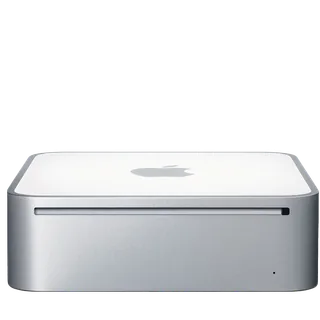
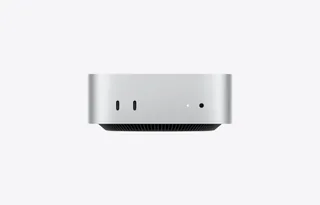
Apple Mac mini (Late 2006) vs Apple Mac mini (M6 or M5 Pro)
Better figure, where one is clearly better
| AppleMac mini (Late 2006) | AppleMac mini (M6 or M5 Pro) | |
|---|---|---|
| Overview | ||
| Released | September 2006 | September 2026 |
| Performance | ||
| Processor | Intel Core Duo T2300 or Intel Core Duo T2400 | Apple M6 or Apple M5 Pro |
| CPU cores | 2 | 12, 15 or 18 |
| Graphics | Intel GMA950 | 12-core GPU, 16-core GPU or 20-core GPU |
| Memory | 512 MB, 1 GB or 2 GB | 16 GB, 24 GB, 32 GB, 48 GB or 64 GB (better) |
| Storage | 60 GB to 160 GB | 256 GB to 8 TB (better) |
| CPU | 1.66 GHz Intel Core Duo T2300 or 1.83 GHz Core Duo T2400, both dual-core, with 2 MB L2 cache and 667 MHz frontside bus; exact identities cross-checked with EveryMac | M6: 12-core CPU with 2 super cores, 4 performance cores and 6 efficiency cores; M5 Pro: 15-core CPU with 5 super cores and 10 performance cores, or 18-core CPU with 6 super cores and 12 performance cores |
| GPU | Intel GMA950 shares 64 MB DDR2 with main memory; maker footnote specifies minimum 80 MB graphics/setup usage, leaving 432 MB available from a standard 512 MB configuration | Neural Accelerators; hardware-accelerated ray tracing |
| AI engine | – | Dual 16-core Neural Engine (M6); 16-core Neural Engine (M5 Pro) |
| Memory bandwidth | – | M6: 153GB/s with 16GB, 170GB/s with 24GB or 32GB; M5 Pro: 307GB/s |
| Memory type | 512 MB standard as two modules of 667 MHz DDR2 SDRAM (PC2-5300); factory options 1 or 2 GB and maximum 2 GB | – |
| Storage type | 1.66 GHz model has a 60 GB 5400 rpm SATA hard drive, configurable to 80, 120 or 160 GB; 1.83 GHz model has 80 GB, configurable to 120 or 160 GB. Lower model Combo drive reads DVDs and burns CDs; higher model 8x SuperDrive burns DVDs with 2.4x double-layer support. | SSD |
| Media engine | – | Hardware-accelerated H.264, HEVC, ProRes and ProRes RAW; video decode engine; video encode engine; ProRes encode and decode engine; AV1 decode |
| Display | ||
| Screen | None built in | None built in |
| Connections | ||
| Ports | 4 × USB-A, Ethernet, headphone jack | 3 × Thunderbolt 4, 2 × USB-C, HDMI, Ethernet, headphone jack |
| Ethernet | 1 Gb/s | 2.5 Gb/s (better) |
| External displays | Up to 1 | Up to 3 (better) |
| Wi-Fi | 802.11g | Wi-Fi 7 |
| Bluetooth | 2.0 + EDR | 6 |
| Front ports | – | 2 × USB-C with USB 3 (up to 10Gb/s); 3.5 mm headphone jack with advanced support for high-impedance headphones |
| Back ports | Four USB 2.0 ports, one FireWire 400 port at 8 W, DVI output, Gigabit Ethernet, combined optical digital/analogue audio input and combined optical digital/headphone output. DVI, FireWire and audio input described here because the main port list has no fields for them; no HDMI or DisplayPort. | M6: 3 × Thunderbolt 4 (USB-C) with Thunderbolt 4 and USB 4 (up to 40Gb/s) and DisplayPort; M5 Pro: 3 × Thunderbolt 5 (USB-C) with Thunderbolt 5 (up to 120Gb/s), USB 4 (up to 40Gb/s) and DisplayPort; HDMI with multichannel audio output; 2.5Gb Ethernet (RJ-45), configurable to 10Gb Ethernet |
| External displays | DVI digital output up to 1920 × 1200; included VGA adapter supports up to 1920 × 1080. Optional Apple DVI to Video Adapter provides S-video/composite output. | M6: up to three (two at up to 6K 60Hz or 4K 165Hz, plus a third at up to 5K 60Hz over Thunderbolt or 4K 60Hz over HDMI), or two (one at up to 8K 60Hz, 5K 120Hz or 4K 240Hz, plus one at up to 5K 60Hz over Thunderbolt or 4K 60Hz over HDMI); M5 Pro: up to three at up to 6K 60Hz or 4K 165Hz, or two (one at up to 8K 60Hz, 5K 120Hz or 4K 240Hz, plus one at up to 5K 120Hz or 4K 200Hz); VRR and HDR supported |
| Speakers | Built-in speaker | Built-in speaker |
| Microphones | – | None built in; Apple says an external microphone or headset is needed for calls |
| Keyboard and mouse | Apple Remote and DVI-to-VGA adapter; display, keyboard and mouse sold separately | – |
| Design and power | ||
| Type | Compact | Compact |
| Weight | 1.31 kg | 0.67 kg (better) |
| Width × depth × height | 165.1 × 165.1 × 50.8 mm | 127 × 127 × 50 mm |
| Operating system | macOS | macOS |
| Power supply | Maximum continuous power 110 W; 100–240 V AC, 50–60 Hz single phase | Built-in; 100–240V AC; 155W maximum continuous power |
| Power use | – | M6 with 16GB and 256GB: 4W idle, 70W maximum; M5 Pro with 64GB and 8TB: 6W idle, 145W maximum |
| Noise | – | 5 dBA sound pressure at idle (operator position); declared to ECMA-109 as 1.3 B sound power and 4 dB sound pressure at idle and wireless web (M5 Pro, 18-core CPU, 20-core GPU) |
| Materials | – | 100% recycled aluminium enclosure; 50% recycled content overall |
| Colours | – | Silver |
| In the box | Mac mini, Apple Remote, power cord, install/restore DVDs and documentation. Mac OS X Tiger, iLife '06 and Front Row; Rosetta translates compatible PowerPC applications. | Mac mini, power lead (1.8 m) |
More comparisons
- Apple Mac mini (M1) vs Apple Mac mini (M6 or M5 Pro)
- Apple Mac mini (2018) vs Apple Mac mini (M6 or M5 Pro)
- Apple Mac mini (Early 2009) vs Apple Mac mini (M6 or M5 Pro)
- Apple Mac mini (M6 or M5 Pro) vs Apple Mac mini (Mid 2010)
- Apple Mac mini (Early 2006) vs Apple Mac mini (M6 or M5 Pro)
- Apple Mac mini (2005) vs Apple Mac mini (M6 or M5 Pro)
- Apple Mac mini (M6 or M5 Pro) vs Apple Mac mini (Mid 2007)
- Apple Mac mini (M4 or M4 Pro) vs Apple Mac mini (M6 or M5 Pro)
- Apple Mac mini (M6 or M5 Pro) vs Framework Desktop (AMD Ryzen AI Max 300 Series)
- Apple Mac mini (M2 or M2 Pro) vs Apple Mac mini (M6 or M5 Pro)
- Apple Mac mini (Late 2014) vs Apple Mac mini (M6 or M5 Pro)
- Apple Mac mini (Late 2012) vs Apple Mac mini (M6 or M5 Pro)
- Apple Mac mini (M6 or M5 Pro) vs Apple Mac mini (Mid 2011)
- Apple Mac mini (M6 or M5 Pro) vs Apple Mac Studio (M5 Max or M5 Ultra)
- Apple Mac mini (Late 2009) vs Apple Mac mini (M6 or M5 Pro)
- Apple Mac mini (Late 2006) vs Apple Mac mini (M4 or M4 Pro)