Apple Mac mini (M4 or M4 Pro) vs Apple Macintosh IIfx
Better figure, where one is clearly better
| AppleMac mini (M4 or M4 Pro) | AppleMacintosh IIfx | |
|---|---|---|
| Overview | ||
| Released | November 2024 | 1990 |
| Performance | ||
| Processor | Apple M4 or Apple M4 Pro | 68030 40 MHz (Macintosh IIfx) |
| CPU cores | 10, 12 or 14 | 1 |
| Graphics | 10-core GPU, 16-core GPU or 20-core GPU | – |
| AI engine (NPU) | 38 TOPS | – |
| Memory | 16 GB, 24 GB, 32 GB or 64 GB (better) | 4 MB |
| Storage | 256 GB to 8 TB (better) | 80 MB to 160 MB |
| CPU | M4: 10-core CPU with 4 performance cores and 6 efficiency cores; M4 Pro: 12-core CPU with 8 performance cores and 4 efficiency cores, or 14-core CPU with 10 performance cores and 4 efficiency cores | 40 MHz Motorola 68030 with integrated memory-management unit and 68882 floating-point coprocessor; 0.5 KB L1 and 32 KB L2 cache |
| GPU | M4: 10-core GPU; M4 Pro: 16-core or 20-core GPU; hardware-accelerated ray tracing | No built-in video; a compatible NuBus video card is required for a display |
| Memory type | – | Eight 64-pin SIMM slots in banks of four, using 80 ns or faster memory; Apple lists 4–128 MB and a 512 KB ROM. The 64-pin modules are specific to the IIfx. |
| AI engine | 16-core Neural Engine | – |
| Memory bandwidth | M4: 120GB/s; M4 Pro: 273GB/s | – |
| Storage type | SSD | One or two internal 1.44 MB floppy drives, with optional 40–160 MB SCSI hard drives; 4 MB floppy-only, 80 MB and 160 MB configurations are represented here |
| Expansion slots | – | Six NuBus slots and one processor-direct slot |
| Media engine | Hardware-accelerated H.264, HEVC, ProRes and ProRes RAW; video decode engine; video encode engine; ProRes encode and decode engine; AV1 decode | – |
| Display | ||
| Screen | None built in | None built in |
| Connections | ||
| Ports | 3 × Thunderbolt 4, 2 × USB-C, HDMI, Ethernet, headphone jack | Headphone jack |
| Ethernet | 1 Gb/s | – |
| External displays | Up to 3 | – |
| Wi-Fi | Wi-Fi 6E | – |
| Bluetooth | 5.3 | – |
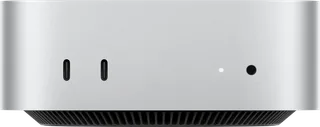
| Front ports | 2 × USB-C with USB 3 (up to 10Gb/s); 3.5 mm headphone jack with advanced support for high-impedance headphones | – |
| Back ports | M4: 3 × Thunderbolt 4 (USB-C) with Thunderbolt 4 and USB 4 (up to 40Gb/s) and DisplayPort; M4 Pro: 3 × Thunderbolt 5 (USB-C) with Thunderbolt 5 (up to 120Gb/s), USB 4 and DisplayPort; HDMI with multichannel audio output; Gigabit Ethernet (RJ-45), configurable to 10Gb Ethernet | Two Apple Desktop Bus ports, DB-25 SCSI, printer and modem serial ports and sound output; no built-in video or Ethernet |
| External displays | M4: up to three (two at up to 6K 60Hz over Thunderbolt, plus one at up to 5K 60Hz over Thunderbolt or 4K 60Hz over HDMI), or two (one at up to 5K 60Hz plus one at up to 8K 60Hz or 4K 240Hz); M4 Pro: up to three at up to 6K 60Hz over Thunderbolt or HDMI, or two (one at up to 6K 60Hz plus one at up to 8K 60Hz or 4K 240Hz) | A NuBus video card is required; resolution and colour depth depend on the fitted card |
| Speakers | Built-in speaker | Internal speaker and sound output |
| Microphones | None built in | – |
| Design and power | ||
| Type | Compact | Compact |
| Weight | 0.67 kg (better) | 10.9 kg |
| Width × depth × height | 127 × 127 × 50 mm | 475 × 366 × 140 mm |
| Operating system | macOS | macOS |
| Size and weight detail | – | Apple's 5.5 × 18.7 × 14.4 inch and 24 lb reference dimensions; metric fields are rounded conversions |
| Power supply | Built-in; 100–240V AC; 155W maximum continuous power | Maximum 230 W; 100–240 V AC, 48–62 Hz; 3.6 V lithium clock battery and keyboard soft power |
| Power use | M4 with 16GB and 256GB: 4W idle, 65W maximum; M4 Pro with 64GB and 8TB: 5W idle, 140W maximum | – |
| Noise | 5 dBA sound pressure at idle (operator position) | – |
| Colours | Silver | – |
| In the box | Mac mini, power lead (1.8 m) | Original System Software 6.0.5. Apple lists 19 March 1990 as introduction; a separate maker first-sale date was not established. |

More comparisons
- Apple Mac mini (M4 or M4 Pro) vs Apple Mac mini (M6 or M5 Pro)
- Apple Mac mini (M4 or M4 Pro) vs Framework Desktop (AMD Ryzen AI Max 300 Series)
- Apple iMac (Retina 4K, 21.5-inch, Late 2015) vs Apple Mac mini (M4 or M4 Pro)
- Apple iMac (Retina 4K, 21.5-inch, 2017) vs Apple Mac mini (M4 or M4 Pro)
- Apple iMac (Retina 4K, 21.5-inch, 2019) vs Apple Mac mini (M4 or M4 Pro)
- Apple iMac (Retina 5K, 27-inch, Late 2015) vs Apple Mac mini (M4 or M4 Pro)
- Apple iMac (Retina 5K, 27-inch, 2017) vs Apple Mac mini (M4 or M4 Pro)
- Apple iMac (Retina 5K, 27-inch, 2019) vs Apple Mac mini (M4 or M4 Pro)
- Apple iMac (Retina 5K, 27-inch, 2020) vs Apple Mac mini (M4 or M4 Pro)
- Apple iMac (21.5-inch, Late 2012) vs Apple Mac mini (M4 or M4 Pro)
- Apple iMac (21.5-inch, Late 2013) vs Apple Mac mini (M4 or M4 Pro)
- Apple iMac (21.5-inch, Mid 2014) vs Apple Mac mini (M4 or M4 Pro)
- Apple iMac (21.5-inch, Late 2015) vs Apple Mac mini (M4 or M4 Pro)
- Apple iMac (21.5-inch, 2017) vs Apple Mac mini (M4 or M4 Pro)
- Apple iMac (27-inch, Late 2012) vs Apple Mac mini (M4 or M4 Pro)
- Apple iMac (27-inch, Late 2013) vs Apple Mac mini (M4 or M4 Pro)