Apple Mac Pro (Late 2013) vs Apple Mac Pro (Mid 2012)
Better figure, where one is clearly better
| AppleMac Pro (Late 2013) | AppleMac Pro (Mid 2012) | |
|---|---|---|
| Overview | ||
| Released | December 2013 | June 2012 |
| Performance | ||
| Processor | Intel Xeon E5-1620 v2, Intel Xeon E5-1650 v2, Intel Xeon E5-1680 v2 or Intel Xeon E5-2697 v2 | Intel Xeon W3565, 2 × Intel Xeon E5645, Intel Xeon W3680, 2 × Intel Xeon X5650 or 2 × Intel Xeon X5675 |
| CPU cores | 4, 6, 8 or 12 | 4, 6 or 12 |
| CPU threads | 8, 12, 16 or 24 | 8, 12 or 24 |
| Graphics | Dual AMD FirePro D300 (2 GB GDDR5 each), Dual AMD FirePro D500 (3 GB GDDR5 each) or Dual AMD FirePro D700 (6 GB GDDR5 each) | ATI Radeon HD 5770 (1 GB GDDR5), ATI Radeon HD 5870 (1 GB GDDR5) or 2 × ATI Radeon HD 5770 (1 GB GDDR5 per card) |
| Memory | 12 GB, 16 GB, 32 GB or 64 GB | 6 GB, 8 GB, 12 GB, 16 GB, 24 GB, 32 GB, 48 GB or 64 GB |
| Storage | 256 GB to 1 TB | 512 GB to 2 TB (better) |
| CPU | 3.7 GHz quad-core, 3.5 GHz six-core, 3.0 GHz eight-core or 2.7 GHz twelve-core Intel Xeon E5. Exact identities are E5-1620 v2, E5-1650 v2, E5-1680 v2 and E5-2697 v2, cross-checked against Geekbench device records and Ars hardware testing; Intel specifications supply thread counts and maximum Turbo frequencies. | Standard single 3.2 GHz quad-core Xeon W3565 (up to 3.46 GHz Turbo Boost) or two 2.4 GHz six-core Xeon E5645 processors (up to 2.67 GHz; twelve physical cores and 24 threads in total). Apple offers a single 3.33 GHz six-core processor or two six-core processors at 2.66 or 3.06 GHz; EveryMac identifies these original factory options as W3680, X5650 and X5675 respectively. Processor count in configurations means physical sockets, with chip figures per processor. |
| GPU | Dual AMD FirePro D300 with 2 GB GDDR5 per GPU, D500 with 3 GB per GPU, or D700 with 6 GB per GPU. Memory is specified separately for each GPU, rather than pooled. All graphics options are available by upgrading the original quad-core base configuration. | ATI Radeon HD 5770 or HD 5870 with 1 GB GDDR5; optional two HD 5770 cards with 1 GB each. Both cards have two Mini DisplayPort outputs and one dual-link DVI port. Graphics memory is per card. |
| Memory type | Four user-accessible slots for 1866 MHz DDR3 ECC memory; 12 GB (three 4 GB modules), 16 GB (four 4 GB), 32 GB (four 8 GB) or 64 GB (four 16 GB) | Single-processor systems have four slots and maker-supported memory up to 32 GB; dual-processor systems have eight slots and up to 64 GB. DDR3 ECC SDRAM at 1066 MHz with the 3.2 GHz CPU and 1333 MHz with the other listed CPUs; 1, 2, 4 or 8 GB DIMMs. |
| Storage type | PCIe-based SSD; 256 GB, 512 GB or 1 TB. No internal hard-drive bays or optical drive. | Four 3.5-inch cable-free drive bays with independent 3 Gb/s SATA channels and included carriers. Each factory bay can hold a 1 or 2 TB 7200 rpm hard drive with 32 MB cache, or a 512 GB SSD. Listed configurations describe one selected drive; optional extra drives can bring total hard-drive capacity to 8 TB. One 18x double-layer SuperDrive is standard, with an optional second optical drive. |
| Expansion slots | No internal PCIe card slots; peripherals and compatible external expansion chassis connect through Thunderbolt | One double-wide PCI Express 2.0 x16 graphics slot and three further full-length slots (one x16 and two x4); 300 W combined maximum. All slots mechanically accept x16 cards. Optional dual- or quad-channel 4 Gb Fibre Channel card. |
| Display | ||
| Screen | None built in | None built in |
| Connections | ||
| Ports | 4 × USB-A, 6 × Thunderbolt 2, 2 × Ethernet, HDMI, headphone jack | 5 × USB-A, 2 × Ethernet, headphone jack |
| Ethernet | 1 Gb/s | 1 Gb/s |
| External displays | Up to 6 | – |
| Wi-Fi | 802.11ac | 802.11n |
| Bluetooth | 4.0 | 2.1 + EDR |
| Front ports | – | Two USB 2.0 ports, two FireWire 800 ports and a headphone minijack |
| Back ports | Four USB 3 USB-A ports, six Thunderbolt 2 ports, two Gigabit Ethernet ports, HDMI 1.4 Ultra HD, 3.5 mm headphone jack with headset support, and a separate combined optical digital audio output/analogue line-out minijack. Thunderbolt ports are divided across three controllers, as explained in Macworld and Ars reviews. | Three USB 2.0 ports, two FireWire 800 ports, two independent Gigabit Ethernet ports with jumbo-frame support, optical TOSLINK audio input and output, and analogue stereo line input and output. Graphics outputs vary by card; FireWire and DVI are described here because the main port list has no fields for them. Included keyboard has two additional USB 2.0 ports, excluded from chassis counts. |
| External displays | Apple's current support specifications allow six Thunderbolt displays or three dual-cable 5K displays. The launch announcement specified support for three 4K displays; the later 5K statement should not be read as launch-day capability. | Up to three displays with one graphics card, or six with two HD 5770 cards. Digital resolution up to 2560 × 1600 and analogue up to 2048 × 1536; optional Mini DisplayPort/DVI/VGA adapters. Multichannel audio through Mini DisplayPort. |
| Speakers | Built-in speaker; HDMI supports multichannel audio output | Internal speaker and front headphone output; optical and analogue audio input/output |
| Keyboard and mouse | Keyboard, mouse and display sold separately | Apple Keyboard with Numeric Keypad and Magic Mouse; optional Apple Wireless Keyboard, Apple Mouse or Magic Trackpad |
| Design and power | ||
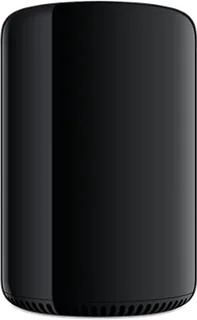
| Type | Compact | Tower |
| Weight | 5 kg | – |
| Width × depth × height | 167 × 167 × 251 mm | 206 × 475 × 511 mm |
| Operating system | macOS | macOS |
| Size and weight detail | Cylindrical enclosure; 251 mm high and 167 mm in diameter, with 5 kg weight from Apple's Japanese specification sheet. Weight varies by configuration and manufacturing process. | Quad-core standard configuration weighs 18.1 kg; standard twelve-core configuration 18.7 kg. Actual weight varies by configuration and manufacturing process, so a shared weight is omitted. |
| Power supply | 100–240 V AC, 50–60 Hz, single phase; maximum continuous power 450 W | AC input 100–120 V or 200–240 V, 50–60 Hz; maximum current 12 A at low voltage or 5 A at high voltage |
| Noise | Apple's overview reports 12 dBA operator-position sound pressure at idle, while the acoustic table reports 14 dB at idle and 14.5 dB during wireless web. These are conflicting maker statements; no single noise value is selected. | Apple gives operator-position sound pressure of 26 dB for the 3.2 GHz model and 25 dB for the 2.4 GHz dual-processor model at idle or during hard-drive access; 42 dB during optical-drive access. Corresponding sound power is 3.7/3.5 B at idle and 4.7/5.1 B during optical access. |
| Materials | Highly recyclable enclosure; BFR-free and PVC-free, with regional exceptions for the power lead | Recyclable aluminium enclosure; BFR-free and internal cables PVC-free |
| In the box | Mac Pro and power lead. Launched with OS X Mavericks; the current support page describes the later macOS Mojave release. Original standard configurations were quad-core with 12 GB memory and D300 graphics, and six-core with 16 GB and D500. The current support sheet also lists an eight-core standard configuration with 16 GB and D700. Configurations below include independent processor, memory, graphics and storage upgrades of the original quad-core base, so 12 GB or D300 with a higher-core processor represents a customised base model. | Mac Pro, power cord, keyboard, Magic Mouse, USB keyboard extension cable and documentation. Current maker sheet describes OS X Mountain Lion and iLife; the generation was introduced before Mountain Lion. Apple also offered a server configuration with OS X Server, 8 GB memory and two 1 TB drives, supplied without keyboard or mouse; its distinct bundled software and drive arrangement are described here. |

More comparisons
- Apple Mac Pro (Late 2013) vs Apple Mac Studio (M4 Max or M3 Ultra)
- Apple Mac Pro (Mid 2012) vs Apple Mac Studio (M4 Max or M3 Ultra)
- Apple Mac mini (M4 or M4 Pro) vs Apple Mac Pro (Late 2013)
- Apple Mac Pro (Late 2013) vs Apple Mac Pro (M2 Ultra)
- Apple Mac Pro (M2 Ultra) vs Apple Mac Pro (Mid 2012)
- Apple Mac Pro (Late 2013) vs Apple Mac Studio (M1 Max / M1 Ultra)
- Apple Mac Pro (2019) vs Apple Mac Pro (Mid 2012)
- Apple Mac Pro (2019) vs Apple Mac Pro (Late 2013)
- Apple Mac mini (2018) vs Apple Mac Pro (Late 2013)
- Apple iMac Pro (2017) vs Apple Mac Pro (Late 2013)
- Apple Mac mini (Late 2014) vs Apple Mac Pro (Late 2013)
- Apple Mac Pro (Late 2013) vs Apple Mac Pro (Mid 2010)
- Apple Mac mini (Late 2012) vs Apple Mac Pro (Late 2013)
- Apple Mac Pro (Early 2009) vs Apple Mac Pro (Late 2013)
- Apple Mac Pro (Early 2008) vs Apple Mac Pro (Late 2013)
- Apple Mac Pro (2006) vs Apple Mac Pro (Late 2013)