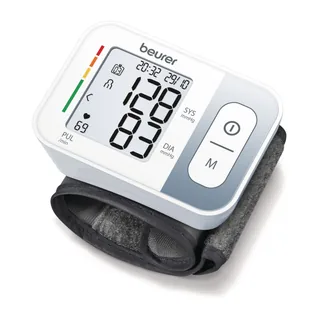
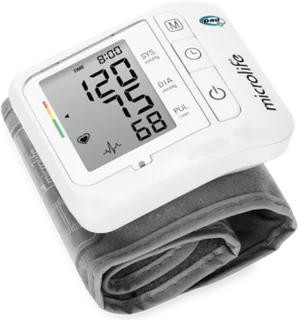
Beurer BC 28 vs Microlife BP W1 Basic
Better figure, where one is clearly better
| BeurerBC 28 | MicrolifeBP W1 Basic | |
|---|---|---|
| Overview | ||
| Released | – | – |
| Measuring | ||
| Type | Wrist | Wrist |
| Irregular heartbeat detection | Yes | Yes |
| AFib detection or ECG | No | No |
| Method | Automatic oscillometric wrist measurement during deflation. Exact white UK item 65044, EAN 4211125650445; BC 27 dark-grey item 65904 has a separate maker product record. First-sale date unconfirmed | Automatic oscillometric wrist measurement during inflation, explicitly described in current exact manual despite Gentle+ marketing name. First on-sale date unresolved |
| Accuracy | Exact manual display accuracy ±3 mmHg for systolic and diastolic pressure and ±5% for pulse. Systolic range 60–260 mmHg, diastolic 40–199 mmHg and pulse 40–180 beats/minute; cuff-pressure range 0–300 mmHg is separate | Static pressure accuracy ±3 mmHg, pulse ±5% of readout; systolic 60–255 mmHg and diastolic 40–200 mmHg. Current manual pulse range 40–199 takes precedence over website 40–200; cuff-pressure display range 0–299 mmHg is separate |
| Clinical validation | Manual gives an unspecified clinical-test maximum permissible standard deviation of 8 mmHg for systolic and diastolic pressure, without identifying a published study. Medaval reports no peer-reviewed clinical validation information for BC 28; headline independently established validation omitted | Manufacturer website claims BIHS A/A and manual states ESH testing; Medaval exact-model record reports no peer-reviewed clinical validation evidence. Headline validation omitted rather than treating manufacturer claim as an independently established trial |
| Features | Irregular-heartbeat warning, coloured classification scale, date/time, application-error messages and automatic switch-off after approximately one minute. No dedicated AFib screening, ECG, movement detection, heart-level position indicator, resting indicator or voice output | LED positioning indicator helps set wrist at heart level; inflation starts after 5–8 seconds. Ordinary irregular-heartbeat indication, traffic-light scale, cuff-fit and arm-movement indicators, low-battery warning and automatic switch-off after approximately one minute. No dedicated AFib algorithm or MAM sequence established |
| Cuff | ||
| Cuff fits | 14–19.5 cm | 13.5–21.5 cm |
| Cuff | Attached wrist cuff for 14–19.5 cm circumference. User must position the cuff at heart level; no electronic position guidance | Attached wrist cuff fits 13.5–21.5 cm according to current manual; clean marks with damp cloth and mild detergent |
| Connections and memory | ||
| Users | 2 | – |
| Readings stored | 60 per user | 60 |
| Bluetooth and app | No | No |
| Memory | Two users with 60 dated readings each; oldest overwritten when full. Average of all stored values and morning (05:00–09:00) or evening (18:00–20:00) readings over the latest seven days. Deletion clears the selected user's entire memory | Stores 60 readings with date/time, oldest overwritten when full; readings retained on battery replacement while clock resets. New result can be excluded; saved history clears as a whole rather than individually. Manual says per user but exact labelled controls/display establish no separate user selection, so no headline user count |
| App | No Bluetooth or connection from the monitor. Current Scan & Save support captures the displayed values using a smartphone camera into beurer HealthManager Pro; not automatic transfer | – |
| Power | Two 1.5 V LR03 AAA alkaline batteries; exact manuals claim approximately 170 measurements depending on blood pressure and inflation pressure, while the current product table says approximately 300. Battery operation only | Two 1.5 V AAA alkaline batteries, approximately 320 measurements with new cells. Current support table incorrectly lists four AAA cells; product page and exact manual both specify two. NiMH rechargeable cells supported but charged externally, not inside the monitor |
| Design | ||
| Display details | Non-illuminated LCD with black digits, maker size 3.5 × 4.0 cm. Physical start/stop and memory controls; low-battery indicator. Manual IP22 | LCD with ON/OFF, memory and time controls; LED positioning indicator. IP22 in current exact manual |
| Size | Exact English and March 2022 multilingual manuals and January 2019 data sheet give 84 × 60 × 29 mm (L × W × H), approximately 92 g with cuff without batteries. Current product table instead gives 60 × 84 × 55 mm and 171 g excluding packaging, with weighing conditions unspecified; differences unresolved | 73 × 66 × 38 mm; 124 g including batteries |
| In the box | Monitor with attached cuff, two AAA batteries, storage box and instructions. Current product page also lists a blood pressure record. Dedicated English manual's footer is September 2019 despite its download filename using March 2022; newer multilingual manual has the same core specifications | Monitor, storage box, two AAA alkaline batteries and blood-pressure diary listed by European manufacturer; official instructions available |
More comparisons
- Beurer BC 21 vs Microlife BP W1 Basic
- Beurer BC 27 vs Microlife BP W1 Basic
- Beurer BC 28 vs Microlife BP W10 Basic
- Beurer BC 28 vs Microlife BP W2 Slim
- Beurer BC 28 vs Microlife BP W3 Comfort
- Beurer BC 28 vs Microlife BP W70
- Beurer BC 28 vs Microlife BP W90
- Beurer BC 28 vs Omron RS1
- Beurer BC 28 vs Omron RS2
- Beurer BC 28 vs Omron RS4