Beurer BM 23 vs Microlife BP A2 Basic
Better figure, where one is clearly better
| BeurerBM 23 | MicrolifeBP A2 Basic | |
|---|---|---|
| Overview | ||
| Released | – | – |
| Measuring | ||
| Type | Upper arm | Upper arm |
| Clinically validated | – | Yes |
| Irregular heartbeat detection | Yes | Yes |
| AFib detection or ECG | No | No |
| Method | Automatic oscillometric upper-arm measurement during deflation. Exact UK item 60493, EAN 4211125604936; manual model BM 23, technical type BM 25. Range tile and SEO title use BM 25, but active product heading, photos, datasheet and instructions identify BM 23. First-sale date unresolved | Automatic oscillometric upper-arm measurement during deflation, marketed as Gentle+ pressure and speed control. Exact operation describes pumping followed by gradual pressure reduction; no MAM sequence established despite copied MAM-button wording in some instructions. First on-sale date unresolved |
| Accuracy | Manual display accuracy ±3 mmHg for systolic and diastolic pressure and ±5% for pulse; systolic range 50–280 mmHg, diastolic 30–200 mmHg and pulse 40–199 beats/minute. Maximum cuff pressure 300 mmHg is separate | July 2025 E-V10 manual gives systolic 60–255 mmHg, diastolic 40–200 mmHg and pulse 40–199 bpm; static pressure ±3 mmHg and pulse ±5%. UK product/support instead give blood pressure 20–280 mmHg and pulse 40–200 bpm; September 2023 S-V11 manual says pulse 20–200 despite its error table's 40 bpm threshold. Conflicting ranges qualified; cuff-pressure display 0–299 mmHg is separate |
| Clinical validation | Current manual claims clinical testing to ISO 81060-2. Medaval lists a Stride BP derivative recommendation based on equivalence to BM 28 via Globalcare GCE603, but says unpublished equivalence results cannot be verified to MDR requirements. Independently established exact-device validation remains unresolved; headline flag omitted | STRIDE BP lists A2 Basic as an equivalent device to BP A100, for adults and diabetes with 22–42 and 32–52 cm cuffs. Headline indicates registry acceptance by equivalence, not a separate exact-model trial. Maker manual instead cites BP 3BT0-A technology; Medaval notes that the equivalence evidence does not establish MDR-compliant accuracy validation |
| Features | Irregular-heartbeat warning, coloured classification scale, electronic cuff-position check, automatic switch-off and battery indicator. No ECG, dedicated AFib screening, resting indicator or voice output | Ordinary IHB indication, traffic-light classification, cuff check, movement warning, low-battery indicator and automatic switch-off after approximately one minute. No dedicated AFib screening or app |
| Cuff | ||
| Cuff fits | 22–42 cm | 22–42 cm |
| Cuff | Supplied universal cuff for 22–42 cm upper-arm circumference, replacement item 110.031; conventional hook-and-loop cuff rather than easyClip or easyLock | Supplied conical M-L cuff fits 22–42 cm in UK maker product page. Manual lists optional S 17–22, M 22–32, L 32–42 and L-XL 32–52 cm; do not treat all optional sizes as supplied |
| Connections and memory | ||
| Readings stored | – | 30 |
| Bluetooth and app | No | No |
| Memory | No stored reading history, user profiles, date/time or calculated averages established by the product table or complete device operation section. Manual's isolated statement about resetting date/time and retaining saved measurements conflicts with those sections; not treated as an implemented feature | Stores last 30 dated readings and first displays their average on recall, then individual results. Oldest overwritten when full. History retained on cell replacement while clock resets. Newly displayed reading can be excluded; stored history clears together. No user-selector operation established; manuals contain copied two-user wording, so headline user count remains omitted |
| App | No Bluetooth connection from the monitor. Scan & Save captures the display with a smartphone camera into beurer HealthManager Pro rather than automatically transmitting measurements | – |
| Power | Four 1.5 V LR03 AAA batteries included; manual approximately 300 measurements depending on blood pressure and inflation pressure. USB-C input supports optional 5 V DC / 1 A mains operation, not battery charging or a demonstrated data connection. Manual lists EU adapter 072.78 and UK adapter 072.79; remove batteries for mains operation | Four 1.5 V AA alkaline batteries, approximately 920 measurements with new cells in July 2025 manual. Optional Microlife DC 6 V, 600 mA mains adapter uses dedicated socket without drawing battery current. NiMH rechargeable cells supported but charged externally; no internal charging |
| Design | ||
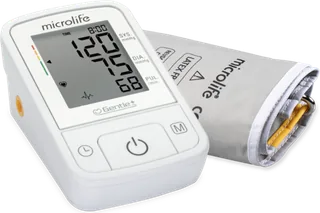
| Display details | Non-illuminated LCD with black digits, maker 4.4 × 5.3 cm; physical START/STOP button. Manual IP21 | LCD with ON/OFF, memory and time controls, cuff socket and adapter socket; IP20 in July 2025 manual |
| Size | 120 × 90 × 40 mm (L × W × H). Manual and datasheet approximately 318 g with cuff and without batteries; current product table's 362 g excluding packaging has unspecified weighing conditions | UK product/support and July 2025 E-V10 manual agree on 135.5 × 82 × 57 mm and 340 g including batteries. September 2023 S-V11 instead says 157.5 × 105 × 61.5 mm and 415 g; those conflicting older figures are not assigned to the headline |
| In the box | Monitor, universal upper-arm cuff, four AAA batteries and instructions according to the datasheet and manual. Product page additionally lists a blood pressure record; mains adapter sold separately | Monitor, textile storage pouch, four AA alkaline cells, blood-pressure diary and M-L 22–42 cm cuff listed by UK maker page; mains adapter optional |

More comparisons
- Beurer BM 23 vs Beurer BM 85
- Beurer BM 23 vs Rossmax AU941f
- Beurer BM 23 vs Rossmax AX356f
- A&D Medical UA-611 vs Beurer BM 23
- Beurer BM 23 vs Microlife BP 3AG1
- Beurer BM 23 vs Microlife BP 3AS1-2
- Beurer BM 23 vs Microlife BP A1 Easy
- A&D Medical UA-611 vs Microlife BP A2 Basic
- Beurer BM 25 vs Microlife BP A2 Basic
- Beurer BM 23 vs Microlife BP A2 Classic
- Beurer BM 23 vs Microlife BP A2 Easy
- Beurer BM 23 vs Microlife BP A3 PC
- Beurer BM 23 vs Microlife BP A3 Plus
- Beurer BM 23 vs Microlife BP A3L Comfort
- Beurer BM 23 vs Microlife BP AG1-10
- Beurer BM 23 vs Microlife BP AG1-20