Beurer BM 25 vs Microlife BP A3 Plus
Better figure, where one is clearly better
| BeurerBM 25 | MicrolifeBP A3 Plus | |
|---|---|---|
| Overview | ||
| Released | – | – |
| Measuring | ||
| Type | Upper arm | Upper arm |
| Irregular heartbeat detection | Yes | Yes |
| AFib detection or ECG | – | No |
| Method | Automatic oscillometric upper-arm measurement during deflation; first on-sale date not established | Oscillometric upper-arm measurement during deflation with Gentle+ pressure control. Side switch selects single measurement or MAM mode; three readings with 15-second pauses produce one analysed result. Individual MAM results are not displayed; a fourth is taken if one is questionable. First actual on-sale date unresolved |
| Accuracy | Maker manual specifies display accuracy of ±3 mmHg for systolic and diastolic pressure and ±5% of the displayed pulse value; this specification is distinct from clinical validation | Current 26 June 2025 UK-linked S-V10-1 guide gives systolic 60–255 mmHg, diastolic 40–200 mmHg, pulse 40–199 bpm, static accuracy ±3 mmHg and pulse accuracy ±5%. UK product page instead gives blood pressure 20–280 mmHg and pulse 40–200; global support also gives pulse 40–200. Range differences retained; cuff-pressure display 0–299 mmHg is separate |
| Clinical validation | Beurer states clinical testing to ISO 81060-2 in the manual; exact independent registry confirmation was not established | Maker claims BIHS A/A and shared measurement technology with BP 3BTO-A, but Medaval reports no peer-reviewed validation evidence for exact BP A3 Plus BP 3GX1-5N. Independent exact-model validation remains unresolved, so headline flag is omitted. A3 PC diabetes study is not transferred to this non-PC model |
| Features | Single start/stop button, cuff fit check, irregular heartbeat warning, classification scale and automatic switch-off; maker lists no resting indicator or calculated averages | Irregular-heartbeat indication, not a dedicated AFib algorithm or ECG. Cuff-fit and arm-movement indicators, coloured classification scale, low-battery warning and automatic switch-off after approximately one minute |
| Cuff | ||
| Cuff fits | 22–42 cm | 22–42 cm |
| Cuff | Supplied upper-arm cuff | UK bundle supplies conical soft M-L 22–42 cm cuff. Current guide lists optional S 17–22, M 22–32, L 32–42 and L-XL 32–52 cm sizes and preformed cuffs; these are not all supplied |
| Connections and memory | ||
| Users | – | 2 |
| Readings stored | – | 99 per user |
| Bluetooth and app | No | No |
| Memory | – | Two separate histories of 99 dated readings each, selected with user switch. First memory recall displays average of all stored values (current guide labels this 28A without defining a narrower period). Oldest overwritten when full. All stored readings for selected user can be cleared, but not individual stored values; freshly displayed reading can be excluded. History survives battery replacement while clock requires reset |
| App | Scan & Save in beurer HealthManager Pro uses a smartphone camera to record the display; no Bluetooth connection | No Bluetooth, phone app or USB PC-transfer interface in exact guide and current hardware views. Separate A3 PC model has USB; its software support is not transferred |
| Power | Four 1.5 V LR03 AAA batteries or optional DC 5 V, 1 A mains adaptor through USB-C; USB-C is for mains operation, not charging the disposable batteries | Four 1.5 V AA alkaline cells; approximately 920 measurements with new batteries, without a separate triple-cycle count. Optional Microlife DC 6 V, 600 mA adapter stops battery-current use when connected. NiMH cells supported with external charging |
| Design | ||
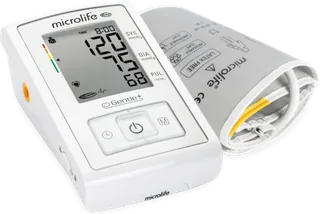
| Display details | Non-illuminated LCD, 4.4 × 5.3 cm, with black digits; maker lists no date/time display | LCD with date/time and user indicator, ON/OFF, memory and time buttons, separate user and 1/3 MAM switches. DC adapter socket. IP20 |
| Size | 12.00 × 9.00 × 4.00 cm (L × W × H) | 143 × 85 × 58 mm; 368 g including batteries in exact current guide and maker pages |
| In the box | Monitor, 22–42 cm cuff and four AAA batteries | UK maker lists conical soft M-L 22–42 cm cuff, four AA alkaline cells, textile soft bag and blood-pressure diary. Adapter optional. Current guide's isolated wrist-measurement paragraph conflicts with its upper-arm intended use and cuff table and is not copied as device type |

More comparisons
- Beurer BM 25 vs Beurer BM 85
- Beurer BM 25 vs Beurer BM 53
- Beurer BM 25 vs Rossmax AU941f
- Beurer BM 25 vs Rossmax AX356f
- A&D Medical UA-611 vs Beurer BM 25
- Beurer BM 25 vs Microlife BP 3AG1
- Beurer BM 25 vs Microlife BP 3AS1-2
- Beurer BM 25 vs Microlife BP A1 Easy
- Beurer BM 25 vs Microlife BP A2 Basic
- Beurer BM 25 vs Microlife BP A2 Classic
- Beurer BM 25 vs Microlife BP A2 Easy
- Beurer BM 25 vs Microlife BP A3 PC
- A&D Medical UA-611 vs Microlife BP A3 Plus
- Beurer BM 23 vs Microlife BP A3 Plus
- Beurer BM 25 vs Microlife BP A3L Comfort
- Beurer BM 25 vs Microlife BP AG1-10