Beurer BM 96 Cardio vs Microlife BP A6 BT
Better figure, where one is clearly better
| BeurerBM 96 Cardio | MicrolifeBP A6 BT | |
|---|---|---|
| Overview | ||
| Released | – | – |
| Measuring | ||
| Type | Upper arm | Upper arm |
| Clinically validated | – | Yes |
| Irregular heartbeat detection | Yes | Yes |
| AFib detection or ECG | Yes | Yes |
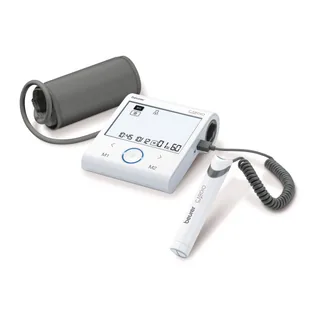
| Method | Automatic oscillometric upper-arm blood pressure measurement during inflation; separate single-channel ECG stick. Exact BM 96 Cardio item 65801. Maker announcement dated 31 August 2021 does not establish the first retail date, which remains unconfirmed | Oscillometric upper-arm measurement during deflation with Gentle+ control. Single or AFIB/MAM triple mode selected by side switch; three measurements separated by 15 seconds produce one analysed result. Questionable measurement triggers a fourth; individual triple-mode results are not displayed. Actual first retail sale unresolved |
| Accuracy | Maker display accuracy ±3 mmHg for systolic and diastolic pressure and ±5% for pulse; systolic range 60–280 mmHg, diastolic 30–200 mmHg and pulse 30–199 beats/minute. Cuff-pressure range 0–300 mmHg is separate. ECG bandwidth 0.05–40 Hz and sample rate 500 Hz | Current E-V11 MDR guide gives systolic 60–255 mmHg, diastolic 40–200 mmHg and pulse 40–199 bpm; global support lists pulse 40–200. Older S-V10 guide and French maker page give blood pressure 20–280 mmHg and pulse 40–200. Static accuracy ±3 mmHg and pulse accuracy ±5%; cuff-pressure display 0–299 mmHg is separate |
| Clinical validation | Independently published exact-device blood pressure validation not established; Medaval reports no peer-reviewed validation information for this technology, so headline validation flag omitted | STRIDE BP accepts exact A6 BT for adult and diabetic home use by equivalence to BP A100, with referenced 2009, 2018 and 2021 studies. This does not establish separate published A6 BT trials for every special population mentioned by the maker. Blood-pressure validation and AFib screening are separate claims |
| Features | AFib detection, irregular-heartbeat warning, cuff-fit check, two measurement reminders, coloured classification scale and HSD haemodynamic resting indicator. ECG recordings can be 30, 60, 90 or 120 seconds; status indications include OK, AFib, heart rate below 60 bpm or above 100 bpm. Chest/finger methods approximate leads II or III; hand-to-hand method approximates lead I and has lower stability. These are alternative single-channel positions, not simultaneous three-lead recording; the maker's doctor annex excludes full clinical or emergency diagnosis | AFib pulse-irregularity screening active only in AFIB/MAM triple mode, not single measurement. Does not record an ECG or provide an ECG-confirmed diagnosis. Cuff-fit and arm-movement indications, LED pressure classification scale, low-battery warning, automatic switch-off and lock switch to prevent accidental activation |
| Cuff | ||
| Cuff fits | 22–42 cm | 22–42 cm |
| Cuff | Upper-arm cuff for 22–42 cm circumference; correct cuff placement and resting conditions are still required | Current MDR guide supplies Microlife Soft Cuff M-L 22–42 cm. Optional soft cuffs S 17–22, M 22–32, L 32–42 and L-XL 32–52 cm are not all supplied. STRIDE lists validated 22–42 and 32–52 cm sizes |
| Connections and memory | ||
| Users | 2 (better) | 1 |
| Readings stored | 60 per user | 99 (better) |
| Bluetooth and app | Yes | Yes |
| Memory | Two users with up to 60 dated blood pressure readings each; oldest overwritten when full. Averages of all stored readings and morning/evening readings over the latest seven days. ECG memory holds up to 60 recordings per user at 30 seconds; longer recordings can reduce capacity. Deleting memory clears the selected user history | One history of the last 99 dated readings, with no user selector in exact controls. First recall shows average of all stored values; older guide calls it 28A without defining a 28-day interval. Forward/backward buttons navigate history, oldest overwritten when full. Complete history can be cleared, individual saved values cannot; newly displayed reading can be excluded. Readings survive battery replacement while clock requires reset. Isolated manual wording per user does not establish two separate histories |
| App | Bluetooth Low Energy transfer to beurer HealthManager Pro. The maker's October 2022 datasheet also specifies web software and USB uploader; these are separate from Bluetooth transfer. Current manual gives compatibility with Bluetooth 4.0 or later, not an exact radio version. Optional MyCardio Pro analysis service is described separately on the product page | Bluetooth 4.0 synchronisation with Microlife Connected Health+; connection active after measurement and can be started with forward button in standby. USB transfer to Blood Pressure Analyzer+ PC software. Both manuals specify Mini-B five-pin connector in PC-link section, while current package list calls its cable Micro USB; connector wording conflict retained. French page keeps older app OS requirements; current supported phone versions should be checked with the app |
| Power | Four 1.5 V AA batteries included; approximately 300 measurements depending on blood pressure, inflation pressure and ECG recording duration | Four 1.5 V AAA alkaline cells; approximately 400 measurements with new batteries, not a separate triple-cycle count. Optional Microlife DC 6 V, 600 mA adapter; French bundle list includes it despite technical table calling it optional. NiMH cells supported with external charging, not charged in monitor |
| Design | ||
| Display details | Illuminated LCD with black digits, maker 10.4 × 6.7 cm; four sensor touch buttons, illuminated start/stop button, date/time and battery indicator. IP21 | LCD with date/time and AFIB/MAM indicators; START/STOP, memory, time and forward/backward controls. Separate lock and single/triple switches, cuff, USB and DC sockets. IP20 |
| Size | Blood pressure unit 120 × 144 × 53 mm (L × W × H), approximately 490 g without batteries and with cuff; ECG stick approximately 40 g and 22 mm diameter × 120 mm height. Web table's 744 g excluding packaging lacks the same weighing conditions and is not substituted for the manual values | Current E-V11 MDR guide, French product and global support agree on 160 × 80 × 32 mm and 354 g including batteries. Older exact S-V10 guide incorrectly gives 150 × 100 × 50 mm and 580 g; conflict retained rather than transferring that table |
| In the box | Blood pressure unit, cuff, ECG stick, four AA batteries, storage pouch, instructions, quick-start guide and annex for the attending doctor, as listed in the May 2026 manual; UK product page additionally lists a USB transfer cable and blood pressure record | Current MDR guide lists soft M-L cuff, cuff holder, cuff-size marker, USB cable, storage bag, diary, instructions and four AAA cells, with adapter optional. French regional list includes adapter; regional bundle differences remain qualified |

More comparisons
- Beurer BM 96 Cardio vs Withings BPM Vision
- Microlife BP A6 BT vs Withings BPM Vision
- Beurer BM 96 Cardio vs Omron M7 Intelli IT AFib
- Microlife BP A6 BT vs Omron M7 Intelli IT AFib
- Beurer BM 96 Cardio vs Withings BPM Core
- Microlife BP A6 BT vs Withings BPM Core
- Beurer BM 96 Cardio vs Omron Complete
- Microlife BP A6 BT vs Omron Complete
- Beurer BM 96 Cardio vs Omron Evolv
- Microlife BP A6 BT vs Omron Evolv
- Beurer BM 85 vs Beurer BM 96 Cardio
- Beurer BM 64 vs Microlife BP A6 BT
- Beurer BM 96 Cardio vs Microlife BP A7 Touch BT
- Beurer BM 96 Cardio vs Microlife BP B4 AFIB BT
- Beurer BM 96 Cardio vs Microlife BP B6 Connect
- Beurer BM 96 Cardio vs Omron M4 Connect AFib