Microlife BP A6 BT vs Withings BPM Core
Better figure, where one is clearly better
| MicrolifeBP A6 BT | WithingsBPM Core | |
|---|---|---|
| Overview | ||
| Released | – | July 2019 |
| Measuring | ||
| Type | Upper arm | Upper arm |
| Clinically validated | Yes | Yes |
| Irregular heartbeat detection | Yes | No |
| AFib detection or ECG | Yes | Yes |
| Method | Oscillometric upper-arm measurement during deflation with Gentle+ control. Single or AFIB/MAM triple mode selected by side switch; three measurements separated by 15 seconds produce one analysed result. Questionable measurement triggers a fourth; individual triple-mode results are not displayed. Actual first retail sale unresolved | Cuff oscillometric; automatic inflation at 15 mmHg/s |
| Accuracy | Current E-V11 MDR guide gives systolic 60–255 mmHg, diastolic 40–200 mmHg and pulse 40–199 bpm; global support lists pulse 40–200. Older S-V10 guide and French maker page give blood pressure 20–280 mmHg and pulse 40–200. Static accuracy ±3 mmHg and pulse accuracy ±5%; cuff-pressure display 0–299 mmHg is separate | ±3 mmHg or 2% of reading (pressure), ±5% of reading (pulse); pressure range 0 to 285 mmHg; heart rate 40 to 180 bpm |
| Clinical validation | STRIDE BP accepts exact A6 BT for adult and diabetic home use by equivalence to BP A100, with referenced 2009, 2018 and 2021 studies. This does not establish separate published A6 BT trials for every special population mentioned by the maker. Blood-pressure validation and AFib screening are separate claims | Listed as validated by STRIDE BP (as BPM Core WPM04); Withings's study to ISO 81060-2:2018/AMD 1:2020, mean error −0.6 mmHg systolic, 0.1 mmHg diastolic |
| Features | AFib pulse-irregularity screening active only in AFIB/MAM triple mode, not single measurement. Does not record an ECG or provide an ECG-confirmed diagnosis. Cuff-fit and arm-movement indications, LED pressure classification scale, low-battery warning, automatic switch-off and lock switch to prevent accidental activation | Single-lead ECG with AFib detection (92% sensitivity, 98.4% specificity, Withings); digital stethoscope for valvular heart disease; colour-coded result |
| Cuff | ||
| Cuff fits | 22–42 cm | 22–42 cm |
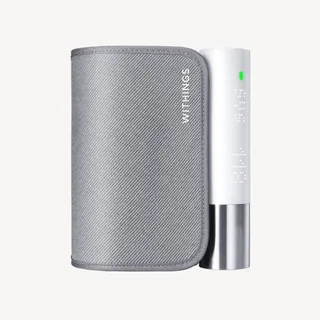
| Cuff | Current MDR guide supplies Microlife Soft Cuff M-L 22–42 cm. Optional soft cuffs S 17–22, M 22–32, L 32–42 and L-XL 32–52 cm are not all supplied. STRIDE lists validated 22–42 and 32–52 cm sizes | Cuff built into the monitor, 22 to 42 cm; ECG electrodes in the cuff and on the tube |
| Connections and memory | ||
| Users | 1 | – |
| Readings stored | 99 | – |
| Bluetooth and app | Yes | Yes |
| Memory | One history of the last 99 dated readings, with no user selector in exact controls. First recall shows average of all stored values; older guide calls it 28A without defining a 28-day interval. Forward/backward buttons navigate history, oldest overwritten when full. Complete history can be cleared, individual saved values cannot; newly displayed reading can be excluded. Readings survive battery replacement while clock requires reset. Isolated manual wording per user does not establish two separate histories | Up to 8 readings on the device between syncs; unlimited storage in the Withings cloud |
| App | Bluetooth 4.0 synchronisation with Microlife Connected Health+; connection active after measurement and can be started with forward button in standby. USB transfer to Blood Pressure Analyzer+ PC software. Both manuals specify Mini-B five-pin connector in PC-link section, while current package list calls its cable Micro USB; connector wording conflict retained. French page keeps older app OS requirements; current supported phone versions should be checked with the app | Withings app (iOS and Android), syncs over Wi-Fi or Bluetooth; works with Apple Health and Google Health Connect |
| Power | Four 1.5 V AAA alkaline cells; approximately 400 measurements with new batteries, not a separate triple-cycle count. Optional Microlife DC 6 V, 600 mA adapter; French bundle list includes it despite technical table calling it optional. NiMH cells supported with external charging, not charged in monitor | Rechargeable battery, up to 6 months per charge; micro-USB charging |
| Design | ||
| Display details | LCD with date/time and AFIB/MAM indicators; START/STOP, memory, time and forward/backward controls. Separate lock and single/triple switches, cuff, USB and DC sockets. IP20 | LED matrix screen |
| Size | Current E-V11 MDR guide, French product and global support agree on 160 × 80 × 32 mm and 354 g including batteries. Older exact S-V10 guide incorrectly gives 150 × 100 × 50 mm and 580 g; conflict retained rather than transferring that table | 560 × 165 × 450 mm unfolded; 430 g |
| In the box | Current MDR guide lists soft M-L cuff, cuff holder, cuff-size marker, USB cable, storage bag, diary, instructions and four AAA cells, with adapter optional. French regional list includes adapter; regional bundle differences remain qualified | BPM Core, charging cable, quick installation guide |

More comparisons
- Microlife BP A6 BT vs Withings BPM Vision
- Withings BPM Core vs Withings BPM Vision
- Microlife BP A6 BT vs Omron M7 Intelli IT AFib
- Withings BPM Connect vs Withings BPM Core
- Beurer BM 64 vs Withings BPM Core
- Beurer BM 96 Cardio vs Withings BPM Core
- Microlife BP A6 BT vs Omron Complete
- Microlife BP A6 BT vs Omron Evolv
- Beurer BM 64 vs Microlife BP A6 BT
- Beurer BM 96 Cardio vs Microlife BP A6 BT
- Microlife BP A6 BT vs Omron M4 Connect AFib
- Microlife BP A6 BT vs Omron M7 Intelli IT
- Microlife BP A6 BT vs Rossmax X5 BT
- Microlife BP A6 BT vs Rossmax X9 BT
- Microlife BP A6 BT vs Rossmax Z5