Canon EF 50mm f/1.4 USM vs Canon EF-S 35mm f/2.8 Macro IS STM
Better figure, where one is clearly better
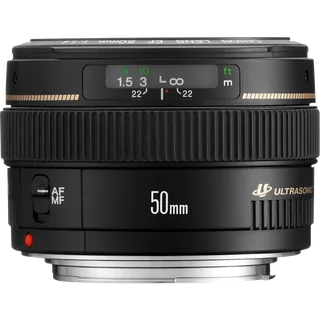
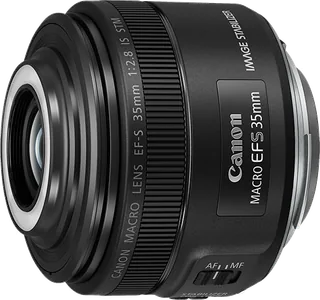
| CanonEF 50mm f/1.4 USM | CanonEF-S 35mm f/2.8 Macro IS STM | |
|---|---|---|
| Overview | ||
| Released | June 1993 | May 2017 |
| Optics | ||
| Lens type | Prime | Prime |
| Focal length | 50 mm | 35 mm |
| Maximum aperture | f/1.4 | f/2.8 |
| Minimum aperture | f/22 | f/32 |
| Optical construction | Seven elements in six groups | 10 elements in six groups |
| Special elements | Two high-refraction glass elements according to Canon Camera Museum | One aspherical element shown in Canon Camera Museum's optical diagram |
| Aperture detail | – | Minimum f/32 with one-third-stop aperture increments |
| Coatings | Super Spectra coating according to Canon UK | – |
| Diaphragm | Eight blades; Canon UK's store describes a circular diaphragm, while Photozone finds angular highlights when stopped down | Seven blades; circular aperture according to Canon Camera Museum |
| Angle of view | 46° diagonal, 40° horizontal and 27° vertical | Horizontal 35°55′, vertical 24°20′, diagonal 42°35′ |
| Mount and compatibility | ||
| Mounts | Canon EF | Canon EF-S |
| Image circle | Full frame | APS-C |
| Compatibility | Canon EF full-frame and APS-C cameras | Canon EF-S compatible APS-C cameras; equivalent angle of view to 56 mm on full frame |
| Teleconverter support | – | Canon EF extenders are not compatible |
| Focus and stabilisation | ||
| Autofocus | Yes | Yes |
| Minimum focus distance | 0.45 m | 0.13 m |
| Maximum magnification | 0.15× | 1× |
| Optical stabilisation | No | Yes |
| Autofocus detail | Micro USM with mechanical full-time manual focus; Canon's manual permits adjustment after One Shot AF while holding the shutter button halfway | STM autofocus; electronic manual focusing requires the camera to be awake according to Dustin Abbott |
| Focus distance detail | Overall linear extension focusing according to Canon USA; front filter thread does not rotate according to The Digital Picture | 0.13 m minimum focus measured from the image plane; approximately 30 mm working distance from the lens front at life-size magnification according to Canon Japan |
| Magnification detail | EF12 II extension tube gives 0.24–0.39×; EF25 II gives 0.53–0.68× according to Canon UK | Maximum 1×; EF12 II extension tube gives 0.34–1.41× and EF25 II gives 0.76–1.91× according to Canon UK |
| Stabilisation detail | No image stabilisation according to The Digital Picture's exact-model specification table | Hybrid IS compensates for angular and lateral movement; Canon states four stops of correction, with effectiveness depending on shooting distance |
| Design | ||
| Dust and moisture resistant | No | – |
| Filter diameter | 58 mm | 49 mm |
| Maximum diameter | 73.8 mm | 69.2 mm |
| Length | 50.5 mm | 55.8 mm |
| Weight | 290 g | 190 g (better) |
| Controls | AF/MF switch, focusing ring, distance scale and infrared index according to Canon's manual | Macro Lite can illuminate both sides or either side individually, with brightness control; AF/MF and stabiliser switches |
| Filter detail | – | 49 mm filter attaches to the ES-27 hood; Canon Japan specifies one filter and removing the hood to use Macro Lite illumination |
| Weather resistance | No weather sealing according to The Digital Picture's exact-model specification table | – |
| Dimensions detail | 73.8 mm diameter × 50.5 mm length in the retracted state according to Canon UK; Canon's manual measures length from the mount surface to the front, with caps adding 21.5 mm | 69.2 mm maximum diameter × 55.8 mm retracted length |
| Weight detail | 290 g for the lens only according to Canon's manual | – |
| Lens hood | Optional ES-71 II hood; reversible for storage according to Canon's manual | ES-27 hood; LP1014 case is optional according to Canon Japan |
| In the box | Lens, E-58II cap, Lens Dust Cap E and user manual according to Canon UK's store | Lens, ES-27 hood, EF-S35 front cap, Lens Dust Cap E and warranty paperwork in Canon Japan's listed package |
| Release detail | Canon Camera Museum records June 1993 marketing | Canon Camera Museum records May 2017 marketing. Canon Japan announced it on 6 April 2017 and records the Japanese first-sale date as 29 June 2017; a UK first-sale day is not established by these sources. |
More comparisons
- Canon EF 50mm f/1.4 USM vs Canon RF 50mm F1.4 L VCM
- Canon EF-S 35mm f/2.8 Macro IS STM vs Canon RF 100mm F2.8 L Macro IS USM
- Canon EF-S 35mm f/2.8 Macro IS STM vs Canon RF 35mm F1.8 MACRO IS STM
- Canon EF 50mm f/1.4 USM vs Canon RF 50mm F1.2 L USM
- Canon EF 70–200mm f/2.8L IS III USM vs Canon EF-S 35mm f/2.8 Macro IS STM
- Canon EF 50mm f/1.4 USM vs Canon EF 70–200mm f/2.8L IS III USM
- Canon EF 70–200mm f/4L IS II USM vs Canon EF-S 35mm f/2.8 Macro IS STM
- Canon EF 50mm f/1.4 USM vs Canon EF 70–200mm f/4L IS II USM
- Canon EF 85mm f/1.4L IS USM vs Canon EF-S 35mm f/2.8 Macro IS STM
- Canon EF 50mm f/1.4 USM vs Canon EF 85mm f/1.4L IS USM
- Canon EF-S 35mm f/2.8 Macro IS STM vs Canon EF-S 60mm f/2.8 Macro USM
- Canon EF-S 24mm f/2.8 STM vs Canon EF-S 35mm f/2.8 Macro IS STM
- Canon EF-S 18–55mm f/4–5.6 IS STM vs Canon EF-S 35mm f/2.8 Macro IS STM
- Canon EF 16–35mm f/2.8L III USM vs Canon EF-S 35mm f/2.8 Macro IS STM
- Canon EF-S 18–135mm f/3.5–5.6 IS USM vs Canon EF-S 35mm f/2.8 Macro IS STM
- Canon EF 24–105mm f/4L IS II USM vs Canon EF-S 35mm f/2.8 Macro IS STM