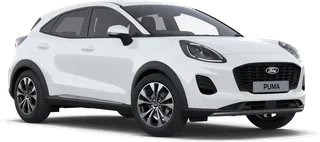
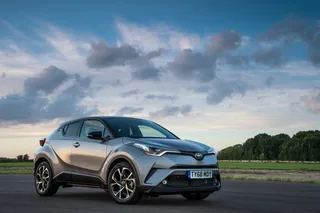
Ford Puma vs Toyota C-HR (2016)
Better figure, where one is clearly better
| FordPuma | ToyotaC-HR (2016) | |
|---|---|---|
| Overview | ||
| Released | October 2019 | October 2016 |
| Performance | ||
| Powertrain | Mild hybrid | Hybrid, Petrol |
| Power | 123–168 bhp (better) | 114–120 bhp |
| 0–62 mph | 7.4–9.8 s (better) | 10.9–11.4 s |
| Top speed | 118–130 mph (better) | 105–118 mph |
| Engine or motors | 1.0-litre EcoBoost three-cylinder petrol with 48V mild hybrid; 125 PS (91 kW), 155 PS (114 kW) or 170 PS (125 kW) on the ST (peak with overboost, 160 PS steady state); bhp converted from Ford's PS figures | 1.8-litre four-cylinder petrol hybrid (engine 97 bhp, system 120 bhp/90 kW, nickel-metal hydride battery) or 1.2-litre four-cylinder turbo petrol (114 bhp/85 kW); launch line-up, before later updates |
| Torque | 210 Nm (125 PS), 240 Nm (155 PS), 248 Nm (ST) | 142 Nm engine and 163 Nm motor (hybrid), 185 Nm (1.2T) |
| Gearbox | 6-speed manual (125 PS only) or 7-speed Powershift dual-clutch automatic | e-CVT (hybrid), 6-speed manual or CVT (1.2T) |
| Drive | Front-wheel drive | Front-wheel drive; all-wheel drive available with 1.2T CVT |
| Range and charging | ||
| Economy (WLTP) | 47.9–52.3 mpg | – |
| Efficiency | WLTP combined: 52.3 mpg (125 PS manual), 48.7–49.6 mpg (125 PS automatic), 49.6 mpg (155 PS), 47.9 mpg (ST) | NEDC combined: 72.4–74.3 mpg (hybrid), 47.1–47.9 mpg (1.2T FWD), 44.8 mpg (1.2T AWD); not comparable with WLTP |
| CO2 emissions | 122–135 g/km (WLTP) | 86–87 g/km (hybrid), 134–136 g/km (1.2T FWD), 144 g/km (1.2T AWD), NEDC combined |
| Practicality | ||
| Body | Crossover | Crossover |
| Seats | 5 | 5 |
| Boot | 456 litres (better) | 377 litres |
| Length | 4,226 mm | 4,360 mm |
| Width | 1,805 mm | 1,795 mm |
| Weight | From 1,201 kg | From 1,320 kg |
| Boot | 456 litres including the 80-litre MegaBox; up to 1,216 litres with the rear seats folded | 377 litres (VDA) |
| Towing | Up to 1,100 kg braked (manual), 900 kg (automatic) | 725 kg (hybrid); 1,300 kg braked (1.2T manual), 1,100 kg (1.2T CVT) |
| Size | 4,226 mm long, 1,805 mm wide, 1,550 mm high; 2,588 mm wheelbase; 10.5 m turning circle | 4,360 mm long, 1,795 mm wide, 1,565 mm high; 2,640 mm wheelbase; kerb weight 1,380–1,420 kg (hybrid), 1,320–1,390 kg (1.2T FWD), 1,460 kg (1.2T AWD); drag coefficient 0.32 (FWD) |
| Tech and safety | ||
| Infotainment | 12-inch SYNC touchscreen with built-in navigation and wireless Apple CarPlay and Android Auto; 12.8-inch digital instrument cluster; wireless charging pad; 10-speaker B&O audio on the ST | – |
| Driver assistance | BlueCruise hands-off motorway driving on automatics with the optional BlueCruise Ready Driver Assistance Pack | – |
| Safety rating | Euro NCAP 4 stars (2022); adult occupant 75%, child occupant 84%, vulnerable road users 70%, safety assist 69% | – |
| Warranty | 3 years or 60,000 miles | – |