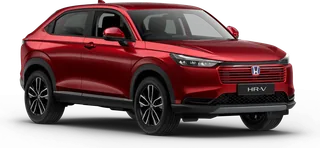
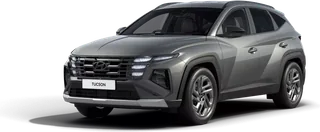
Honda HR-V vs Hyundai TUCSON
Better figure, where one is clearly better
| HondaHR-V | HyundaiTUCSON | |
|---|---|---|
| Overview | ||
| Released | 2021 | January 2021 |
| Performance | ||
| Powertrain | Hybrid | Petrol, Hybrid, Plug-in hybrid |
| Power | 129 bhp | 148–284 bhp (better) |
| 0–62 mph | 10.6 s | 7.5–9.5 s (better) |
| Top speed | 105 mph | 116–128 mph (better) |
| Engine or motors | 1.5-litre i-VTEC petrol engine, 107 PS (79 kW), with Honda's i-MMD two-motor hybrid system; electric drive motor 131 PS (96 kW), the figure used for power here (bhp converted from kW); 0–62 mph in 10.6 s (Elegance) or 10.7 s (other grades) | 1.6-litre T-GDi four-cylinder petrol, 150 PS; hybrid with a 47.7 kW motor, 239 PS system; plug-in hybrid with a 79 kW motor, 288 PS system; bhp converted from Hyundai's PS figures |
| Torque | 253 Nm (electric motor); 131 Nm (petrol engine) | 250 Nm (150 PS), 379 Nm system (hybrid and plug-in hybrid) |
| Gearbox | Automatic (eCVT), with paddles to adjust regenerative braking | 6-speed manual or 7-speed dual-clutch (150 PS); 6-speed automatic (hybrids) |
| Drive | Front-wheel drive | Front-wheel drive; four-wheel drive available on the plug-in hybrid |
| Range and charging | ||
| Zero-emission range (WLTP) | – | 38.2–40.7 miles |
| Battery | – | 13.8 kWh |
| Economy (WLTP) | 52.3 mpg | 39.8–256.8 mpg (better) |
| Range detail | – | Plug-in hybrid: WLTP electric range 40.7 miles (2WD) or 38.2 miles (4WD) |
| Efficiency | WLTP combined: 52.3 mpg (5.4 l/100 km) on all grades | WLTP combined: 39.2–39.8 mpg (manual), 39.8–40.9 mpg (DCT), 48.7–50.4 mpg (hybrid), 256.8 mpg (plug-in 2WD) and 235.4 mpg (plug-in 4WD) weighted |
| CO2 emissions | 122 g/km (WLTP combined) | 23–164 g/km (WLTP) |
| Practicality | ||
| Body | SUV | SUV |
| Seats | 5 | 5 |
| Boot | 319 litres | 620 litres (better) |
| Length | 4,355 mm | 4,510 mm |
| Width | 1,790 mm | 1,865 mm |
| Weight | From 1,381 kg | – |
| Boot | 319 litres (VDA) with the rear seats up; 971 litres to the window or 1,289 litres to the roof with them folded; 60/40 split Magic Seats | 620 litres (petrol), 616 litres (hybrid) or 558 litres (plug-in hybrid) with the rear seats up (VDA); 1,721–1,799 litres folded |
| Towing | – | 1,650 kg braked (petrol), 1,510 kg (hybrid), 1,210 kg (plug-in hybrid) |
| Size | 4,355 mm long, 1,790 mm wide (2,028 mm including mirrors), 1,582 mm high; 2,610 mm wheelbase; 11.3 m turning circle; 188 mm ground clearance; kerb weight 1,381–1,416 kg | 4,510–4,535 mm long depending on version, 1,865 mm wide without mirrors, 1,650 mm high; 2,680 mm wheelbase; 11 m turning circle; heaviest kerb weight 1,608 kg (manual) to 1,944 kg (plug-in 4WD) |
| Tech and safety | ||
| Warranty | – | 5 years, unlimited mileage |
| Infotainment | Honda CONNECT 9-inch touchscreen with navigation, DAB, Apple CarPlay (wireless) and Android Auto; 7-inch driver's display | – |
| Driver assistance | Honda SENSING: adaptive cruise control with low-speed following, Traffic Jam Assist, Collision Mitigation Braking System, Lane Keeping Assist, Road Departure Mitigation, Traffic Sign Recognition, driver monitoring camera; blind spot information with cross traffic monitor from Advance | – |