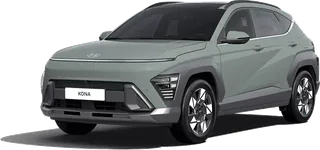
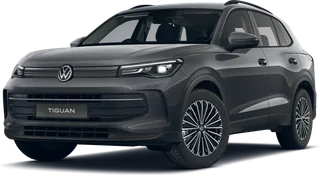
Hyundai KONA vs Volkswagen Tiguan
Better figure, where one is clearly better
| HyundaiKONA | VolkswagenTiguan | |
|---|---|---|
| Overview | ||
| Released | April 2023 | January 2024 |
| Performance | ||
| Powertrain | Petrol, Hybrid, Electric | Mild hybrid, Plug-in hybrid, Diesel |
| Power | 113–215 bhp | 128–268 bhp (better) |
| 0–62 mph | 7.8–11.9 s | 7.2–10.2 s (better) |
| Top speed | 103–125 mph | 124–134 mph (better) |
| Engine or motors | 1.0-litre T-GDi three-cylinder petrol, 115 PS; 1.6-litre T-GDi petrol, 150 PS; 1.6 GDi hybrid with a 32 kW motor and 1.32 kWh battery, 138 PS system; KONA Electric front motor, 160 kW (218 PS); bhp converted from Hyundai's PS figures | 1.5-litre four-cylinder eTSI petrol with 48V mild hybrid (130 or 150 PS), 1.5 TSI eHybrid plug-in hybrid (204 or 272 PS system output) and 2.0-litre TDI diesel (150 PS); bhp converted from Volkswagen's PS figures |
| Torque | 200 Nm (1.0), 250 Nm (1.6 T-GDi), 265 Nm system (hybrid), 255 Nm (Electric) | 220 Nm (130 PS), 250 Nm (150 PS eTSI), 350 Nm system (204 PS eHybrid), 360 Nm (TDI) |
| Gearbox | 6-speed manual or 7-speed dual-clutch (petrol); 6-speed dual-clutch (hybrid); single-speed (Electric) | 7-speed DSG (eTSI and TDI) or 6-speed DSG (eHybrid) |
| Drive | Front-wheel drive | Front-wheel drive |
| Range and charging | ||
| Zero-emission range (WLTP) | 319 miles (better) | 72–75 miles |
| Battery | 65.4 kWh (better) | 19.7 kWh |
| Fastest charging | 101 kW (better) | 40 kW |
| Economy (WLTP) | 44.1–60.1 mpg | 46.4–188.1 mpg (better) |
| Range detail | KONA Electric: WLTP combined 319 miles (Advance) or 282 miles (N Line, N Line S, Ultimate) | WLTP electric range: 72–75 miles combined, 88–90 miles city (204 PS eHybrid, by trim); 72 miles combined, 87 miles city (272 PS eHybrid) |
| Charging | KONA Electric: 10–80% in about 41 minutes at up to 101 kW DC; 10–100% in 5 h 24 min on an 11 kW wallbox (10.4 kW on-board charger) | 19.7 kWh battery on eHybrids; up to 11 kW AC (2 h 30 min to full) and 40 kW DC (5–80% in about 26 minutes) |
| Efficiency | WLTP combined: 46.3–47.9 mpg (1.0), 42.8–44.1 mpg (1.6 T-GDi), 60.1 mpg (hybrid); 14.7–16.6 kWh/100 km (Electric) | WLTP combined: 47.6–47.7 mpg (130 PS), 44.6–46.4 mpg (150 PS), 170.8–188.1 mpg plus 13.5–14.1 kWh/62 miles (204 PS eHybrid), 173.3–173.9 mpg plus 13.8 kWh/62 miles (272 PS eHybrid), 50.7–52.2 mpg (TDI); depends on trim |
| CO2 emissions | 0–153 g/km (WLTP) | 135–144 g/km (eTSI), 142–146 g/km (TDI), 34–38 g/km (eHybrid), WLTP combined |
| Practicality | ||
| Body | SUV | SUV |
| Seats | 5 | 5 |
| Boot | 466 litres | 652 litres (better) |
| Length | 4,350 mm | 4,539 mm |
| Width | 1,825 mm | 1,842 mm |
| Weight | From 1,295 kg | From 1,598 kg |
| Boot | 466 litres with the rear seats up, 1,300 litres folded (VDA) | 652 litres (eTSI and TDI) or 490 litres (eHybrid) to the height of the rear seat backrest; 1,650 or 1,486 litres with the rear seats folded |
| Towing | 1,210 kg braked (1.0), 1,310 kg (1.6 T-GDi), 1,110 kg (hybrid), 750 kg (Electric) | Up to 1,600 kg braked (130 PS), 1,800 kg (150 PS and 204 PS eHybrid), 2,000 kg (272 PS eHybrid and TDI) |
| Size | 4,350 mm long (4,385 mm N Line; 4,355 mm Electric Advance), 1,825 mm wide without mirrors, 1,580–1,585 mm high; 2,660 mm wheelbase; 10.6 m turning circle; kerb weight 1,295–1,525 kg (petrol and hybrid), 1,698–1,795 kg (Electric) | 4,539 mm long, 1,842 mm wide (1,859 mm R-Line, excluding mirrors), 1,658 mm high; 2,677–2,679 mm wheelbase; 11.7 m turning circle; weight is Volkswagen's unladen figure with driver, 1,598 kg (eTSI) to 1,879 kg (272 PS eHybrid) |
| Tech and safety | ||
| Infotainment | – | 12.9-inch MIB4 touchscreen (1,920 x 1,080) as standard, 15-inch (2,240 x 1,260) optional on Style and standard on Black Edition; 10.25-inch Digital Cockpit Pro; driving experience switch with OLED display |
| Driver assistance | – | IQ.LIGHT HD matrix headlights and DCC Pro adaptive chassis control optional (DCC Pro not on diesel) |
| Warranty | 5 years, unlimited mileage | 3 years or 60,000 miles; high-voltage battery 8 years or 100,000 miles (eHybrid) |