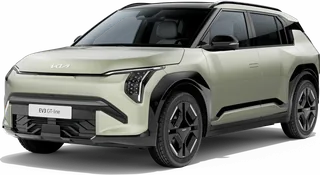
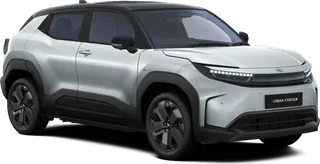
Kia EV3 vs Toyota Urban Cruiser
Better figure, where one is clearly better
| KiaEV3 | ToyotaUrban Cruiser | |
|---|---|---|
| Overview | ||
| Released | August 2024 | December 2025 |
| Performance | ||
| Powertrain | Electric | Electric |
| Power | 201 bhp (better) | 142–172 bhp |
| 0–62 mph | 7.5–7.7 s (better) | 8.7–9.6 s |
| Top speed | 105 mph (better) | 93 mph |
| Engine or motors | Single front permanent-magnet synchronous motor, 150 kW (201 bhp) | Single front permanent-magnet synchronous motor, 142 bhp (144 DIN hp, 106 kW) with the 49 kWh battery or 172 bhp (174 DIN hp, 128 kW) with the 61 kWh battery; lithium iron phosphate batteries of 49 kWh (96 cells, 305 V) or 61 kWh (120 cells, 381 V; 60 kWh usable) |
| Torque | 283 Nm | 193 Nm |
| Gearbox | Single-speed automatic | Single-speed automatic |
| Drive | Front-wheel drive | Front-wheel drive |
| Range and charging | ||
| Zero-emission range (WLTP) | 270–375 miles (better) | 213–264 miles |
| Battery | 58.3–81.4 kWh (better) | 60 kWh |
| Fastest charging | 101–128 kW (better) | 53–67 kW |
| Range detail | WLTP combined: 270 miles (58.3 kWh); 361–375 miles (81.4 kWh) depending on trim and wheels; WLTP city up to 479 miles | WLTP combined: 213 miles (49 kWh Icon); 264 miles (61 kWh Design and Excel) |
| Charging | 10–80% DC in 29 minutes at 101 kW (58.3 kWh) or 31 minutes at 128 kW (81.4 kWh); 10–100% on 11 kW AC in 5 h 20 min or 7 h 15 min | DC peak 53 kW (49 kWh) or 67 kW (61 kWh), 10–80% in about 45 minutes; 11 kW AC |
| Efficiency | – | WLTP combined: 24 kWh/100 miles |
| CO2 emissions | 0 g/km | 0 g/km at the tailpipe |
| Practicality | ||
| Body | SUV | SUV |
| Seats | 5 | 5 |
| Boot | 460 litres (better) | 310 litres |
| Length | 4,310 mm | 4,285 mm |
| Width | 1,850 mm | 1,800 mm |
| Weight | From 1,800 kg | From 1,700 kg |
| Boot | 460 litres with the rear seats up; 25-litre front boot | 310 litres with the rear seats slid forward, 244 litres with them slid back (both to the tonneau cover); 566 litres with the rear seats folded |
| Towing | 500 kg braked (58.3 kWh) or 1,000 kg (81.4 kWh) | 750 kg |
| Size | 4,310 mm long, 1,850 mm wide, 1,570 mm high; 2,680 mm wheelbase; 10.4 m turning circle | 4,285 mm long, 1,800 mm wide (2,065 mm with mirrors), 1,635 mm high; 2,700 mm wheelbase; 5.2 m turning radius (tyres); kerb weight 1,700–1,742 kg (49 kWh), 1,760–1,839 kg (61 kWh) |
| Tech and safety | ||
| Infotainment | – | 10.1-inch multimedia touchscreen and 10.25-inch digital driver's display; JBL audio and wireless phone charger on Excel |
| Driver assistance | – | Pre-Collision System, Adaptive Cruise Control, Lane Trace Assist, Road Sign Assist, Blind Spot Monitor and rear-view camera on all versions; Panoramic View Monitor and Adaptive High-beam System on Excel |
| Warranty | 7 years or 100,000 miles (3 years unlimited mileage); battery 8 years or 100,000 miles | 3 years or 60,000 miles; battery 8 years or 100,000 miles, extendable to 10 years or 650,000 miles with an annual EV Care battery health check |