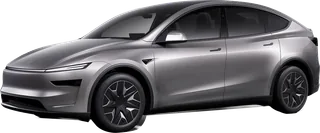
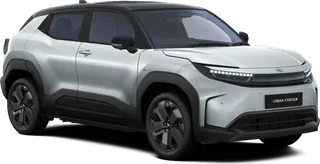
Tesla Model Y L vs Toyota Urban Cruiser
Better figure, where one is clearly better
| TeslaModel Y L | ToyotaUrban Cruiser | |
|---|---|---|
| Overview | ||
| Released | September 2025 | December 2025 |
| Performance | ||
| Powertrain | Electric | Electric |
| Power | – | 142–172 bhp |
| 0–62 mph | 4.5–5 s (better) | 8.7–9.6 s |
| Top speed | – | 93 mph |
| Engine or motors | Dual-motor all-wheel drive. US Premium AWD: Tesla publishes 4.4 seconds 0–60 mph, which is not a 0–62 mph figure. | Single front permanent-magnet synchronous motor, 142 bhp (144 DIN hp, 106 kW) with the 49 kWh battery or 172 bhp (174 DIN hp, 128 kW) with the 61 kWh battery; lithium iron phosphate batteries of 49 kWh (96 cells, 305 V) or 61 kWh (120 cells, 381 V; 60 kWh usable) |
| Torque | – | 193 Nm |
| Gearbox | – | Single-speed automatic |
| Drive | Dual-motor all-wheel drive. Second-row captain's chairs and two third-row seats form a 2–2–2 seating layout. | Front-wheel drive |
| Range and charging | ||
| Zero-emission range (WLTP) | 423 miles (better) | 213–264 miles |
| Battery | – | 60 kWh |
| Fastest charging | 250 kW (better) | 53–67 kW |
| Range detail | Australian Premium AWD is rated at 681 km WLTP (423 miles). Tesla China's current October 2026 specification states 776 km CLTC; the original 2025 launch version was rated at 751 km CLTC. CLTC figures are not placed in the WLTP comparison row. Tesla's September 2025 first-delivery announcement is reported directly by CnEVPost; Australian sales followed in March 2026. Regional 0–100 km/h claims are 5.0 seconds in Australia and 4.5 seconds in China. United States: 332 miles EPA estimated, which is not a WLTP result and is therefore omitted from the structured range field. | WLTP combined: 213 miles (49 kWh Icon); 264 miles (61 kWh Design and Excel) |
| Charging | Up to 250 kW DC Supercharging. Tesla's current Chinese page confirms external power with the Tesla Outlet Adapter; the Australian page also lists this feature. Tesla does not publish usable battery capacity on these product pages. | DC peak 53 kW (49 kWh) or 67 kW (61 kWh), 10–80% in about 45 minutes; 11 kW AC |
| Efficiency | – | WLTP combined: 24 kWh/100 miles |
| CO2 emissions | – | 0 g/km at the tailpipe |
| Practicality | ||
| Body | SUV | SUV |
| Seats | 6 (better) | 5 |
| Boot | 420 litres (better) | 310 litres |
| Length | 4,969 mm | 4,285 mm |
| Width | 1,920 mm | 1,800 mm |
| Weight | From 2,088 kg | From 1,700 kg |
| Boot | 420 litres behind the third row with all six seats up; 1,076 litres with the third row folded; 2,423 litres with both rear rows folded. Separate front boot is 116 litres. The advertised 2,539-litre maximum includes the front boot; total with all six passengers is 536 litres (Tesla owner's manual). | 310 litres with the rear seats slid forward, 244 litres with them slid back (both to the tonneau cover); 566 litres with the rear seats folded |
| Towing | – | 750 kg |
| Size | Australian product page lists 4,969 mm length, 1,668 mm height and 2,088 kg weight; Chinese page lists 4,976 mm length, 1,668 mm height and the same weight. Width excluding mirrors is 1,920 mm; folded mirrors 1,982 mm; extended mirrors 2,129 mm; wheelbase 3,040 mm (Tesla manual). Product pages give 169 mm ground clearance; the Hong Kong manual gives 166 mm unladen and 118 mm laden and a different 1,664 mm height. Values vary by region/configuration. Standard 19-inch wheels; continuous variable damping adjusts suspension to road conditions. US maker specifications use 195.6 inches length, 65.7 inches height and 4,612 lb curb mass; these regional figures are not substituted into the metric Australian headline. | 4,285 mm long, 1,800 mm wide (2,065 mm with mirrors), 1,635 mm high; 2,700 mm wheelbase; 5.2 m turning radius (tyres); kerb weight 1,700–1,742 kg (49 kWh), 1,760–1,839 kg (61 kWh) |
| Tech and safety | ||
| Infotainment | 16-inch centre touchscreen and 8-inch second-row touchscreen; 19-speaker Tesla Audio. Second-row seats have heating, ventilation, powered armrests and electric folding; third-row seats have heating and electric folding, with separate air vents. No Apple CarPlay or Android Auto (Carsales). | 10.1-inch multimedia touchscreen and 10.25-inch digital driver's display; JBL audio and wireless phone charger on Excel |
| Driver assistance | Forward Collision Warning, Automatic Emergency Braking and Lane Departure Avoidance are standard. Optional Full Self-Driving (Supervised) requires active driver supervision and does not make the car autonomous; availability depends on region. | Pre-Collision System, Adaptive Cruise Control, Lane Trace Assist, Road Sign Assist, Blind Spot Monitor and rear-view camera on all versions; Panoramic View Monitor and Adaptive High-beam System on Excel |
| Warranty | Australian new-vehicle warranty is five years with unlimited kilometres, subject to terms, for vehicles delivered from 1 January 2026; battery and drive unit eight years or 192,000 km. China lists four years or 80,000 km for the vehicle and eight years or 192,000 km for the battery and drive unit. | 3 years or 60,000 miles; battery 8 years or 100,000 miles, extendable to 10 years or 650,000 miles with an annual EV Care battery health check |
More comparisons
- BMW iX5 vs Tesla Model Y L
- Tesla Model Y L vs Toyota bZ4X Touring
- Kia EV3 vs Toyota Urban Cruiser
- Škoda Enyaq vs Toyota Urban Cruiser
- Tesla Model Y L vs Toyota bZ4X (2025)
- Tesla Model Y (2025) vs Tesla Model Y L
- Tesla Model X (2025) vs Tesla Model Y L
- Audi Q6 Sportback e-tron vs Tesla Model Y L
- Tesla Model Y (2020) vs Tesla Model Y L
- Škoda Enyaq vs Tesla Model Y L
- Tesla Model Y L vs Toyota Proace Verso