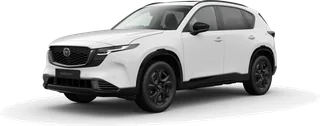
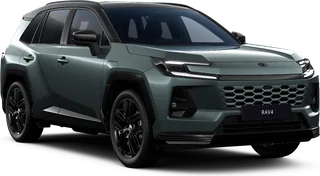
Mazda CX-5 vs Toyota RAV4
Better figure, where one is clearly better
| MazdaCX-5 | ToyotaRAV4 | |
|---|---|---|
| Overview | ||
| Released | August 2026 | May 2026 |
| Performance | ||
| Powertrain | Mild hybrid | Plug-in hybrid |
| Power | 138 bhp | 268–305 bhp (better) |
| 0–62 mph | 10.5 s | 5.8–7.5 s (better) |
| Top speed | 116 mph (better) | 112 mph |
| Engine or motors | 2.5-litre e-Skyactiv G four-cylinder petrol with 24V Mazda M Hybrid mild hybrid and cylinder deactivation, 141 PS (103 kW); bhp converted from kW | 2.5-litre four-cylinder petrol (141 bhp) with front motor (151.4 kW); AWD-i adds a 40.7 kW rear motor; system output 268 bhp (272 DIN hp, 201 kW) FWD or 305 bhp (309 DIN hp, 227 kW) AWD-i |
| Torque | 238 Nm | Engine 227 Nm; front motor 272 Nm; rear motor 122.6 Nm (AWD-i) |
| Gearbox | 6-speed automatic | CVT (shift-by-wire) |
| Drive | Front-wheel drive; all-wheel drive on Exclusive-Line and Homura (Mazda UK press release; Mazda's UK site doesn't yet list figures for it) | Front-wheel drive (Icon, Design, Excel) or AWD-i all-wheel drive (Design, Excel, GR Sport) |
| Range and charging | ||
| Zero-emission range (WLTP) | – | 83–85 miles |
| Fastest charging | – | 35 kW |
| Economy (WLTP) | 40.4 mpg | 176.6–217.3 mpg (better) |
| Range detail | – | WLTP electric range: up to 85 miles (FWD), up to 83 miles (AWD-i) |
| Charging | – | 22.7 kWh lithium-ion battery; 11 kW AC; 35 kW DC (10–80% in 28 minutes) |
| Efficiency | WLTP combined 40.4 mpg (7.0 l/100 km); low 39.2, medium 47.9, high 42.2, extra high 30.7 mpg | WLTP weighted combined: 217.3 mpg (Icon), 166.2 mpg (Design, Excel FWD), 176.6 mpg (Excel AWD-i, GR Sport) |
| CO2 emissions | 157 g/km (WLTP combined) | 30–39 g/km weighted combined; 117–131 g/km in charge-sustaining mode (WLTP) |
| Practicality | ||
| Body | SUV | SUV |
| Seats | 5 | 5 |
| Boot | 583 litres | 672 litres (better) |
| Length | 4,690 mm | 4,600 mm |
| Width | 1,860 mm | 1,855 mm |
| Weight | – | From 1,920 kg |
| Boot | 583 litres with the rear seats up (including underfloor storage, to the belt line); 2,019 litres with them folded; 40:20:40 split rear seat | 672 litres with the rear seats in place; 1,189 litres folded to the tonneau cover, 1,690 litres to the roof |
| Towing | 2,000 kg braked (12% gradient), 750 kg unbraked | 800 kg braked (FWD), 2,000 kg (AWD-i); 750 kg unbraked |
| Size | 4,690 mm long, 1,860 mm wide (without mirrors), 1,690 mm high; 2,815 mm wheelbase; 12.0 m turning circle (wall to wall); 205 mm ground clearance; Mazda doesn't list a kerb weight on its UK site | 4,600 mm long, 1,855 mm wide (1,880 mm GR Sport), 1,700 mm high; 2,690 mm wheelbase; kerb weight 1,920–1,990 kg (FWD), 1,980–2,060 kg (AWD-i); drag coefficient 0.35 |
| Tech and safety | ||
| Infotainment | 12.9-inch touchscreen (15.6-inch on Homura) with Google built-in, wired Apple CarPlay and Android Auto, DAB, 8 speakers (12-speaker Bose on Exclusive-Line and Homura); 10.25-inch driver display | 12.9-inch multimedia touchscreen on the Arene software platform; 12.3-inch digital instrument display |
| Warranty | – | 3 years or 60,000 miles |
| Driver assistance | Mazda Radar Cruise Control with Stop & Go, Emergency Lane-Keeping, Blind Spot Monitoring with Rear Cross Traffic Alert, Front Cross Traffic Alert, Smart Brake Support front and rear, Driver Attention Alert, front and rear parking sensors and reversing camera on every grade | – |
| Safety rating | Euro NCAP 5 stars (as stated by Mazda UK) | – |
More comparisons
- Mazda CX-5 vs Toyota Yaris Cross
- Mazda CX-5 vs Volkswagen T-Roc
- Mazda CX-5 vs Vauxhall Frontera
- Audi Q9 vs Toyota RAV4
- Audi Q7 vs Toyota RAV4
- Mercedes-Benz GLB vs Toyota RAV4
- Audi Q3 vs Toyota RAV4
- Audi Q3 Sportback vs Toyota RAV4
- Toyota RAV4 vs Toyota RAV4 (2019)
- Mercedes-Benz CLA Shooting Brake vs Toyota RAV4