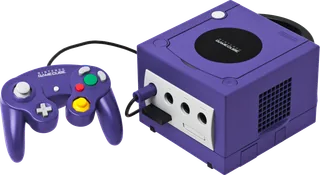
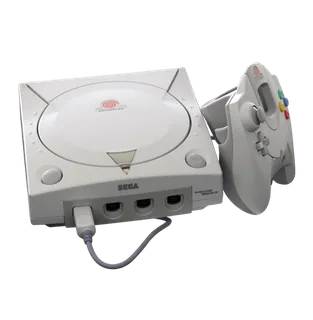
Nintendo GameCube vs SEGA Dreamcast
Better figure, where one is clearly better
| NintendoGameCube | SEGADreamcast | |
|---|---|---|
| Overview | ||
| Released | May 2002 | October 1999 |
| Performance | ||
| Type | Home console | Home console |
| CPU | IBM Gekko (PowerPC), 485 MHz | Hitachi SH-4, 200 MHz |
| GPU | ATI Flipper, 162 MHz | NEC PowerVR2 DC |
| Memory | 40 MB (better) | 24 MB |
| Disc drive | Yes | Yes |
| CPU | IBM Gekko (PowerPC-based) at 485 MHz (Nintendo UK) | SH4 128-bit graphics-engine RISC CPU at 200 MHz, 360 MIPS, 1.4 GFLOPS |
| GPU | ATI/Nintendo Flipper at 162 MHz, with 2 MB frame buffer and 1 MB texture cache (Nintendo UK) | PowerVR2 DC, over 3 million polygons per second; bump mapping, fog, alpha blending, mip mapping, trilinear filtering, anti-aliasing, environment mapping |
| Memory detail | 40 MB system memory (24 MB 1T-SRAM main memory plus 16 MB auxiliary DRAM); Flipper also has 3 MB embedded graphics memory (Nintendo UK) | 16 MB main memory, 8 MB texture (video) memory, 2 MB sound memory |
| Storage detail | GameCube Game Discs (8 cm, miniDVD-based, up to 1.5 GB); saves on GameCube memory cards (two slots) | GD-ROM drive (about 1 GB per disc), up to 12× speed; saves on the VMU (Visual Memory) |
| Storage expansion | Serial ports for the broadband or modem adapter; Hi-Speed port underneath for the Game Boy Player | – |
| Display and video | ||
| Maximum output | 576i | 480p |
| Built-in screen | No built-in screen | No built-in screen |
| Video output | Analogue AV out (composite or RGB SCART); DOL-001 also has Digital AV out, but PAL games offer 576i or 480i rather than native 480p | AV out (composite, S-Video, RGB SCART); 640 × 480 progressive VGA through a separately sold adaptor, in supported games (ConsoleMods) |
| Audio | Analogue stereo; 16-bit Macronix DSP with 64 channels at 48 kHz (Nintendo UK) | Super Intelligent Sound Processor with a 32-bit RISC CPU, 64 channels PCM/ADPCM |
| Design and power | ||
| Weight | 1,400 g (better) | 1,500 g |
| Power use | 39 W AC adapter rating (12 V × 3.25 A; Nintendo UK) | – |
| Connections | ||
| Ports | 4 × controller ports, 2 × memory card slots, analogue and digital AV outputs, 2 × high-speed serial ports, 1 × high-speed parallel port (Nintendo UK) | 4 × controller ports, AV out, serial port, removable 33.6 kbit/s modem (SEGA hardware outline) |
| Controller | GameCube controller; WaveBird wireless controller sold separately | Dreamcast controller with analogue stick, analogue triggers and two slots for the VMU and other expansion units |