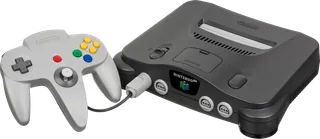
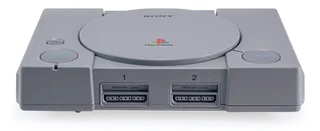
Nintendo Nintendo 64 vs Sony PlayStation
Better figure, where one is clearly better
| NintendoNintendo 64 | SonyPlayStation | |
|---|---|---|
| Overview | ||
| Released | March 1997 | September 1995 |
| Performance | ||
| Type | Home console | Home console |
| CPU | NEC VR4300 (64-bit), 93.75 MHz | MIPS R3000A-compatible, 33.87 MHz |
| GPU | SGI Reality Coprocessor (RCP), 62.5 MHz | PlayStation GPU |
| Memory | 4 MB (better) | 3 MB |
| Disc drive | No | Yes |
| CPU | NEC VR4300 (MIPS R4300 family, 64-bit) at 93.75 MHz | Custom 32-bit R3000A-based CPU at 33.8688 MHz; a Geometry Transformation Engine coprocessor handles 3D calculations (Sony developer manual) |
| GPU | Reality Coprocessor at 62.5 MHz, with signal and display processors for graphics and audio | PlayStation GPU with textured and Gouraud-shaded polygons; up to 360,000 polygons per second (Sony) |
| Memory detail | 4 MB Rambus RDRAM, shared; 8 MB with the Expansion Pak | 2 MB main RAM, 1 MB video RAM, 512 KB sound RAM and a 512 KB operating system ROM (Sony developer manual) |
| Storage detail | Nintendo 64 Game Paks (cartridges); some games save on the cartridge, others on a Controller Pak | Double-speed (2×) CD-ROM drive; saves on removable 128 KB memory cards (two slots) |
| Storage expansion | Memory expansion slot (Expansion Pak); Controller Pak slot in each controller | – |
| Display and video | ||
| Maximum output | 576i | – |
| Built-in screen | No built-in screen | No built-in screen |
| Video output | Multi AV out with composite video; some PAL revisions also support S-Video with the correct cable, but stock consoles do not output RGB; up to 576i on PAL consoles | AV Multi Out for composite and RGB; separate composite video and stereo audio RCA outputs on the original SCPH-1002 |
| Audio | Stereo audio mixed by the Reality Signal Processor | 16-bit Sony sound processor, 24 ADPCM channels at up to 44.1 kHz; analogue stereo out; plays audio CDs |
| Design and power | ||
| Weight | 1,100 g | – |
| Power use | Power supply provides 12 V and 3.3 V DC | – |
| Connections | ||
| Ports | 4 × controller ports, Multi AV out, memory expansion slot, extension port underneath | 2 × controller ports and 2 × memory card slots on the front; serial I/O, parallel I/O and AV Multi Out on the back (serial and parallel ports dropped on later models) |
| Controller | Nintendo 64 controller with analogue Control Stick, Z trigger and Controller Pak slot | PlayStation controller at launch; later bundles came with the DUALSHOCK analogue controller |
More comparisons
- Sony PlayStation vs Sony PlayStation 5 Pro
- Sony PlayStation vs Sony PlayStation Portal
- Sony PlayStation vs Sony PlayStation 5 Slim
- Sony PlayStation vs Sony PlayStation 5
- Sony PlayStation vs Sony PlayStation 4 Pro
- Sony PlayStation vs Sony PlayStation 4 Slim
- Sony PlayStation vs Sony PlayStation 4 (CUH-1200)
- Sony PlayStation vs Sony PlayStation 4
- Nintendo GameCube vs Nintendo Nintendo 64
- Sony PlayStation vs Sony PlayStation 2
- Nintendo Nintendo 64 vs Sony PS one
- Sony PlayStation vs Sony PS one
- Nintendo Nintendo 64 vs SEGA Saturn
- SEGA Saturn vs Sony PlayStation
- Nintendo Super Nintendo Entertainment System (SNES) vs Sony PlayStation