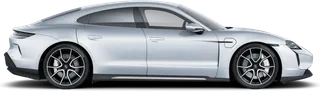
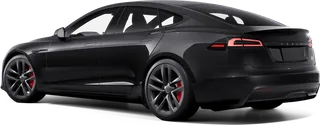
Porsche Taycan vs Tesla Model S (2021)
Better figure, where one is clearly better
| PorscheTaycan | TeslaModel S (2021) | |
|---|---|---|
| Overview | ||
| Released | December 2019 | June 2021 |
| Performance | ||
| Powertrain | Electric | Electric |
| Power | 429–1,019 bhp | 676–1,019 bhp |
| 0–62 mph | 2.3–4.8 s (better) | 3.2 s |
| Top speed | 143–180 mph (better) | 155–175 mph |
| Engine or motors | Overboost power with Launch Control: 320 kW / 435 PS (Taycan, Performance Battery Plus; 300 kW with the standard battery), 440 kW / 598 PS (4S, Performance Battery Plus; 400 kW standard battery), 515 kW (GTS), 650 kW (Turbo), 700 kW (Turbo S), 760 kW (Turbo GT); bhp converted from these kW figures; 0–62 mph with Launch Control | Tesla’s 2021+ owner guide specifies permanent-magnet synchronous motors at both axles, with two carbon-fibre-wrapped rear motors on Plaid. The listed later European EV Database versions have 504 kW and 760 kW, converted to 676 and 1,019 bhp; these are not asserted as every launch-market specification. |
| Gearbox | – | Single-speed fixed gear; front 7.56:1, rear 9.04:1 (Plaid 7.56:1) |
| Torque | With Launch Control: 420 Nm (Taycan), 710 Nm (4S), 790 Nm (GTS), 890 Nm (Turbo), 1,110 Nm (Turbo S), 1,240 Nm (Turbo GT) | – |
| Drive | Rear-wheel drive (Taycan); all-wheel drive on the other versions | All-wheel drive |
| Range and charging | ||
| Zero-emission range (WLTP) | 347–434 miles (better) | 373–403 miles |
| Fastest charging | 320 kW (better) | 250 kW |
| Range detail | WLTP combined (model range, both batteries): 372–434 miles (Taycan), 352–400 (4S), 352–394 (GTS), 355–394 (Turbo), 356–393 (Turbo S), 337–347 miles (Turbo GT); the highest figure is shown for each | WLTP combined ratings for EV Database’s European 2024–2025 versions: 394–403 miles Dual Motor, depending on wheels, and 373 miles Plaid. Plaid’s maker-reported 2.1-second 0–62 mph claim excludes rollout; the database’s adjusted 2.4-second figure is estimated and omitted from the main field. |
| Charging | Standard battery 89.0 kWh gross with up to 270 kW DC; Performance Battery Plus 105.0 kWh gross with up to 320 kW DC; 10–80% in 18 minutes | EV Database lists 11 kW AC for the specified European versions. Car and Driver’s actual 2021 Plaid charging test reached 250 kW for about five minutes. Dual Motor’s database DC limit and both usable battery capacities are marked estimates and omitted. Tesla’s owner guide specifies 407 V nominal voltage. |
| Efficiency | 2.9–3.8 mi/kWh (WLTP combined, model range) | WLTP rated 282 Wh/mile (Dual Motor), 301 Wh/mile (Plaid) (EV Database) |
| CO2 emissions | 0 g/km | 0 g/km |
| Practicality | ||
| Body | Saloon | Saloon |
| Seats | 5 | 5 |
| Boot | 407 litres | 709 litres (better) |
| Length | 4,963 mm | 5,021 mm |
| Width | 1,966 mm | 1,987 mm |
| Weight | From 2,165 kg | – |
| Boot | 407 litres rear (366 litres GTS, Turbo and Turbo S; 326 litres Turbo GT) plus 81 litres at the front. Sport Turismo and Cross Turismo estates are also sold | Tesla’s GB 2021+ guide: 709 litres behind the rear seats, 1,739 litres with them folded, and a separate 89-litre front boot. The 1,828-litre combined maximum includes the front boot. |
| Size | 4,962–4,968 mm long, 1,966 mm wide (1,998 mm Turbo GT); EC unladen weight from 2,165 kg (Taycan, standard battery) | 5,021 mm long, 1,987 mm wide (2,189 mm with mirrors), 1,431 mm high with the air suspension at medium; 2,960 mm wheelbase; 12.3 m turning circle (Tesla owner's manual) |
| Release and generation details | – | Tesla confirms redesigned Model S deliveries began in Q2 2021; contemporaneous Reuters reporting confirms June customer handovers. Tesla’s January 2021 update explicitly says the Performance versions of Model S and Model X were replaced by tri-motor Plaid, supporting the link to the preceding 2019 generation without suggesting all versions immediately ceased sale. Auto Express tested UK left-hand-drive stock offered in 2023. Later configurations here precede the separate 2025 physical refresh. |
| Tech and safety | ||
| Infotainment | – | Centre touchscreen, driver display and a rear touchscreen; yoke or steering wheel; no Apple CarPlay or Android Auto |
| Safety rating | – | Euro NCAP 5 stars (2022): adult occupant 94%, child occupant 91%, vulnerable road users 85%, safety assist 98% |
More comparisons
- Tesla Model S (2021) vs Tesla Model S (2025)
- Mercedes-Benz EQS Saloon vs Tesla Model S (2021)
- Audi e-tron GT vs Tesla Model S (2021)
- Tesla Model S (2019) vs Tesla Model S (2021)
- Tesla Model S (2016) vs Tesla Model S (2021)
- Tesla Model S (2012) vs Tesla Model S (2021)
- Porsche Taycan vs Tesla Model 3 (2020 refresh)
- Porsche Taycan vs Tesla Model S (2019)
- Porsche Taycan vs Tesla Model 3 (2017)
- Porsche Taycan vs Tesla Model S (2016)