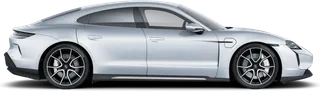
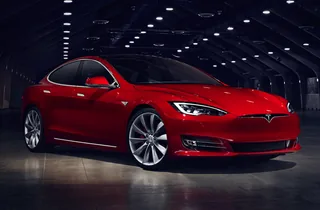
Porsche Taycan vs Tesla Model S (2016)
Better figure, where one is clearly better
| PorscheTaycan | TeslaModel S (2016) | |
|---|---|---|
| Overview | ||
| Released | December 2019 | 2016 |
| Performance | ||
| Powertrain | Electric | Electric |
| Power | 429–1,019 bhp (better) | 315–605 bhp |
| 0–62 mph | 2.3–4.8 s (better) | 2.7–5.8 s |
| Top speed | 143–180 mph (better) | 130–155 mph |
| Engine or motors | Overboost power with Launch Control: 320 kW / 435 PS (Taycan, Performance Battery Plus; 300 kW with the standard battery), 440 kW / 598 PS (4S, Performance Battery Plus; 400 kW standard battery), 515 kW (GTS), 650 kW (Turbo), 700 kW (Turbo S), 760 kW (Turbo GT); bhp converted from these kW figures; 0–62 mph with Launch Control | Configuration power figures are from EV Database: 235 kW (60 and 75), 245 kW (60D), 350 kW (later 75D), 311 kW (90D), 345 kW (P90D), 397 kW (P90D Ludicrous) and 451 kW (100D), converted to bhp. Its P100D power is explicitly estimated and is omitted. These represent the listed configurations during their production periods, not a single launch specification. |
| Gearbox | – | Single-speed fixed gear |
| Torque | With Launch Control: 420 Nm (Taycan), 710 Nm (4S), 790 Nm (GTS), 890 Nm (Turbo), 1,110 Nm (Turbo S), 1,240 Nm (Turbo GT) | – |
| Drive | Rear-wheel drive (Taycan); all-wheel drive on the other versions | Rear-wheel drive on 60 and 75; front and rear motors with all-wheel drive on D versions |
| Range and charging | ||
| Zero-emission range (WLTP) | 347–434 miles | – |
| Fastest charging | 320 kW (better) | 120–145 kW |
| Range detail | WLTP combined (model range, both batteries): 372–434 miles (Taycan), 352–400 (4S), 352–394 (GTS), 355–394 (Turbo), 356–393 (Turbo S), 337–347 miles (Turbo GT); the highest figure is shown for each | These versions use NEDC rather than WLTP. EV Database lists 249 miles (60), 254 miles (60D), 298 miles (75), 304 miles (75D), 557 km (90D), 509 km (P90D), 316 miles (P90D Ludicrous) and 393 miles (100D). No NEDC or estimated real-world range is placed in the WLTP comparison field. |
| Charging | Standard battery 89.0 kWh gross with up to 270 kW DC; Performance Battery Plus 105.0 kWh gross with up to 320 kW DC; 10–80% in 18 minutes | Maximum DC charging figures are from EV Database: 120 kW for the listed 60–90 kWh configurations and 145 kW for 100D/P100D; output varies during charging. Tesla confirms that the 2016 60 and 60D had batteries upgradeable to 75 kWh by a paid software update. Model badges are not usable battery capacities, and EV Database’s estimated usable capacities are omitted. |
| Efficiency | 2.9–3.8 mi/kWh (WLTP combined, model range) | – |
| CO2 emissions | 0 g/km | – |
| Practicality | ||
| Body | Saloon | Saloon |
| Seats | 5 | 5 |
| Boot | 407 litres | – |
| Length | 4,963 mm | 4,970 mm |
| Width | 1,966 mm | 1,964 mm |
| Weight | From 2,165 kg | – |
| Boot | 407 litres rear (366 litres GTS, Turbo and Turbo S; 326 litres Turbo GT) plus 81 litres at the front. Sport Turismo and Cross Turismo estates are also sold | – |
| Size | 4,962–4,968 mm long, 1,966 mm wide (1,998 mm Turbo GT); EC unladen weight from 2,165 kg (Taycan, standard battery) | Tesla’s historical 2012–2020 North American manual gives 4,970 mm length, 1,964 mm width without mirrors, 2,189 mm with mirrors and 2,960 mm wheelbase. Its software documentation is updated, so features must be checked against the vehicle’s build date and options. |
| Tech and safety | ||
| Infotainment | – | 17-inch portrait centre touchscreen and a separate instrument display. The April 2016 hardware update included a new front fascia, adaptive headlights and access to optional HEPA filtration. Autopilot hardware and software differ by build date and purchased options. |
More comparisons
- Tesla Model S (2016) vs Tesla Model S (2025)
- Porsche Taycan vs Tesla Model S (2021)
- Tesla Model S (2016) vs Tesla Model S (2021)
- Porsche Taycan vs Tesla Model 3 (2020 refresh)
- Porsche Taycan vs Tesla Model S (2019)
- Porsche Taycan vs Tesla Model 3 (2017)
- Tesla Model S (2016) vs Tesla Model S (2019)
- Tesla Model 3 (2017) vs Tesla Model S (2016)
- Tesla Model S (2012) vs Tesla Model S (2016)
- Tesla Model S (2016) vs Tesla Model X (2015)