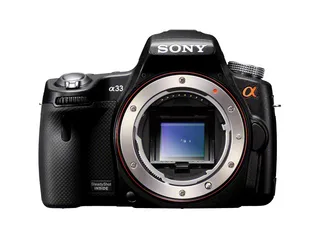
Sony Alpha 1 II vs Sony Alpha SLT-A33
Better figure, where one is clearly better
| SonyAlpha 1 II | SonyAlpha SLT-A33 | |
|---|---|---|
| Overview | ||
| Released | December 2024 | September 2010 |
| Image and sensor | ||
| Camera type | Mirrorless | Translucent mirror |
| Sensor format | Full frame | APS-C |
| Sensor type | Stacked Exmor RS CMOS with integral memory | Exmor APS HD CMOS |
| Sensor dimensions | 35.9 × 24 mm | 23.4 × 15.6 mm |
| Effective resolution | 50.1 MP | 14.2 MP |
| Largest image | 8640 × 5760 | 4592 × 3056 |
| RAW recording | Yes | Yes |
| Standard ISO range | 100–32000 | 100–12800 |
| Sensor detail | Approximately 50.5 million total pixels; Pixel Shift Multi Shooting uses four or 16 exposures combined in compatible computer software. | 14.6 million total photosites; fixed translucent mirror directs light to a separate phase-detection AF sensor while the main sensor supplies live view |
| Image formats | JPEG, HEIF and Sony ARW 5.0 RAW. | JPEG, RAW (Sony ARW 2.2) and RAW+JPEG; 3:2 or 16:9 stills; Sweep Panorama and 3D MPO panorama recording |
| ISO detail | Standard ISO 100–32000 for stills and movies; stills expand to ISO 50–102400. | Auto ISO 100–1600; multi-frame noise reduction extends sensitivity to ISO 25600; movie Auto ISO 100–1600 |
| Image processor | BIONZ XR and dedicated AI processing unit. | BIONZ |
| Lens and shooting | ||
| Lens mount | Sony E-mount | Sony A-mount |
| Stabilisation | Sensor shift | Sensor shift |
| Maximum continuous burst | 30 fps | 7 fps |
| Lens detail | – | Compatible Sony, Minolta and Konica Minolta A-mount AF lenses; kit lenses are separate from body specifications |
| Autofocus | Up to 759 phase-detection points for stills and movies; sensitivity EV −4 to 20 in AF-S with an F2 lens at ISO 100. Automatic or selected recognition of people, animals, birds, insects, cars, trains and aircraft. Sony's current feature page specifies Real-time Recognition AF+ from firmware version 4.00; launch reviews describe earlier firmware. | 15-point phase-detection AF with three cross sensors; EV −1–18 at ISO 100; single-shot, automatic and continuous AF, manual focus and Eye-Start AF |
| Shutter | – | 1/4000–30 seconds and Bulb; flash sync 1/160 second |
| Burst detail | Up to 30 fps electronic Hi+ with AF/AE tracking under compatible-lens and maker conditions; uncompressed or lossless-compressed RAW up to 20 fps; mechanical Hi+ up to 10 fps. Pre-Capture retains up to one second before full shutter press, subject to camera temperature and shooting conditions. A custom button can temporarily change burst speed. | Up to 7 fps in Continuous Advance Priority AE, with focus and exposure adjusted during AF-C according to the maker manual; AF-S fixes focus to the first frame. Ordinary continuous drive reaches 6 fps; its maker buffer figures are 16 Fine JPEG, 20 Standard JPEG, seven RAW or seven RAW+JPEG frames. PhotographyBlog's exposure-lock description conflicts with the manual. |
| Stabilisation detail | Five-axis sensor shift; centre 8.5 stops and periphery 7.0 stops under CIPA 2024 pitch/yaw/roll conditions with FE 50mm F1.2 GM and long-exposure noise reduction off. Active and Dynamic Active movie modes narrow the field of view and are unavailable in 8K or at frame rates of 120 fps or higher. | SteadyShot INSIDE sensor-shift system; maker claim approximately 2.5–4 stops depending on lens and conditions |
| Flash | – | Automatic pop-up flash, guide number 10 in metres at ISO 100; ADI and pre-flash TTL control; compatible external flash required for wireless flash and high-speed sync |
| Exposure controls | – | PASM, Auto, Auto+, scene, panorama and Continuous Advance Priority AE modes; 1200-zone main-sensor metering; ±2 EV compensation in 1/3 steps; D-Range Optimizer and three-frame Auto HDR |
| Video | ||
| Highest video resolution | 7680 × 4320 at 30 fps | 1920 × 1080 at 29.97 fps |
| Video detail | Sony's current feature page lists internal 7680 × 4320 30p XAVC HS with 8.6K oversampling and 10-bit 4:2:2 support. Lower-resolution 4K up to 120p has approximately 10% crop; Full HD 240 fps is lower resolution. S-Log3, S-Cinetone and imported LUTs supported; external HDMI RAW is separate from internal recording. | Japan/NTSC specification is 1920 × 1080 AVCHD at 59.94 interlaced fields/s from 29.97 sensor frames/s, approximately 17 Mbps; PAL bodies use 50i from 25 frames/s. MP4 supports 1440 × 1080 and VGA. At 20°C Sony claims approximately 11 minutes of continuous recording with SteadyShot enabled or 29 minutes disabled; higher temperatures shorten this further. |
| Audio | – | Built-in stereo microphone, mono playback speaker and external microphone input |
| Screen and viewfinder | ||
| Viewfinder | Electronic | Electronic |
| Screen size | 3.2″ | 3″ |
| Screen dots | 2,095,104 | 921,600 |
| Touchscreen | Yes | – |
| Tilting screen | Yes | Yes |
| Display detail | Four-axis TFT LCD opens approximately 98° up, 40° down and 180° sideways, with 270° rotation when opened sideways. | Xtra Fine TruBlack LCD; 180° tilt and 270° rotation on a bottom hinge; dots count colour subpixels |
| Viewfinder detail | 0.64-inch Quad-XGA OLED with 9437184 dots and approximately 0.90× magnification with a 50 mm lens at infinity. Selectable 60/120/240 fps; standard magnification is unavailable at 240 fps. | Electronic finder with approximately 100% coverage, 1.10× magnification with a 50 mm lens, and 1,152,000 effective equivalent dots out of 1,440,000 total; electronic level and grid display |
| Connections and design | ||
| Wi-Fi | Yes | – |
| Bluetooth | Yes | – |
| Battery life (maker's claim) | 520 photographs | 270 photographs |
| Body weight | 658 g | 433 g (better) |
| Release detail | Sony UK specifies availability in December 2024; no release day inferred. Exact technical figures use Sony Japan because the UK specification URLs were inaccessible during research. | Sony's US announcement specifies September 2010 retail availability; Sony Japan specifies 10 September 2010. The month is the earliest maker-stated precision found across regions. |
| Recording media | Both slots accept CFexpress 2.0 Type A or UHS-I/UHS-II SD. | Single slot accepting SD, SDHC, SDXC, Memory Stick PRO Duo and PRO-HG Duo |
| Ports | USB Type-C at 10 Gbps, Multi/Micro USB, full-size HDMI, 2.5GBASE-T Ethernet, sync terminal, 3.5 mm microphone and headphone sockets and digital-audio Multi Interface Shoe. | USB 2.0 Hi-Speed, mini HDMI Type C, external microphone input and wired remote terminal; optional infrared remote and AC adaptor |
| Wireless connections | Wi-Fi IEEE 802.11a/b/g/n/ac at 2.4/5 GHz and Bluetooth 5.0. | – |
| Battery life detail | NP-FZ100; Sony Japan CIPA approximately 520 photographs with LCD or 420 with viewfinder. PhotographyBlog's 530/400 figures are not used. USB Type-C Power Delivery charging and power supported. | NP-FW50; CIPA maker claim approximately 270 photographs using the viewfinder or 340 using the LCD |
| Charging | – | Supplied BC-VW1 external battery charger |
| Dimensions | Approximately 136.1 × 96.9 × 82.9 mm (width × height × maximum depth); grip-to-monitor depth 72.8 mm. | Approximately 124.4 × 92 × 84.7 mm (width × height × depth) |
| Weight detail | Approximately 658 g body only or 743 g with battery and memory card, excluding lens. PhotographyBlog's inconsistent 617 g figure is not used. | Approximately 433 g body only; 492 g including battery and Memory Stick PRO Duo |
| Colours | – | Black |
| In the box | One NP-FZ100 battery, BC-ZD1 dual-battery charger, cable protector, shoulder strap, body cap, accessory shoe cap and FDA-EP19/FDA-EP21 eyepiece cups, according to Sony Japan. USB Power Delivery AC adaptor and USB cable are not included. | NP-FW50 battery, BC-VW1 charger, USB cable, shoulder strap, caps and software CD; kit lenses depend on configuration |

More comparisons
- Sony Alpha 1 II vs Sony Alpha 7R VI
- Sony Alpha 7R VI vs Sony Alpha SLT-A33
- Sony Alpha 7 V vs Sony Alpha SLT-A33
- Sony Alpha 1 II vs Sony Alpha 7 V
- Nikon Z 9 vs Sony Alpha 1 II
- Canon EOS R1 vs Sony Alpha 1 II
- Sony Alpha 1 vs Sony Alpha 1 II
- Sony Alpha 1 II vs Sony Alpha 9 III
- Canon EOS R5 Mark II vs Sony Alpha 1 II
- Nikon Z6III vs Sony Alpha 1 II
- Sony Alpha 1 II vs Sony Alpha 7C II
- Sony Alpha 1 II vs Sony Alpha 7CR
- Sony Alpha 1 II vs Sony Alpha 6700
- Sony Alpha 1 II vs Sony Alpha 7R V
- Sony Alpha 1 II vs Sony Alpha 7 IV
- Sony Alpha 1 II vs Sony Alpha 7R III (ILCE-7RM3A)