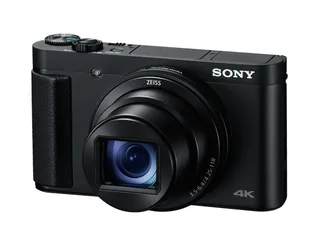
Sony Cyber-shot DSC-HX99 vs Sony Cyber-shot DSC-WX200
Better figure, where one is clearly better
| SonyCyber-shot DSC-HX99 | SonyCyber-shot DSC-WX200 | |
|---|---|---|
| Overview | ||
| Released | October 2018 | 2013 |
| Image and sensor | ||
| Camera type | Compact | Compact |
| Sensor format | 1/2.3-type | 1/2.3-type |
| Sensor type | Back-illuminated Exmor R CMOS | Exmor R CMOS |
| Effective resolution | 18.2 MP | 18.2 MP |
| Largest image | 4896 × 3672 | 4896 × 3672 |
| RAW recording | Yes | No |
| Standard ISO range | 80–3200 | 100–3200 |
| Sensor detail | 1/2.3-type Exmor R CMOS; approximately 21.1 million total photosites. Optical format is not physical sensor dimensions | 1/2.3-type back-illuminated Exmor R CMOS; approximately 18.2 million effective and 18.9 million total photosites. Optical format is not physical dimensions |
| Image formats | Sony ARW 2.3 RAW, RAW+JPEG or JPEG Extra Fine/Fine/Standard; sRGB or Adobe RGB; 4:3, 3:2, 16:9 and square photographs plus Sweep Panorama | JPEG in sRGB, maximum 4896 × 3672 in 4:3 or 4896 × 2752 in 16:9; 3D still images in MPF. Sweep Panorama up to 11520 × 1080 in 360-degree mode or 10480 × 4096 in high-resolution mode |
| ISO detail | Ordinary ISO 80–3200; extended single-frame ISO 6400. Multi-shot Noise Reduction offers ISO 6400 and 12800 using combined exposures | Ordinary settings ISO 100–3200; ISO 6400/12800 use Sony’s pixel-processing technology and overlaid burst exposures rather than ordinary single-exposure sensitivity |
| Image processor | BIONZ X with front-end LSI | BIONZ |
| Lens and shooting | ||
| Built-in lens | 24–720 mm equivalent | 25–250 mm equivalent |
| Maximum aperture | f/3.5–6.4 | f/3.3–5.9 |
| Optical zoom | 28× | 10× |
| Stabilisation | Optical lens stabilisation | Optical lens stabilisation |
| Maximum continuous burst | 10 fps | – |
| Lens detail | ZEISS Vario-Sonnar T*, actual 4.25–118 mm, 11 elements in 10 groups with five aspherical elements; five-blade iris. Maker specifies 28× optical zoom, while 24–720 mm equivalent values are those displayed by the camera and recorded in Exif | Sony G ten-times optical zoom, nine elements in seven groups including four aspherical elements; actual 4.45–44.5 mm. Equivalent 25–250 mm for 4:3 photographs or 27.5–275 mm for 16:9 photographs. Movie 16:9 Standard stabilisation 27.5–275 mm, Active 27.5–385 mm; 4:3 Standard 33.5–335 mm, Active 33.5–469 mm |
| Autofocus | 25-point contrast autofocus, AF-S, Direct Manual Focus and manual focus; AF-C available for movies only. Eye AF, Lock-on AF and flexible spot areas; minimum focus approximately 5 cm wide or 250 cm telephoto | Nine-point multipoint, centre, spot, tracking and face-tracking AF, with AF illuminator; approximately 5 cm minimum focus wide or 150 cm telephoto |
| Shutter | Mechanical shutter: Manual and shutter-priority 30–1/2000 second, aperture-priority 8–1/2000, Program 1–1/2000 and Intelligent Auto 1/4–1/2000 | Intelligent Auto 4–1/1600 second; Program Auto 1–1/1600 second |
| Burst detail | Full-resolution Speed Priority Continuous up to 10 fps, or ordinary Continuous approximately 3 fps. Up to 155 frames in Speed Priority with JPEG Fine; rate falls as buffer fills. Focus, exposure and white balance lock to first frame in either mode | Maximum approximately 10 fps at full resolution for ten frames; this is a brief buffered burst rather than sustained continuous shooting. Some modes prevent burst shooting, and flash reduces its speed |
| Stabilisation detail | Optical SteadyShot for stills; Intelligent Active movies combine optical and electronic correction | Optical SteadyShot for photographs; movie Active mode combines optical and electronic stabilisation and narrows the angle of view. Sony’s launch comparison with WX100 is approximately four times the telephoto correction effect under its test conditions, not a four-stop rating |
| Flash | Built-in pop-up flash; ISO Auto range approximately 0.3–5.4 m wide or 2.5–3.0 m telephoto; no accessory shoe | Built-in fixed front flash with Auto, forced, slow-sync, off and Advanced Flash; ISO Auto range approximately 0.2–3.7 m wide or 1.5–2.2 m telephoto |
| Exposure controls | P/A/S/M and two Memory Recall modes; ±3 EV in 1/3 EV steps; multi-pattern, centre-weighted, spot, entire-screen average and highlight metering | Superior Auto, Intelligent Auto, Easy, Program Auto, scenes, Picture Effects, 3D, Background Defocus and panoramas; ±2 EV in 1/3 EV steps. Wide-angle F3.3/F8 ND-filter aperture settings; no aperture/shutter-priority or manual exposure modes |
| Video | ||
| Highest video resolution | 3840 × 2160 at 30 fps | 1920 × 1080 at 30 fps |
| Video detail | XAVC S 3840 × 2160 at 30p or 24p, 60/100 Mbps; PAL uses 25p. Full-pixel readout without pixel binning. Full HD up to 120p (100p PAL); 4K and 120p/100p HD sessions limited to approximately five minutes, with possible earlier thermal shutdown. Other modes approximately 29 minutes subject to temperature. UHS-I U3 microSDHC/XC required for 100 Mbps | AVCHD 2.0, maximum 1920 × 1080 interlaced at 24 Mbps or 17 Mbps; Japan/NTSC versions use 60 fields/30 frames per second, UK/PAL versions 50 fields/25 frames per second. No 1080p50/60. MP4 options 1440 × 1080 at 12 Mbps, 1280 × 720 at 6 Mbps and VGA at 3 Mbps, at 30 fps NTSC or 25 fps PAL. Approximately 29-minute per-clip limit; MP4 12M reaches the 2 GB file limit at approximately 15 minutes. Optical zoom works during recording |
| Audio | Stereo recording: XAVC S Linear PCM or AVCHD Dolby Digital | – |
| Screen and viewfinder | ||
| Viewfinder | Electronic | None |
| Screen size | 3″ | 2.7″ |
| Screen dots | 921,600 | 460,800 |
| Touchscreen | Yes | No |
| Tilting screen | Yes | No |
| Display detail | 3.0-type 4:3 TFT LCD, 921600 dots; tilts up 180 degrees. Touch focus, touch shutter and touchpad focus while using viewfinder; menus are not touch controlled | Fixed 2.7-type Clear Photo TFT LCD with 460800 dots; no touch panel or viewfinder |
| Viewfinder detail | Retractable 0.2-type OLED, 638400 dots; 100% coverage (97% during 4K recording), 0.50× equivalent magnification, −4 to +3 dioptres | – |
| Connections and design | ||
| Wi-Fi | Yes | Yes |
| Bluetooth | Yes | – |
| Battery life (maker's claim) | 370 photographs | 220 photographs |
| Body weight | 216 g | 105 g (better) |
| Release detail | Sony Switzerland states availability from late October 2018; Sony Hong Kong specifies 26 October locally. October precision retained because the international first-sale day is not established | Released in 2013. Sony’s 16 January Japanese announcement scheduled 25 January availability; the prospective date alone does not establish the actual first on-sale day or month |
| Recording media | microSD, microSDHC, microSDXC and Memory Stick Micro/Mark2; no full-size SD slot | Approximately 48 MB internal memory; SD, SDHC, SDXC, microSD/microSDHC/microSDXC with adapters, Memory Stick Duo/PRO Duo/PRO-HG Duo/XC-HG Duo and Memory Stick Micro with an adapter |
| Ports | Micro HDMI and Multi/Micro USB with USB 2.0 | Multi terminal with USB 2.0 Hi-Speed; micro-HDMI output |
| Wireless connections | 2.4 GHz IEEE 802.11 b/g/n Wi-Fi, NFC Type 3 and Bluetooth for location information from a compatible smartphone; no built-in GPS or compass | Built-in Wi-Fi for smartphone transfer and remote control, compatible TV viewing and computer transfer; PlayMemories Mobile required for smartphone functions. Eye-Fi support; no built-in GPS |
| Battery life detail | NP-BX1; CIPA claim approximately 370 photographs with LCD or 300 with viewfinder. LCD claim rises to 460 with monitor auto-off set to two seconds | Supplied NP-BN; optional NP-BN1. Approximately 220 photographs or 110 minutes under CIPA conditions; approximately 35 minutes actual movie use or 55 minutes continuous movie use, distinct from per-clip limits |
| Charging | In-camera USB charging and USB external power using supplied AC adapter with battery inserted | In-camera USB charging and playback power; shooting power requires optional AC-UD10 according to Sony Japan |
| Dimensions | 102 × 58.1 × 35.5 mm (width × height × depth), CIPA | 92.3 × 52.4 × 21.6 mm (width × height × depth), CIPA compliant; 17.5 mm at the thinnest part |
| Weight detail | Approximately 216 g body only, or 242 g including NP-BX1 and memory card | Approximately 105 g body-only; approximately 121 g including NP-BN and Memory Stick Duo |
| Colours | Black | Silver, black, pink or gold in Japan; regional choices differ |
| In the box | NP-BX1, AC-UB10C adapter, micro USB cable, wrist strap and instructions in Japan; regional mains fittings vary | NP-BN, AC-UB10/UB10B and regional AC-UB10C/UB10D variants, micro-USB cable, wrist strap and instructions |

More comparisons
- Sony Cyber-shot DSC-HX99 vs Sony Cyber-shot DSC-RX100 VII
- Sony Cyber-shot DSC-RX100 VII vs Sony Cyber-shot DSC-WX200
- Sony Cyber-shot DSC-HX90V vs Sony Cyber-shot DSC-HX99
- Sony Cyber-shot DSC-HX80 vs Sony Cyber-shot DSC-HX99
- Sony Cyber-shot DSC-HX50V vs Sony Cyber-shot DSC-HX99
- Sony Cyber-shot DSC-HX99 vs Sony Cyber-shot DSC-WX500
- Sony Cyber-shot DSC-HX350 vs Sony Cyber-shot DSC-HX99
- Sony Cyber-shot DSC-HX400V vs Sony Cyber-shot DSC-HX99
- Sony Cyber-shot DSC-HX60V vs Sony Cyber-shot DSC-HX99
- Sony Cyber-shot DSC-H400 vs Sony Cyber-shot DSC-HX99
- Sony Cyber-shot DSC-HX99 vs Sony Cyber-shot DSC-W800
- Sony Cyber-shot DSC-HX99 vs Sony Cyber-shot DSC-W830
- Sony Cyber-shot DSC-HX99 vs Sony Cyber-shot DSC-WX350
- Sony Cyber-shot DSC-HX300 vs Sony Cyber-shot DSC-HX99
- Sony Cyber-shot DSC-H200 vs Sony Cyber-shot DSC-HX99
- Sony Cyber-shot DSC-HX99 vs Sony Cyber-shot DSC-WX300