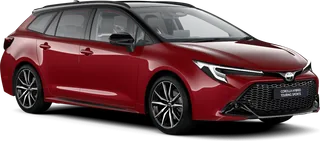
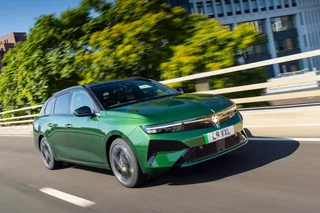
Toyota Corolla Touring Sports vs Vauxhall Astra Sports Tourer
Better figure, where one is clearly better
| ToyotaCorolla Touring Sports | VauxhallAstra Sports Tourer | |
|---|---|---|
| Overview | ||
| Released | February 2019 | February 2022 |
| Performance | ||
| Powertrain | Hybrid | Petrol, Hybrid, Plug-in hybrid, Electric |
| Power | 138–176 bhp | 129–193 bhp (better) |
| 0–62 mph | 7.7–9.4 s | 7.7–10 s |
| Top speed | 111 mph | 105–140 mph (better) |
| Engine or motors | 1.8-litre four-cylinder petrol (2ZR-FXE), 97 bhp (98 DIN hp, 72 kW) at 5,200 rpm, with a 70 kW motor; system output 138 bhp (140 DIN hp, 103 kW). 2.0-litre four-cylinder petrol (M20A-FXS), 130 bhp (131 DIN hp) at 6,000 rpm, with an 83 kW motor; system output 176 bhp (178 DIN hp, 131 kW). Fifth-generation Toyota hybrid system with lithium-ion battery | 1.2-litre three-cylinder turbo petrol, 130PS (96 kW); Hybrid: 1.2 turbo with 48V battery and a 21 kW (28hp) electric motor in the gearbox, 145PS (107 kW); Plug-in Hybrid: 1.6-litre four-cylinder turbo petrol, 150PS (110 kW), with a 92 kW (125PS) electric motor, 144 kW (195PS) combined; Electric: 115 kW (156PS); bhp converted from Vauxhall's kW figures |
| Torque | 1.8: 142 Nm (engine) at 3,600 rpm, 185 Nm (motor); 2.0: 190 Nm (engine) at 4,400 rpm, 206 Nm (motor) | 230 Nm (1.2 petrol and Hybrid), 360 Nm combined (Plug-in Hybrid), 270 Nm (Electric) |
| Gearbox | CVT automatic (e-CVT) | 6-speed manual or 8-speed automatic (130PS), 6-speed e-DCT6 dual-clutch automatic (Hybrid), 7-speed electrified automatic (Plug-in Hybrid), single-speed (Electric) |
| Drive | Front-wheel drive | Front-wheel drive |
| Range and charging | ||
| Zero-emission range (WLTP) | – | 52–275 miles |
| Battery | – | 14–55.4 kWh |
| Fastest charging | – | 100 kW |
| Economy (WLTP) | 61.4–62.7 mpg | 47.9–122.8 mpg (better) |
| Range detail | – | WLTP: Astra Sports Tourer Electric 274–275 miles depending on trim (preliminary); Plug-in Hybrid equivalent all-electric range up to 52 miles (Griffin) or 51 miles (GS and Ultimate). Vauxhall gives one combined figure of 122.8 mpg for the Astra Plug-in Hybrid range. Electric battery 55.4 kWh usable, 58.3 kWh total; Plug-in Hybrid battery 14 kWh usable (Opel), 17.2 kWh total (Vauxhall) |
| Charging | – | Electric: 100 kW DC, 20–80% in 32 minutes; 11 kW three-phase AC on-board charger, 20–80% in 3 h 20 min; vehicle-to-load. Plug-in Hybrid: 3.7 kW AC on-board charger as standard (20–80% in 4 h 6 min), optional 7.4 kW (2 h 53 min) |
| Efficiency | WLTP combined (Toyota UK site): 1.8 57.6–62.7 mpg; 2.0 57.6–61.4 mpg, by grade and wheel size; 43-litre fuel tank | WLTP combined: 47.9–49.6 mpg (130PS manual), 46.3–47.9 mpg (130PS automatic), 56.5–57.6 mpg (Hybrid), 122.8 mpg (Plug-in Hybrid); 19.5–20.1 kWh/100 km (Plug-in Hybrid), 14.8–15.2 kWh/100 km (Electric) |
| CO2 emissions | 101–108 g/km (WLTP combined, by grade) | 129–136 g/km (130PS), 111–114 g/km (Hybrid), 49–52 g/km (Plug-in Hybrid), 0 g/km (Electric), WLTP |
| Practicality | ||
| Body | Estate | Estate |
| Seats | 5 | 5 |
| Boot | 596 litres | – |
| Length | 4,650 mm | 4,642 mm |
| Width | 1,790 mm | – |
| Weight | From 1,400 kg | – |
| Boot | 596 litres (VDA, to the tonneau) with the 1.8 hybrid, 581 litres with the 2.0; 1,606 litres (1.8) or 1,591 litres (2.0) with the rear seats folded, to the roof | 597 litres below the cover, 1,634 litres with the rear seats folded (petrol and Hybrid); 466 and 1,483 litres (Plug-in Hybrid); 516 and 1,553 litres (Electric); ECIE method |
| Towing | 750 kg braked, 450 kg unbraked | 1,200 kg braked (130PS manual), 1,400 kg factory-fit or 1,200 kg retailer-fit (130PS automatic), 1,100 kg (Hybrid), 1,330 kg (Plug-in Hybrid); 600–690 kg unbraked; Electric not approved for towing |
| Size | 4,650 mm long (4,660 mm GR Sport), 1,790 mm wide, 1,460 mm high; 2,700 mm wheelbase; 135 mm ground clearance; 5.2–5.4 m turning radius (tyres); drag coefficient 0.31; kerb weight 1,400–1,480 kg (1.8), 1,440–1,535 kg (2.0) | 4,642 mm long, 2,062 mm wide with mirrors, 1,443 mm high; 2,732 mm wheelbase; 10.71 m turning circle; kerb weight including a 75 kg driver 1,421 kg (130PS automatic), 1,502 kg (Hybrid), 1,736 kg (Plug-in Hybrid), 1,765 kg (Electric); 52-litre fuel tank (42 litres Plug-in Hybrid) |
| Tech and safety | ||
| Infotainment | Toyota Smart Connect+ with 10.5-inch touchscreen, cloud and embedded navigation, voice agent, wireless Apple CarPlay and wired Android Auto, over-the-air updates; 12.3-inch digital driver's display | 10-inch touchscreen and 10-inch digital instrument cluster; wireless Apple CarPlay and Android Auto |
| Driver assistance | Toyota Safety Sense: Pre-Collision System with Intersection Collision Avoidance and Emergency Steering Assist, Full Range Adaptive Cruise Control, Lane Trace Assist, Road Sign Assist, Emergency Driving Stop System, Proactive Driving Assist, acceleration suppression and Driver Monitor Camera; Blind Spot Monitor, Rear Cross Traffic Alert with braking and Safe Exit Assist on Excel | – |
| Warranty | 3 years or 60,000 miles; up to 10 years or 100,000 miles with Toyota servicing | 3 years (first year unlimited mileage, then 60,000 miles); battery 8 years or 100,000 miles (70% capacity) |
More comparisons
- BMW M3 Touring vs Vauxhall Astra Sports Tourer
- Peugeot Peugeot 308 SW vs Vauxhall Astra Sports Tourer
- Vauxhall Astra vs Vauxhall Astra Sports Tourer
- Peugeot Peugeot 308 SW vs Toyota Corolla Touring Sports
- BMW 3 Series Touring vs Toyota Corolla Touring Sports
- Toyota Corolla vs Toyota Corolla Touring Sports