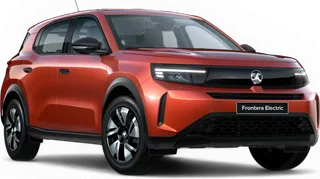
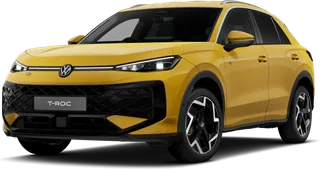
Vauxhall Frontera vs Volkswagen T-Roc
Better figure, where one is clearly better
| VauxhallFrontera | VolkswagenT-Roc | |
|---|---|---|
| Overview | ||
| Released | January 2025 | January 2026 |
| Performance | ||
| Powertrain | Hybrid, Electric | Mild hybrid |
| Power | 109–143 bhp | 114–148 bhp (better) |
| 0–62 mph | 9–13 s | 8.9–10.6 s (better) |
| Top speed | 88–118 mph | 122–132 mph (better) |
| Engine or motors | Hybrid: 1.2-litre three-cylinder turbo petrol with 48V battery and a 21 kW (28hp) electric motor in the gearbox, 110PS (81 kW) or 145PS (107 kW); Electric: 83 kW (113PS) peak, 53 kW continuous; bhp converted from Vauxhall's kW figures | 1.5-litre four-cylinder eTSI turbocharged petrol with 48V mild hybrid, 116 PS (85 kW) or 150 PS (110 kW); bhp converted from Volkswagen's PS figures |
| Torque | 205 Nm (Hybrid 110PS), 230 Nm (Hybrid 145PS), 124.5 Nm (Electric) | 220 Nm (116 PS), 250 Nm (150 PS) |
| Gearbox | 6-speed e-DCT6 dual-clutch automatic (Hybrid), single-speed (Electric) | 7-speed DSG automatic |
| Drive | Front-wheel drive | Front-wheel drive |
| Range and charging | ||
| Zero-emission range (WLTP) | 190–248 miles | – |
| Battery | 44–54 kWh | – |
| Fastest charging | 100 kW | – |
| Economy (WLTP) | 53.3 mpg (better) | 50.4–50.7 mpg |
| Range detail | WLTP: up to 190 miles (44 kWh) or 247–248 miles (54 kWh Extended Range) depending on trim. Vauxhall's 44 kWh spec sheet calls that capacity net; Opel describes the Extended Range's 54 kWh as usable. Vauxhall's online datasheet lists other figures for the same batteries | – |
| Charging | 100 kW DC, 20–80% in 26 minutes (44 kWh) or 28 minutes (54 kWh); 11 kW three-phase AC on-board charger, 20–80% in 2 h 55 min (44 kWh) or 3 h 25 min (54 kWh) | – |
| Efficiency | WLTP combined: 53.3–54.3 mpg (both Hybrids); 18.1–18.2 kWh/100 km (44 kWh), 16.1 kWh/100 km (54 kWh) | WLTP combined: 50.0–50.7 mpg (116 PS), 49.7–50.4 mpg (150 PS); depends on trim |
| CO2 emissions | 119–120 g/km (Hybrid, WLTP); 0 g/km (Electric) | 127–130 g/km (WLTP combined) |
| Practicality | ||
| Body | SUV | SUV |
| Seats | 7 (better) | 5 |
| Boot | – | 475 litres |
| Length | 4,385 mm | 4,372 mm |
| Width | 1,795 mm | 1,828 mm |
| Weight | – | From 1,457 kg |
| Boot | 460 litres below the cover, 1,600 litres with the rear seats folded; seven-seat Hybrid 370 and 1,400 litres | 475 litres with the rear seats up |
| Towing | 1,250 kg braked (Hybrid five-seat), 1,050 kg (seven-seat); Electric not approved for towing | Up to 1,300 kg braked (116 PS), 1,500 kg (150 PS) |
| Size | 4,385 mm long, 1,795 mm wide without mirrors, 1,655 mm high; 2,670 mm wheelbase; kerb weight including 75 kg driver 1,343 kg (Hybrid five-seat), 1,375 kg (seven-seat), 1,514 kg (44 kWh), 1,535 kg (54 kWh); 44-litre fuel tank | 4,372 mm long, 1,828 mm wide (excluding mirrors), 1,573 mm high; 2,629 mm wheelbase; weight is Volkswagen's unladen figure with driver, 1,457 kg (116 PS) or 1,465 kg (150 PS) |
| Tech and safety | ||
| Infotainment | 10-inch touchscreen with navigation and 10-inch digital instrument cluster; wireless Apple CarPlay and Android Auto; wireless phone charging | 12.9-inch touchscreen as standard; 10-inch Digital Cockpit Pro from Style; wireless phone charging; head-up display optional |
| Driver assistance | Automatic emergency braking, lane keep assist, speed sign recognition, cruise control and rear-view camera as standard; blind spot alert from GS | LED headlights standard; IQ.LIGHT LED matrix headlights, Travel Assist with automatic lane changes, Park Assist Pro with memory and smartphone control, and exit warning optional |
| Safety rating | – | Euro NCAP 5 stars (2025) |
| Warranty | 3 years (first year unlimited mileage, then 60,000 miles); battery 8 years or 100,000 miles (70% capacity) | 3 years or 60,000 miles |