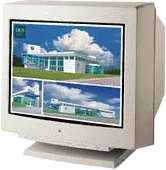
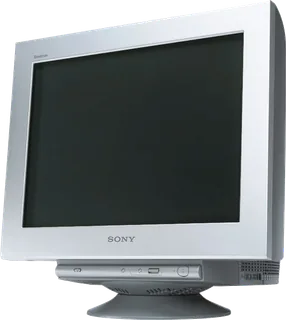
Apple Multiple Scan 20 Display vs Sony GDM-F520
Better figure, where one is clearly better
| AppleMultiple Scan 20 Display | SonyGDM-F520 | |
|---|---|---|
| Overview | ||
| Released | March 1994 | 2001 |
| Display | ||
| Screen size | 19.1″ | 19.8″ |
| Panel | CRT (Original nominal 20-inch Trinitron CRT, 19.1-inch viewable image and 0.31 mm stripe pitch; no fixed native matrix. Later Revision B uses a different 0.26 mm tube and is not substituted here.) | CRT (Flat FD Trinitron aperture-grille CRT; marketed as a 21-inch tube with a 19.8-inch viewable image. No fixed pixel matrix or native refresh rate.) |
| Colour modes | – | PROFESSIONAL, STANDARD and DYNAMIC Picture Effect modes; EASY, PRESET, EXPERT and sRGB colour settings; 5000 K, 6500 K and 9300 K presets with 5000–11000 K adjustment in EASY |
| Pixel pitch | – | Uniform 0.22 mm aperture-grille pitch across the screen; not an LCD pixel pitch |
| Supported signal modes | Apple's support sheet lists 640 × 480 at 59.95, 66.7 or 75 Hz; 800 × 600 at 75 Hz; 832 × 624 at 75 Hz; 1024 × 768 at 74.93 or 75 Hz; 1152 × 870 at 75 Hz; and 1280 × 1024 at 75 Hz. Service Source gives horizontal scan range 29–82 kHz and vertical range 50–150 Hz. These are supported CRT signal modes, not a native pixel matrix or native refresh rate; modes depend on the computer and adaptor. | Sony specifies a maximum 2048 × 1536 at 85 Hz and recommends 1600 × 1200 at 85 Hz. Horizontal scan range 30–137 kHz; vertical scan range 48–170 Hz. These are supported timings, not native resolution or refresh. Maximum viewable area approximately 403.8 × 302.2 mm; standard image area 388 × 291 mm (4:3) or 364 × 291 mm (5:4). |
| Screen coating | Bonded glass panel with multilayer antiglare and antistatic coating | High Contrast AR screen coating |
| Calibration | – | RGB gain/bias, horizontal/vertical convergence, top/bottom vertical convergence, corner landing, geometry and moiré controls; automatic/manual degaussing and Image Restoration after a 30-minute warm-up |
| Connections | ||
| Video inputs | DA-15 | VGA |
| USB-C charging | None | None |
| USB ports | – | 4 × USB-A |
| Other connections | Macintosh 15-pin DA-15 analogue RGB cable; VGA computers need a video adaptor. Two front ADB device ports and rear ADB pass-through port. | One HD15 VGA input and one analogue RGB video input comprising five BNC connectors (R, G, B, horizontal sync and vertical sync). Separate/composite sync and sync-on-green supported; DDC Plug & Play is available over HD15 only. |
| USB hub detail | – | One square USB-B upstream connector and four rectangular USB-A downstream connectors on the right side; hub operates while the monitor is on or in power-saving mode |
| Design | ||
| Stand adjusts | Tilt, swivel | Tilt, swivel |
| Weight with stand | 30 kg | 30 kg |
| Tilt | −5° to +15° | 5° down to 15° up |
| Swivel | At least ±45° | 90° left or right |
| Size with stand | Apple support publishes 18.7 × 18.7 × 19.7 inches (height × width × depth); Service Source separately lists 474 × 474 × 501.5 mm | Approximately 497 × 499 × 487 mm (W × H × D) |
| Weight detail | Service Source gives monitor weight 30 kg (66 lb), distinct from the 36 kg boxed shipping weight. The later 1995 Apple Facts sheet for the 0.26 mm tube instead gives 29.7 kg. | Approximately 30 kg for the complete monitor; Sony's instructions say not to remove the stand |
| Controls | Front-panel power, reset, brightness and contrast; image position, size, rotation, convergence and colour-temperature controls. Automatic power-on degauss. | Front input selector, Picture Effect button, menu button and up/down/push control button; automatic sizing/centring, control lock and nine menu languages |
| Power and support | ||
| Power use | Maximum 165 W; less than 15 W in Energy Saver mode | Up to 145 W in normal operation and up to 3 W in active-off deep sleep, without USB peripherals connected |
| Power supply | Service Source specifies 90–132 or 198–264 V AC, 47–63 Hz; support archive instead gives the upper band as 198–260 V. These are mains ratings. | International operating instructions specify 100–240 V AC, 50–60 Hz, 2.0–1.0 A; Japanese archive specifies 100 V AC. Use the appropriate supplied regional mains lead. |
| Software | System 7.1 or later; older Macs may need additional adaptors. Apple support identifies March 1994 introduction, and InfoWorld's 14 March 1994 shipping section reports rollout that week; month precision retained. Service Source distinguishes original 0.31 mm hardware from later Revision B 0.26 mm hardware with different deflection board, controller and power supply. No Revision B retail date is inferred. Brightness and contrast ratio are unpublished. | DDC2B/DDC2Bi over HD15, with stored preset/user timings and GTF support; exact signal support also depends on the graphics card |
| Certifications | US EPA Energy Star power conservation | ENERGY STAR, TCO'99 and MPR II in the international operating instructions; Japanese archive also lists VCCI Class B and FCC Class B |
| In the box | – | Power cord, HD15 video-signal cable, USB cable, Power Mac G3/G4 adapter and operating instructions (international manual; regional contents may vary) |
More comparisons
- Apple Multiple Scan 20 Display vs Apple Studio Display (2026)
- Apple Multiple Scan 20 Display vs Apple Studio Display XDR
- Apple Cinema Display (20-inch, DVI) vs Sony GDM-F520
- Apple Cinema Display (20-inch, ADC) vs Sony GDM-F520
- Apple Studio Display (21-inch CRT, 1999) vs Sony GDM-F520
- Apple AppleVision 850 vs Sony GDM-F520
- Sony GDM-F520 vs Sony GDM-FW900
- Apple AppleVision 850AV vs Sony GDM-F520
- Apple Multiple Scan 20 Display vs Sony GDM-FW900
- Apple Multiple Scan 20 Display vs Apple Studio Display (21-inch CRT, 1999)
- Apple AppleVision 850 vs Apple Multiple Scan 20 Display
- Apple AppleVision 850AV vs Apple Multiple Scan 20 Display
- Apple Multiple Scan 20 Display vs Apple Multiple Scan 720 Display
- Apple Multiple Scan 14 Display vs Apple Multiple Scan 20 Display
- Apple Multiple Scan 1705 Display vs Apple Multiple Scan 20 Display
- Apple Multiple Scan 15 Display vs Apple Multiple Scan 20 Display