Beurer BM 64 vs Rossmax Z5
Better figure, where one is clearly better
| BeurerBM 64 | RossmaxZ5 | |
|---|---|---|
| Overview | ||
| Released | – | – |
| Measuring | ||
| Type | Upper arm | Upper arm |
| Irregular heartbeat detection | Yes | Yes |
| AFib detection or ECG | Yes | Yes |
| Method | Automatic oscillometric upper-arm measurement during inflation. UK item 65400, EAN 4211125654009; manual type BM 64. Announced on 12 November 2023 with planned German availability from March 2024; actual first-sale date unresolved | Automatic oscillometric upper-arm measurement during deflation with semiconductor pressure sensor. First-sale date unresolved |
| Accuracy | Manual display accuracy ±3 mmHg for systolic and diastolic pressure and ±5% for pulse. Systolic range 50–280 mmHg, diastolic 30–200 mmHg and pulse 40–199 beats/minute; maximum cuff pressure 300 mmHg is separate | Pressure 30–260 mmHg; pulse 40–199 bpm. Maker accuracy ±3 mmHg pressure and ±5% pulse |
| Clinical validation | Current manual claims clinical testing to ISO 81060-2; independent validation for this exact model not established. The shared launch release's pregnancy-validation claim belongs to BM 53, not BM 64 | STRIDE BP lists Z5 as equivalent to the validated Rossmax CF175, rather than directly studied. Medaval says the equivalence evidence is unpublished and cannot be checked against MDR requirements; headline validation omitted |
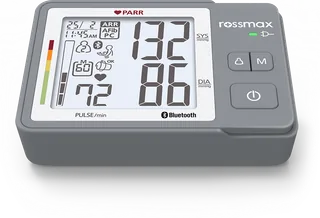
| Features | Advanced arrhythmia detection flags possible atrial fibrillation, without recording an ECG. Coloured classification scale, cuff-position check, HSD resting indicator and low-battery indication. Maker retains triple-measurement mode; May 2024 instructions describe three measurements with 30-second waits and a final average, while September 2026 instructions omit that operation section | PARR flags AFib, premature contractions and combined findings; not an ECG. Cuff-fit, movement and hypertension indicators; non-storing guest mode. Generic tachycardia/bradycardia marketing does not establish dedicated detection icons |
| Cuff | ||
| Cuff fits | 22–42 cm | 24–40 cm |
| Cuff | Supplied premium cuff fits upper-arm circumferences of 22–42 cm; conventional tube connection, not easyClip or easyLock | Latex-free Universal Cone Cuff for 24–40 cm arms |
| Connections and memory | ||
| Users | 2 | 2 |
| Readings stored | 120 per user (better) | 60 per user |
| Bluetooth and app | Yes | Yes |
| Memory | Two separately selected users with 120 readings each; oldest reading replaced when full. Recall individual readings and average of all stored readings, plus morning (05:00–09:00) and evening (18:00–20:00) averages over the last seven days. Date/time and user-selection slider explicitly described in the manual | Two 60-reading histories with date/time; latest-three average and seven-day morning/nighttime averages. Morning uses 04:00–11:59 and nighttime 18:00–02:00. Oldest reading replaced when full; guest readings not stored |
| App | Bluetooth transfer to beurer HealthManager Pro with automatic transfer configurable on the monitor; six-digit pairing PIN. Manual publishes 2400–2483 MHz band and maximum 5 dBm transmission power, without a Bluetooth version | Bluetooth low energy transfers new and saved readings to the phone app after pairing. USB cable is specified for power only; a generic BP Manager diagram does not establish PC data transfer |
| Power | Four included 1.5 V LR6 AA batteries; approximately 300 measurements depending on blood pressure, inflation pressure and Bluetooth connections. Optional USB-C mains supply 5 V DC / 1 A; remove batteries for mains use. Included USB-C cable does not charge batteries | Built-in non-detachable DC 3.7 V lithium-ion battery; Type-C input 5 V, 1 A. Maker claims approximately 600 measurements per full charge, depending on battery and storage condition; charging takes up to three hours depending on discharge. Green charging light goes out when full. Battery replacement by authorised service centre; automatic shutdown after one minute |
| Design | ||
| Display details | Illuminated inverse XL LCD with white digits on black; four sensor touch buttons and a central START/STOP control. Manual IP20 | 69 × 64.4 mm LCD; IP21 |
| Size | 143 × 105 × 60 mm (L × W × H). Manual and datasheet approximately 450 g with cuff and without batteries; current UK website lists 646 g excluding packaging without specifying cuff/battery weighing conditions | 120 × 80 × 57 mm (L × W × H); 276 g including battery, excluding cuff |
| In the box | Monitor, 22–42 cm premium cuff, four AA batteries, USB-C cable, storage pouch and instructions; mains adapter optional | Universal Cone Cuff, USB cable, instruction manual and zipper bag; mains adaptor optional |

More comparisons
- Beurer BM 64 vs Withings BPM Vision
- Beurer BM 64 vs Omron M7 Intelli IT AFib
- Beurer BM 64 vs Withings BPM Core
- Beurer BM 64 vs Omron Complete
- Beurer BM 64 vs Omron Evolv
- Beurer BM 64 vs Beurer BM 85
- Beurer BM 64 vs Microlife BP A6 BT
- Beurer BM 64 vs Microlife BP A7 Touch BT
- Beurer BM 64 vs Microlife BP B4 AFIB BT
- Beurer BM 64 vs Microlife BP B6 Connect
- Beurer BM 64 vs Omron M4 Connect AFib
- Beurer BM 64 vs Omron M7 Intelli IT
- Beurer BM 64 vs Rossmax X5 BT
- Beurer BM 64 vs Rossmax X9 BT
- Beurer BM 96 Cardio vs Rossmax Z5
- Microlife BP A6 BT vs Rossmax Z5