Beurer BM 64 vs Rossmax X9 BT
Better figure, where one is clearly better
| BeurerBM 64 | RossmaxX9 BT | |
|---|---|---|
| Overview | ||
| Released | – | – |
| Measuring | ||
| Type | Upper arm | Upper arm |
| Irregular heartbeat detection | Yes | Yes |
| AFib detection or ECG | Yes | Yes |
| Method | Automatic oscillometric upper-arm measurement during inflation. UK item 65400, EAN 4211125654009; manual type BM 64. Announced on 12 November 2023 with planned German availability from March 2024; actual first-sale date unresolved | Automatic oscillometric measurement or auscultatory mode using a separate stethoscope and marker button. Intended for adults at home and in clinical settings. First-sale date unresolved |
| Accuracy | Manual display accuracy ±3 mmHg for systolic and diastolic pressure and ±5% for pulse. Systolic range 50–280 mmHg, diastolic 30–200 mmHg and pulse 40–199 beats/minute; maximum cuff pressure 300 mmHg is separate | Pressure 30–260 mmHg; pulse 40–199 bpm. Maker accuracy ±3 mmHg pressure and ±5% pulse |
| Clinical validation | Current manual claims clinical testing to ISO 81060-2; independent validation for this exact model not established. The shared launch release's pregnancy-validation claim belongs to BM 53, not BM 64 | Maker carries ESH/BIHS claims. Medaval's exact X9 BT entry says peer-reviewed validation evidence and protocol-compliant equivalence remain unproven; non-Bluetooth X9's registry listing is not transferred |
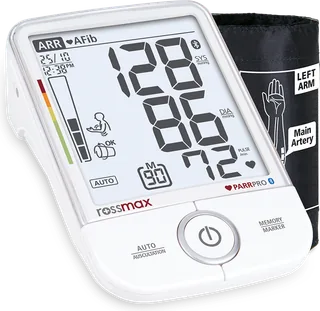
| Features | Advanced arrhythmia detection flags possible atrial fibrillation, without recording an ECG. Coloured classification scale, cuff-position check, HSD resting indicator and low-battery indication. Maker retains triple-measurement mode; May 2024 instructions describe three measurements with 30-second waits and a final average, while September 2026 instructions omit that operation section | PARR flags AFib, premature beats, tachycardia above 100 bpm and bradycardia below 55 bpm, including combined findings. Pulse screening, not ECG. Cuff-fit, movement and hypertension indicators |
| Cuff | ||
| Cuff fits | 22–42 cm | 16–46 cm |
| Cuff | Supplied premium cuff fits upper-arm circumferences of 22–42 cm; conventional tube connection, not easyClip or easyLock | Supplied latex-free small 16–26 cm, medium 24–36 cm and large 34–46 cm cuffs; overall range requires choosing the appropriate cuff. Cuff holder |
| Connections and memory | ||
| Users | 2 (better) | 1 |
| Readings stored | 120 per user (better) | 90 |
| Bluetooth and app | Yes | Yes |
| Memory | Two separately selected users with 120 readings each; oldest reading replaced when full. Recall individual readings and average of all stored readings, plus morning (05:00–09:00) and evening (18:00–20:00) averages over the last seven days. Date/time and user-selection slider explicitly described in the manual | Single 90-reading history with date/time for automatic measurements; oldest replaced when full. Auscultatory readings are not included in this stored automatic-mode history |
| App | Bluetooth transfer to beurer HealthManager Pro with automatic transfer configurable on the monitor; six-digit pairing PIN. Manual publishes 2400–2483 MHz band and maximum 5 dBm transmission power, without a Bluetooth version | Bluetooth low energy sends completed readings to Rossmax Healthstyle after pairing; stored automatic-mode readings can also be transferred. Auscultatory systolic/diastolic readings transfer when marked with the button. Guide documents an optional specially designed USB cable for PC transfer, but Rossmax now says BP Manager software is discontinued and no longer available; monitor remains independently usable |
| Power | Four included 1.5 V LR6 AA batteries; approximately 300 measurements depending on blood pressure, inflation pressure and Bluetooth connections. Optional USB-C mains supply 5 V DC / 1 A; remove batteries for mains use. Included USB-C cable does not charge batteries | Four AA alkaline cells, DC 6 V; supplied 6 V mains adaptor rated at least 600 mA. Automatic shutdown after one minute without key operation |
| Design | ||
| Display details | Illuminated inverse XL LCD with white digits on black; four sensor touch buttons and a central START/STOP control. Manual IP20 | Backlit 99 × 115 mm LCD with mode and pulse-arrhythmia flags; IP21 |
| Size | 143 × 105 × 60 mm (L × W × H). Manual and datasheet approximately 450 g with cuff and without batteries; current UK website lists 646 g excluding packaging without specifying cuff/battery weighing conditions | 173 × 115 × 64.5 mm (L × W × H); maker guide lists 410 g without batteries |
| In the box | Monitor, 22–42 cm premium cuff, four AA batteries, USB-C cable, storage pouch and instructions; mains adapter optional | Batteries, small/medium/large cuffs, 6 V adaptor, instruction manual and zipper bag; PC cable optional. Stethoscope not listed as supplied |

More comparisons
- Beurer BM 64 vs Withings BPM Vision
- Beurer BM 64 vs Omron M7 Intelli IT AFib
- Beurer BM 64 vs Withings BPM Core
- Beurer BM 64 vs Omron Complete
- Beurer BM 64 vs Omron Evolv
- Beurer BM 64 vs Beurer BM 85
- Beurer BM 64 vs Microlife BP A6 BT
- Beurer BM 64 vs Microlife BP A7 Touch BT
- Beurer BM 64 vs Microlife BP B4 AFIB BT
- Beurer BM 64 vs Microlife BP B6 Connect
- Beurer BM 64 vs Omron M4 Connect AFib
- Beurer BM 64 vs Omron M7 Intelli IT
- Beurer BM 64 vs Rossmax X5 BT
- Beurer BM 96 Cardio vs Rossmax X9 BT
- Microlife BP A6 BT vs Rossmax X9 BT
- Beurer BM 64 vs Rossmax Z5