Intel Core 2 Duo E6600 vs Intel Core i3-530
Better figure, where one is clearly better
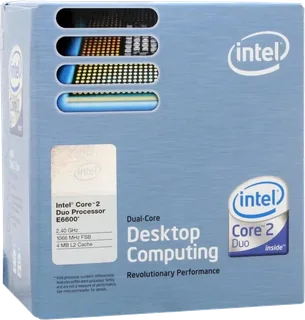
| IntelCore 2 Duo E6600 | IntelCore i3-530 | |
|---|---|---|
| Overview | ||
| Released | July 2006 | January 2010 |
| Cores and clocks | ||
| Cores | 2 | 2 |
| Threads | 2 | 4 (better) |
| Base clock | 2.4 GHz | 2.93 GHz |
| L3 cache | – | 4 MB |
| Cores | Conroe; two cores and two threads, without Hyper-Threading. | Two cores and four threads with Hyper-Threading. Multiplier unlock status is omitted because the bounded exact source pass did not establish it. |
| Clocks | Published operating frequency 2.40 GHz; 1066 MHz front-side bus. Intel unveiled the family on 27 July 2006 and said complete Core 2 Duo desktop systems would arrive in early August. TechSpot’s 2 August review says boxed CPUs began shipping late the previous week, supporting July CPU availability without an exact sale day. No unpublished boost figure is supplied. | 2.93 GHz base; no Turbo Boost, explicitly listed as not applicable in Intel’s 7 January 2010 launch table. The same release states that the new family is immediately available and names this model. |
| Cache | 4 MB shared L2 cache, as Intel’s datasheet states; no L3 figure supplied. | 4 MB shared L3 cache. |
| Graphics and AI | ||
| Built-in graphics | No | Yes |
| Graphics | No integrated graphics, explicitly confirmed by the exact-model CPU-Monkey specification entry. Chipset graphics are separate from the processor. | Intel HD Graphics at 733 MHz in Intel’s exact-model original launch table, also corroborated by bit-tech and the exact retail listing. The later Intel Core i3 comparison chart prints 773 MHz, conflicting with those sources. |
| Platform | ||
| Socket | LGA775 | LGA1156 |
| Base power | 65 W | 73 W |
| Cooler in the box | Yes | Yes |
| Memory support | Intel’s datasheet routes memory and I/O transactions through the front-side bus and chipset; memory types and capacity depend on the motherboard. | Two channels of DDR3-1066/1333 in Intel’s exact-model comparison chart. |
| PCIe | – | 16 PCIe 2.0 lanes, as described in bit-tech’s exact review. |
| Chipsets | – | H55, H57 or Q57 provides display outputs for integrated graphics; compatible P55 boards can use a discrete graphics card, subject to BIOS support (bit-tech). |
| Process | 65 nm; Conroe; LGA775. | 32 nm CPU and separate 45 nm graphics die, as described by bit-tech’s exact review. |
| Cooler | Intel’s boxed-processor specification confirms an unattached fan heatsink. Published processor TDP is 65 W. | Retail boxed heatsink and fan confirmed by the exact Newegg listing and Phoronix’s exact-model retail sample inspection. |
More comparisons
- Intel Core i3-530 vs Intel Core Ultra 9 285K
- AMD Ryzen 7 9700X vs Intel Core 2 Duo E6600
- Intel Core i3-530 vs Intel Core i9-14900KS
- Intel Core 2 Duo E6600 vs Intel Core i9-14900KS
- Intel Core i3-530 vs Intel Core i5-14400F
- Intel Core i3-530 vs Intel Core i5-14500
- Intel Core 2 Duo E6600 vs Intel Core i5-14400F
- Intel Core 2 Duo E6600 vs Intel Core i5-14500
- Intel Core i3-530 vs Intel Core i5-14600K
- Intel Core i3-530 vs Intel Core i7-14700K
- Intel Core i3-530 vs Intel Core i9-14900K
- Intel Core 2 Duo E6600 vs Intel Core i5-14600K
- Intel Core 2 Duo E6600 vs Intel Core i7-14700K
- Intel Core 2 Duo E6600 vs Intel Core i9-14900K
- Intel Core i3-530 vs Intel Core i9-13900KS
- Intel Core 2 Duo E6600 vs Intel Core i9-13900KS