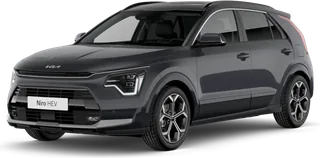
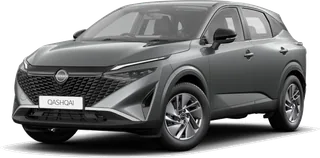
Kia Niro vs Nissan Qashqai
Better figure, where one is clearly better
| KiaNiro | NissanQashqai | |
|---|---|---|
| Overview | ||
| Released | 2022 | March 2021 |
| Performance | ||
| Powertrain | Hybrid, Plug-in hybrid | Mild hybrid, Hybrid |
| Power | 136–168 bhp | 156–202 bhp (better) |
| 0–62 mph | 11.1 s | 7.6–9.5 s (better) |
| Top speed | 104 mph | 105–128 mph (better) |
| Engine or motors | 1.6 GDi four-cylinder petrol (1,580 cc) with an electric motor; hybrid 136 bhp with a 1.32 kWh battery, plug-in hybrid 168 bhp with an 11.1 kWh lithium-ion polymer battery and an 83 kW battery output; Kia does not state usable battery capacity | 1.3-litre DIG-T four-cylinder petrol with 12V mild hybrid, 116 kW (158 PS); e-POWER 1.5-litre three-cylinder generator engine (158 PS) and electric drive motor, 140 kW (190 PS) or 151 kW (205 PS) in Sport mode, 1.97 kWh usable battery; bhp converted from Nissan's PS figures |
| Torque | – | 260 Nm (manual), 270 Nm (Xtronic), 311 Nm or 330 Nm in Sport mode (e-POWER) |
| Gearbox | 6-speed dual-clutch automatic | 6-speed manual or Xtronic CVT (mild hybrid); single-speed (e-POWER) |
| Drive | Front-wheel drive | Front-wheel drive |
| Range and charging | ||
| Zero-emission range (WLTP) | 40 miles | – |
| Economy (WLTP) | 353.1 mpg (better) | 65.7 mpg |
| Range detail | Plug-in hybrid: WLTP electric range 40 miles (grade 2) or 37 miles (grades 3 and 4). Kia UK gives the plug-in hybrid 0–60 mph in 9.6–9.8 seconds; Kia's MY26 hybrid specification gives 0–100 km/h in 11.1–11.4 seconds | – |
| Charging | Plug-in hybrid: Type 2, up to 3.3 kW AC; Kia UK gives 2 h 55 min from 15 to 95% charge; no DC charging | – |
| Efficiency | Hybrid: Kia UK's earlier technical sheet gives 60.1–64.2 mpg WLTP combined across grades 2–4; current grade-specific UK figures are not on Kia's main spec page. Plug-in hybrid: weighted combined 353.1 mpg (grade 2), 313.9 mpg (grade 3), 282.5 mpg (grade 4) | WLTP combined: 6.2–6.4 l/100 km (mild hybrid); 62.8–65.7 mpg (4.3–4.5 l/100 km) for e-POWER |
| CO2 emissions | 18–22 g/km weighted (plug-in hybrid), WLTP | 98–145 g/km (WLTP) |
| Practicality | ||
| Body | Crossover | Crossover |
| Seats | 5 | 5 |
| Boot | 451 litres | 504 litres (better) |
| Length | 4,420 mm | 4,425 mm |
| Width | 1,825 mm | 1,835 mm |
| Weight | From 1,474 kg | From 1,345 kg |
| Boot | 451 litres (hybrid) or 348 litres (plug-in hybrid) with the rear seats up; 1,445 or 1,342 litres folded per Kia UK's technical sheet | 455–504 litres under the luggage cover with the rear seats up (VDA); 1,379–1,447 litres folded |
| Towing | Kia UK's earlier technical sheet gives both hybrids 1,300 kg braked and 100 kg tow ball load; the current UK specification retains those figures for the plug-in hybrid | 1,680 kg braked (manual), 1,830 kg (Xtronic), 770 kg (e-POWER) |
| Size | 4,420 mm long, 1,825 mm wide, 1,545–1,560 mm high depending on trim; 2,720 mm wheelbase; 10.6 m turning circle; Kia UK's earlier technical sheet gives 1,474 kg kerb weight for the hybrid and 1,594 kg for the plug-in hybrid | 4,425 mm long, 1,835 mm wide without mirrors, 1,625 mm high; 2,665 mm wheelbase; 11.1 m turning circle |
| Tech and safety | ||
| Infotainment | Kia UK lists 10.25-inch touchscreen navigation as standard on the current plug-in hybrid; its 2023 brochure lists an 8-inch display on grade 2 and a 10.25-inch navigation display on grades 3 and 4; head-up display on grade 4 | – |
| Driver assistance | Remote Smart Parking Assist on grade 4 | – |
| Warranty | 7 years or 100,000 miles | 3 years or 60,000 miles |