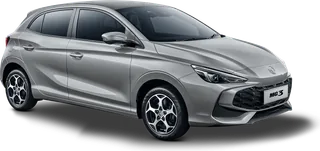
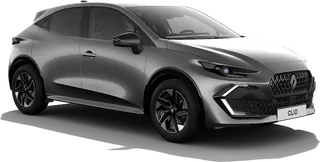
MG MG3 vs Renault Clio (2027)
Better figure, where one is clearly better
| MGMG3 | RenaultClio (2027) | |
|---|---|---|
| Overview | ||
| Released | March 2024 | Coming 2027 |
| Performance | ||
| Powertrain | Petrol, Hybrid | Hybrid, Petrol |
| Power | 113–191 bhp (better) | 113–158 bhp |
| 0–62 mph | 8–10.8 s (better) | 8.3–10.3 s |
| Top speed | 106–115 mph | – |
| Engine or motors | Petrol: 1,495 cc naturally aspirated four-cylinder, 115 PS (85 kW). Hybrid+: 1,498 cc Atkinson-cycle four-cylinder, 102 PS (75 kW), with a 136 PS (100 kW) motor, 194 PS (143 kW) combined; bhp converted from MG's PS figures | full hybrid E-Tech 160: 1.8-litre four-cylinder petrol engine with electric motors and a 1.4 kWh battery, 160 hp; TCe 115: 1.2-litre three-cylinder turbo petrol, 115 hp (84 kW); bhp converted from Renault's metric horsepower; 0–62 mph times are Renault's 0–100 km/h (TCe 115: 10.3 s on Renault France's spec page, 10.1 s in the press kit) |
| Torque | 148 Nm (petrol); 425 Nm combined (Hybrid+), 250 Nm from the motor | E-Tech 160: 172 Nm from the engine and 205 Nm from the electric motor (Renault France quotes 270 Nm maximum); TCe 115: 190 Nm |
| Gearbox | 5-speed manual (petrol); 3-speed automatic (Hybrid+) | Clutchless multimode automatic (E-Tech 160); 6-speed manual or optional EDC dual-clutch automatic (TCe 115), per Renault's press kit |
| Drive | Front-wheel drive | – |
| Range and charging | ||
| Battery | 0.92 kWh | – |
| Economy (WLTP) | 46.3–64.2 mpg | – |
| Range detail | Hybrid+ battery: 1.83 kWh nominal, 0.92 kWh usable, lithium nickel manganese (NCM) | Up to 621 miles on a tank, with electric driving at up to 65 mph (E-Tech 160), pending UK homologation |
| Efficiency | WLTP combined: 46.3 mpg (petrol), 64.2 mpg (Hybrid+); fuel tank 45 litres (petrol) or 36 litres (Hybrid+) | WLTP combined: 3.9 l/100 km (E-Tech 160), 5.0 l/100 km (TCe 115), 5.1 l/100 km (TCe 115 EDC); UK mpg not yet published |
| CO2 emissions | 137 g/km (petrol), 100 g/km (Hybrid+), WLTP | From 89 g/km (E-Tech 160, pending UK homologation), 114 g/km (TCe 115), 116 g/km (TCe 115 EDC), WLTP combined |
| Practicality | ||
| Body | Hatchback | Hatchback |
| Seats | 5 | 5 |
| Boot | 293 litres | 391 litres (better) |
| Length | 4,113 mm | 4,116 mm |
| Width | 1,797 mm | 1,768 mm |
| Weight | From 1,162 kg | From 1,155 kg |
| Boot | 293 litres with the rear seats up (MG Europe); MG UK doesn't publish a figure | 391 litres (1,176 litres with the rear seats folded) with the TCe 115, 309 litres (1,094 litres) with the full hybrid; 327 and 267 dm³ (VDA); 735 mm load sill |
| Towing | 500 kg braked or unbraked; 50 kg tow ball load | 900 kg braked, 615 kg unbraked (TCe 115) |
| Size | 4,113 mm long, 1,797 mm wide without mirrors (2,014 mm with), 1,502 mm high; 2,570 mm wheelbase; 10.5 m turning circle; kerb weight 1,162 kg (petrol), 1,298 kg (Hybrid+ SE), 1,308 kg (Hybrid+ Trophy) | 4,116 mm long, 1,768 mm wide (2,006 mm with mirrors), 1,451 mm high; 2,591 mm wheelbase; 142 mm ground clearance unladen; from 1,155 kg |
| Tech and safety | ||
| Infotainment | 10.25-inch touchscreen with navigation and 7-inch driver display; Apple CarPlay and Android Auto; 360° camera on Hybrid+ Trophy | Two 10-inch openR screens with openR link and Google built-in, wireless Apple CarPlay and Android Auto; Harman Kardon audio depending on version |
| Driver assistance | MG Pilot: active emergency braking, cruise control; rear cross traffic alert and blind zone detection with lane change assist on Hybrid+ Trophy | Up to 29 driver assistance systems depending on version, including active driver assist, emergency stop assist, rear automatic emergency braking and a 360° camera |
| Warranty | 7 years or 80,000 miles | – |