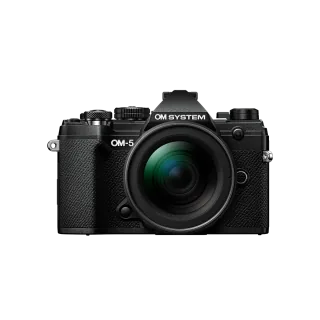
OM SYSTEM OM-3 vs OM SYSTEM OM-5
Better figure, where one is clearly better
| OM SYSTEMOM-3 | OM SYSTEMOM-5 | |
|---|---|---|
| Overview | ||
| Released | February 2025 | November 2022 |
| Image and sensor | ||
| Camera type | Mirrorless | Mirrorless |
| Sensor format | Four Thirds | Four Thirds |
| Sensor type | Stacked BSI Live MOS | Live MOS |
| Sensor dimensions | 17.3 × 13 mm | 17.4 × 13 mm |
| Effective resolution | 20.4 MP | 20.4 MP |
| Largest image | 5184 × 3888 | 5184 × 3888 |
| RAW recording | Yes | Yes |
| Standard ISO range | 80–102400 | 200–25600 |
| Sensor detail | UK specification rounds effective resolution to 20.4 MP and total to 22.9 MP; maker US press release specifies 20.37 effective and 22.93 total. 5184×3888 single-shot output, separate from 80 MP tripod or 50 MP handheld pixel-shift composites | Approximately 20.37 effective and 21.77 total megapixels in maker Japan table; UK rounds to 20.4 and 21.8. Japan image area 17.4×13 mm; UK gives 17.3×13 mm |
| Image formats | ORF RAW and JPEG; high-resolution modes combine eight exposures and can save composite RAW; moving subjects and capture conditions affect results | JPEG and 12-bit losslessly compressed ORF RAW; ordinary output 5184×3888. Handheld composite 50 MP JPEG/RAW; tripod composite 50 MP JPEG or 80 MP RAW developed with OM Workspace, not a single-shot 80 MP sensor |
| ISO detail | Maker UK published sensitivity range includes LOW, approximately ISO 80, through ISO 102400; default Auto upper limit ISO 25600. This headline range includes expanded settings, rather than implying ISO 80 is the native base sensitivity | Manual ISO 200–25600, expanded LOW approximately 64 and 100; default Auto upper limit 6400 (maker Japan). Amateur Photographer calls values above 6400 extended, unlike the maker manual table |
| Image processor | TruePic X | TruePic IX |
| Lens and shooting | ||
| Lens mount | Micro Four Thirds | Micro Four Thirds |
| Stabilisation | Lens and sensor shift | Lens and sensor shift |
| Maximum continuous burst | 120 fps | 30 fps |
| Lens detail | Native Micro Four Thirds mount; Sync IS and fastest continuous tracking depend on compatible lenses; kit lens is excluded from body specifications | – |
| Autofocus | 1053 cross-type sensor phase-detection and contrast positions; AI recognition for humans, birds, cats/dogs, motorsports, aircraft and trains; EV −8 to 19 at approximately ISO 100 with an f/1.2 lens. Subject type is selected manually (Amateur Photographer) | Sensor phase/contrast detection, 121 cross-type phase positions; face/eye detection and Starry Sky AF. No animal/vehicle recognition (Amateur Photographer) |
| Shutter | Mechanical focal-plane 1/8000–60 seconds and Bulb up to 30 minutes; electronic high-speed modes have additional restrictions | Mechanical 1/8000–60 seconds; electronic 1/32000–60 seconds; Bulb up to 30 minutes and Live Composite modes |
| Burst detail | Electronic SH1 up to 120 fps with focus/exposure fixed; SH2 up to 50 fps tracking with specified compatible lenses, no slow shutter or flash. Maker example buffer at 120 fps is 88 RAW/90 large fine JPEG, versus 102/125 at 50 fps and 151/375 at 20 fps, with specified KIOXIA card and 12–40mm F2.8 PRO II. Mechanical approximately 6 fps | Electronic high approximately 30 fps and low 10 fps; mechanical high 10 fps and low 6 fps. Maker example buffers 18 RAW/20 JPEG at 30 fps, 149 RAW at mechanical 10 fps, with specified KIOXIA card and 12–40mm F2.8 PRO |
| Stabilisation detail | Five-axis sensor shift, CIPA 2024 up to 6.5 centre/5.5 corner stops with 12–45mm F4 PRO at 45mm; compatible Sync IS up to 7.5/6.5 with 12–100mm F4 IS PRO at 100mm and half-press stabilisation off | Five-axis sensor shift; CIPA up to 6.5 stops with 12–40mm F2.8 PRO at 40mm; Sync IS up to 7.5 with 12–100mm F4 IS PRO at 100mm and half-press stabilisation off |
| Flash | External hot-shoe flash support. Maker interface table lists a sync socket, while the read review's port discussion does not; no assumed connector shape | – |
| Exposure controls | PASM, five saved custom modes, front colour/monochrome profile dial and CP button. Live ND to ND64; Live GND to GND8. Restrictions on mode, flash, ISO and shutter apply | PASM, Live ND, HDR, focus stacking and multiple exposure; Live ND2–16 (Amateur Photographer), with mode, shutter, ISO and lens restrictions |
| Video | ||
| Highest video resolution | 4096 × 2160 at 60 fps | 4096 × 2160 at 24 fps |
| Video detail | Internal C4K 4096×2160 or UHD 3840×2160 up to 60p; H.264 and HEVC MOV formats, OM-Log400, HLG and OM-Cinema profiles. FHD high-speed 240 fps is separate from 4K. External 12-bit RAW HDMI needs a recorder and disables internal recording. Maker thermal claim of 30 minutes at 40°C or no thermal time limit at 25°C applies specifically to 4K30 10-bit testing, not every mode | Internal H.264 MOV C4K 4096×2160 at 24p approximately 237 Mbps; UHD 3840×2160 at 30/25/24p approximately 102 Mbps. Separate FHD high-speed 120 fps; Flat and OM-Log400 profiles. No fixed clip-duration limit, with card, battery and file-splitting restrictions |
| Audio | Maker MOV settings include 48 kHz/16-bit and 96 kHz/24-bit; external 3.5 mm microphone and headphone connections | Built-in stereo microphones; 48 kHz/16-bit or 96 kHz/24-bit audio; external 3.5 mm microphone socket |
| Screen and viewfinder | ||
| Viewfinder | Electronic | Electronic |
| Screen size | 3″ | 3″ |
| Screen dots | 1,620,000 | 1,037,000 |
| Touchscreen | Yes | Yes |
| Tilting screen | Yes | Yes |
| Display detail | Fully articulated three-inch touchscreen, approximately 1.62 million dots; connected port cables can restrict rotation (Amateur Photographer) | Fully articulated touchscreen; UK 1.037 million dots, Japan rounds to 1.04 million |
| Viewfinder detail | OLED approximately 2.36 million dots, 100% coverage, maximum 1.37× with 50mm lens at infinity and −1 dioptre depending on finder style; review figures near 0.68× are full-frame-equivalent magnification | OLED approximately 2.36 million dots, approximately 100% coverage; 1.23–1.37× magnification with 50mm lens at infinity at −1 dioptre depends on finder style |
| Connections and design | ||
| Wi-Fi | Yes | Yes |
| Bluetooth | Yes | Yes |
| Battery life (maker's claim) | 590 photographs | 310 photographs |
| Body weight | 413 g | 366 g (better) |
| Release detail | Maker US press release confirms late February 2025 availability; earliest UK/worldwide retail day unconfirmed, so month precision retained. Press PDF's June upload path is not the release date | Japan body and 14–150mm II kit on sale 18 November 2022, 12–45mm PRO kit 10 December. Earlier worldwide day unconfirmed, so month precision retained |
| Recording media | One SD/SDHC/SDXC slot with UHS-I and UHS-II support | One SD/SDHC/SDXC slot, UHS-I and UHS-II |
| Ports | USB 3 Type-C, Type D micro-HDMI, 3.5 mm microphone and headphone connections; maker launch release explicitly says wired remote operation is unsupported | USB 2.0 Hi-Speed Micro-B; micro-HDMI Type D; 3.5 mm microphone and 2.5 mm remote sockets; hot shoe |
| Wireless connections | Wi-Fi and Bluetooth Low Energy 5.2; optional RM-WR2 remote support; GPS tagging uses smartphone location, not an inferred built-in receiver | Wi-Fi b/g/n and Bluetooth Low Energy 4.2; location tagging from connected smartphone rather than built-in GPS |
| Battery life detail | BLX-1; approximately 590 standard-mode shots or 1040 Quick Sleep shots with specified KIOXIA UHS-II card. Maker video figures 120 minutes CIPA or 190 with zoom and other operations disabled | BLS-50; standard 310 or low-power 660 CIPA shots with specified KIOXIA card, stabilisation on and no flash. Approximately 60 minutes JEITA video or 110 minutes with other operations disabled |
| Charging | In-camera USB charging and USB Power Delivery bus power; charger not included, optional BCX-1 dual charger and F-5AC/F-7AC adapters | USB in-camera charging with camera off; behaviour depends on supply capability |
| Dimensions | Approximately 139.3 × 88.9 × 45.8 mm, excluding protrusions | Approximately 125.3×85.2×49.7 mm excluding protrusions |
| Weight detail | Approximately 413 g body only or 496 g including battery and memory card; photographed 12–45mm kit lens excluded | 366 g body only or 414 g with battery and card, excluding eyecup; photographed kit lens excluded |
| Materials | Magnesium alloy, −10 to 40°C operation; IP53 or IPX1 performance depends on attached lens. Maker weather qualification excludes charging and HDMI connection, and is not an immersion rating | IP53 when paired with an IP53 lens, IPX1 with an IPX1 lens; not an immersion rating. Operating temperature −10 to 40°C |
| Colours | Silver-and-black body | Black and silver |

More comparisons
- OM SYSTEM OM-3 vs OM SYSTEM PEN
- OM SYSTEM OM-3 vs OM SYSTEM OM-3 ASTRO
- OM SYSTEM OM-3 ASTRO vs OM SYSTEM OM-5
- OM SYSTEM OM-5 vs OM SYSTEM OM-5 Mark II
- OM SYSTEM OM-3 vs OM SYSTEM OM-5 Mark II
- OM SYSTEM OM-1 Mark II vs OM SYSTEM OM-3
- OM SYSTEM OM-3 vs Panasonic LUMIX G9II
- Fujifilm X-T5 vs OM SYSTEM OM-3
- OM SYSTEM OM-3 vs Panasonic LUMIX G97
- OM SYSTEM OM-3 vs Panasonic LUMIX GH7
- OM SYSTEM OM-1 Mark II vs OM SYSTEM OM-5
- OM SYSTEM OM-5 vs Panasonic LUMIX G9II
- OM SYSTEM OM-5 vs Panasonic LUMIX GH6
- Olympus PEN E-P7 vs OM SYSTEM OM-5
- OM SYSTEM OM-5 vs Panasonic LUMIX GH5 II
- OM SYSTEM OM-5 vs Panasonic LUMIX G100