Sony INZONE M3 vs Sony INZONE M9
Better figure, where one is clearly better
| SonyINZONE M3 | SonyINZONE M9 | |
|---|---|---|
| Overview | ||
| Released | December 2022 | July 2022 |
| Display | ||
| Screen size | 27″ | 27″ |
| Resolution | 1920 × 1080 (Full HD) | 3840 × 2160 (4K) (better) |
| Sharpness | 82 pixels per inch | 163 pixels per inch (better) |
| Panel | IPS (Edge-lit LED backlight without local dimming) | IPS (Direct LED backlight with full-array local dimming) |
| Refresh rate | 240 Hz (better) | 144 Hz |
| Response time (grey to grey) | 1 ms | 1 ms |
| Brightness (typical) | 400 nits | 400 nits |
| HDR peak brightness | 400 nits | 600 nits (better) |
| HDR certification | DisplayHDR 400 | DisplayHDR 600 |
| HDR formats | HDR10, HLG | HDR10, HLG |
| Contrast ratio | 1,000:1 | 1,000:1 |
| Colour range | 99% sRGB | Over 95% DCI-P3 |
| DCI-P3 coverage | – | 95% |
| Screen finish | Matte | Matte |
| Shape | Flat | Flat |
| Adaptive sync | VESA AdaptiveSync, G-Sync Compatible, HDMI VRR | G-Sync Compatible, HDMI VRR |
| Colour depth | 1.07 billion colours | 1.07 billion colours |
| Colour modes | Standard, FPS Game, Cinema, Game 1 and Game 2; black equalizer, crosshair, timer and frame-rate counter | Standard, FPS Game, Cinema, Game 1 and Game 2; black equalizer, crosshair, timer and frame-rate counter |
| HDR detail | VESA DisplayHDR 400; edge-lit backlight without local dimming. Typical and peak brightness 400 cd/m²; static and dynamic contrast 1,000:1. | Full-array local dimming; 96 zones reported by TechSpot. Sony's formal specifications give 600 cd/m² peak brightness, while its Japanese engineer interview describes a 750-nit design target. Dynamic contrast 80,000:1; static contrast 1,000:1. |
| Response time detail | 1 ms grey-to-grey in Faster mode (Sony UK specifications); the Japanese table calls this Fast mode. These mode labels differ between regional tables. | 1 ms grey-to-grey in Fast mode (Sony Japan) |
| Variable refresh range | – | 48–144 Hz over DisplayPort and 48–120 Hz over HDMI (Sony FAQ); supported vertical-frequency ranges are 24–144 Hz and 24–120 Hz respectively |
| Motion blur reduction | No backlight strobing (Sony FAQ) | No backlight strobing (Sony FAQ) |
| Viewing angles | 178° horizontal and vertical | 178° horizontal and vertical |
| Eye care | TÜV Rheinland-certified low blue light and flicker-free display | TÜV Rheinland-certified low blue light and flicker-free display |
| Calibration | Sony states Delta E below 1 for HDR input in its shared original M9/M3 FAQ; a factory colour-calibration report is supplied. This is not an SDR accuracy claim. | Sony states Delta E below 1 for HDR input in its FAQ; a factory colour-calibration report is supplied. This is not an SDR accuracy claim. |
| Connections | ||
| Video inputs | 2 × HDMI 2.1, DisplayPort 1.4, USB-C | 2 × HDMI 2.1, DisplayPort 1.4, USB-C |
| USB-C charging | Up to 15 W | Up to 15 W |
| USB ports | 3 × USB-A | 3 × USB-A |
| KVM switch | Yes | Yes |
| Ethernet | No | No |
| Speakers | Yes | Yes |
| HDMI detail | 2 × HDMI 2.1; Full HD at up to 240 Hz, HDMI VRR, ALLM, CEC and HDCP 2.3. Supported vertical frequencies 24–240 Hz. PS5 Auto HDR Tone Mapping and Auto Genre Picture Mode require supported PS5 software and settings. | 2 × HDMI 2.1, up to 4K 120 Hz; HDMI VRR, ALLM, CEC and HDCP 2.3. PS5 Auto HDR Tone Mapping and Auto Genre Picture Mode require supported PS5 software and settings. |
| DisplayPort detail | 1 × DisplayPort 1.4; Full HD at up to 240 Hz, VESA AdaptiveSync and NVIDIA G-SYNC Compatible. Supported vertical frequencies 24–240 Hz. | 1 × DisplayPort 1.4, up to 4K 144 Hz |
| USB-C detail | DisplayPort Alternate Mode and USB upstream; USB data transfer up to 480 Mbps (USB 2.0). Power output 5 V / 3 A, equivalent to 15 W (Sony FAQ). | DisplayPort Alternate Mode and USB upstream; USB data transfer up to 480 Mbps (USB 2.0). Power output 5 V / 3 A, equivalent to 15 W (Sony FAQ). |
| USB hub detail | 1 × USB-B upstream (USB 3.0, 5 Gbps), 3 × USB-A downstream (5 V / 0.9 A each). Auto KVM switches peripherals between USB-B and USB-C upstream connections; both computers need their corresponding USB upstream connections as well as video. | 1 × USB-B upstream (USB 3.0, 5 Gbps), 3 × USB-A downstream (5 V / 0.9 A each). Auto KVM switches peripherals between USB-B and USB-C upstream connections; video alone does not establish both USB connections. |
| Audio out | 3.5 mm headphone jack | 3.5 mm headphone jack |
| Speaker detail | 2 W × 2 | 2 W × 2 |
| Design | ||
| Stand adjusts | Height, tilt | Height, tilt |
| VESA mount | Yes | Yes |
| Weight with stand | 6.2 kg | 6.8 kg |
| Height adjustment | 70 mm | 70 mm |
| Tilt | 0° to 20° | 0° to 20° |
| Swivel | No swivel | No swivel |
| Pivot | No portrait pivot | No portrait pivot |
| VESA pattern | 100 × 100 mm | 100 × 100 mm |
| Size with stand | Approximately 615 × 479 × 248 mm (W × H × D) | Approximately 615 × 479 × 248 mm (W × H × D) |
| Size without stand | Approximately 615 × 363 × 73 mm (W × H × D) | Approximately 615 × 363 × 73 mm (W × H × D) |
| Weight without stand | Approximately 4.1 kg | Approximately 4.6 kg |
| Weight detail | Approximately 6.2 kg including the stand | Approximately 6.8 kg including the stand |
| Controls | Rear five-way joystick; no rear RGB lighting | Rear joystick; configurable rear lighting with 13 colour options |
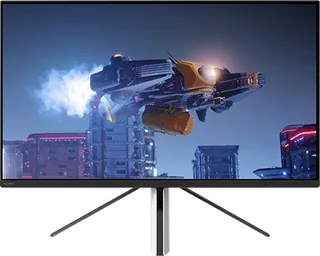
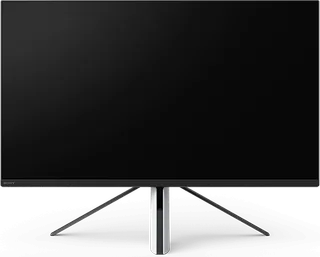
| Colours | White rear housing and black bezel | White rear housing and black bezel |
| Power and support | ||
| Power use | Typical 103 W; Eco mode 21.6 W; standby 0.5 W (Sony UK specifications) | Typical 139 W; Eco mode 28.9 W; standby 0.5 W (Sony UK specifications) |
| Power supply | External AC adapter; 100–240 V AC, 50/60 Hz | External AC adapter; 100–240 V AC, 50/60 Hz |
| Laptop charging | USB supply depends on USB-hub/KVM selection; the Help Guide says USB-B and USB-C upstream connections are required. | USB charging depends on the USB-hub/KVM selection settings (Sony FAQ) |
| Software | INZONE Hub for Windows; current version 1.0.19.0 lists Windows 11 Home/Pro. Older launch pages describe Windows 10 support. Firmware updates use a USB upstream connection and video connection. | INZONE Hub for Windows; firmware updates through the PC software using a USB upstream connection |
| In the box | AC adapter, AC power cord, DisplayPort cable, setup guide, operating instructions, factory colour-calibration report, warranty card and INZONE sticker (exact M3 specifications). The shared M9/M3 FAQ says cables are not supplied, conflicting with the exact M3 list. | AC adapter, AC power cord, setup guide, operating instructions, factory colour-calibration report, warranty card and INZONE sticker. Video and USB cables are not included (Sony UK specifications and FAQ). |
More comparisons
- Sony INZONE M10S II vs Sony INZONE M3
- Sony INZONE M10S II vs Sony INZONE M9
- Dell 27 240Hz Monitor (SE2726HG) vs Sony INZONE M3
- Dell 27 Plus Monitor (S2725HSM) vs Sony INZONE M3
- Gigabyte M27UP vs Sony INZONE M9
- Dell 27 Plus 4K Monitor (S2725QS) vs Sony INZONE M9
- MSI MAG 275UPD E14 vs Sony INZONE M9
- Dell 27 Plus 4K USB-C (S2725QC) vs Sony INZONE M9
- Dell Pro 27 Plus 4K USB-C Hub (P2725QE) vs Sony INZONE M9
- Dell UltraSharp 27 4K Thunderbolt Hub (U2725QE) vs Sony INZONE M9
- MSI MAG 274F vs Sony INZONE M3
- Sony INZONE M10S vs Sony INZONE M3
- Sony INZONE M10S vs Sony INZONE M9
- Sony INZONE M3 vs Sony INZONE M9 II
- Sony INZONE M9 vs Sony INZONE M9 II