Apple Mac Studio (M1 Max / M1 Ultra) vs Framework Desktop (AMD Ryzen AI Max 300 Series)
Better figure, where one is clearly better
| AppleMac Studio (M1 Max / M1 Ultra) | FrameworkDesktop (AMD Ryzen AI Max 300 Series) | |
|---|---|---|
| Overview | ||
| Released | March 2022 | August 2025 |
| Performance | ||
| Processor | Apple M1 Max or Apple M1 Ultra | AMD Ryzen AI Max 385 or AMD Ryzen AI Max+ 395 |
| CPU cores | 10 or 20 | 8 or 16 |
| CPU threads | – | 16 or 32 |
| Graphics | 24-core GPU, 32-core GPU, 48-core GPU or 64-core GPU | Radeon 8050S Graphics or Radeon 8060S Graphics |
| AI engine (NPU) | 22 TOPS | 50 TOPS (better) |
| Memory | 32 GB, 64 GB or 128 GB | 32 GB, 64 GB or 128 GB |
| Storage | 512 GB to 8 TB | 500 GB to 8 TB |
| CPU | M1 Max has 10 CPU cores (8 performance, 2 efficiency); M1 Ultra has 20 (16 performance, 4 efficiency) | Ryzen AI Max 385 with 8 cores and 16 threads, 3.6 GHz base, up to 5.0 GHz boost, 32 MB L3 cache; Ryzen AI Max+ 395 with 16 cores and 32 threads, 3.0 GHz base, up to 5.1 GHz boost, 64 MB L3 cache; Zen 5 cores with AVX-512; soldered; runs at 120 W sustained and 140 W boost |
| GPU | M1 Max has 24 or 32 GPU cores; M1 Ultra has 48 or 64 | Radeon 8050S with 32 RDNA 3.5 compute units up to 2.8 GHz, or Radeon 8060S with 40 compute units up to 2.9 GHz; 32 MB MALL cache; up to 96 GB of memory can be assigned to the GPU on Windows |
| AI engine | 16-core Neural Engine (M1 Max); 32-core Neural Engine (M1 Ultra) | – |
| Memory bandwidth | 400 GB/s (M1 Max); 800 GB/s (M1 Ultra) | 256 GB/s (256-bit LPDDR5x-8000, soldered) |
| Storage type | SSD; M1 Max starts at 512 GB, configurable to 1 TB, 2 TB, 4 TB or 8 TB; M1 Ultra starts at 1 TB with 2 TB, 4 TB or 8 TB options | 2 × NVMe PCIe 4.0 x4 M.2 2280 sockets with heatspreaders, up to 8 TB each; SanDisk SN7100 (500 GB to 4 TB) or 850X (1 TB to 8 TB) SSDs offered, or bring your own; PCIe x4 slot on the mainboard (not exposed in the standard case) |
| Media engine | Hardware-accelerated H.264, HEVC, ProRes and ProRes RAW; M1 Max has one video decode, two video encode and two ProRes engines; M1 Ultra has two video decode, four video encode and four ProRes engines | – |
| Display | ||
| Screen | None built in | None built in |
| Connections | ||
| Ports | 4 × Thunderbolt 4, 2 × USB-C, 2 × USB-A, HDMI, Ethernet, SD card slot, headphone jack | 2 × USB4, 2 × USB-A, HDMI, 2 × DisplayPort, Ethernet, headphone jack |
| Ethernet | 10 Gb/s (better) | 5 Gb/s |
| External displays | Up to 5 (better) | Up to 4 |
| Wi-Fi | Wi-Fi 6 | Wi-Fi 7 |
| Bluetooth | 5.0 | – |
| Front ports | Two USB-C ports up to 10 Gb/s (M1 Max) or two Thunderbolt 4 ports up to 40 Gb/s (M1 Ultra); SDXC slot with UHS-II support | 2 × Expansion Card slots (USB 3.2 Gen 1, configurable to Gen 2 in the BIOS); cards sold separately, including USB-C, USB-A, microSD, SD, Audio, Ethernet and WisdPi 10G Ethernet |
| Back ports | Four Thunderbolt 4 ports with DisplayPort, Thunderbolt 4 and USB 4 up to 40 Gb/s, and USB 3.1 Gen 2 up to 10 Gb/s; two USB-A up to 5 Gb/s; HDMI; 10 Gb Ethernet supporting 1, 2.5, 5 and 10 Gb/s; 3.5 mm jack with high-impedance headphone support | HDMI 2.1 with CEC; 2 × DisplayPort 2.1; 2 × USB4 (USB-C); 2 × USB-A (USB 3.2 Gen 2); 5 Gbit Ethernet (Realtek RTL8126); 3.5 mm combo audio jack (Realtek ALC623) |
| External displays | Four displays at up to 6K 60 Hz over USB-C and one at up to 4K 60 Hz over HDMI, simultaneously | – |
| Speakers | Built-in speaker; HDMI multichannel audio output | – |
| Design and power | ||
| Type | Compact | Compact |
| Weight | 2.7 kg (better) | 3.1 kg |
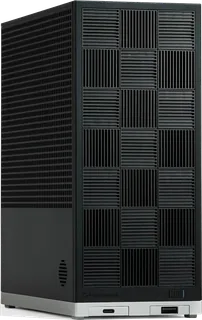
| Width × depth × height | 197 × 197 × 95 mm | 96.8 × 205.5 × 226.1 mm |
| Operating system | macOS | Windows |
| Size and weight detail | Weight is 2.7 kg with M1 Max or 3.6 kg with M1 Ultra; both enclosures are 197 × 197 × 95 mm | – |
| Power supply | Built-in; 100–240 V AC, 50–60 Hz; maximum continuous power 370 W | Internal 400 W FlexATX (ATX 3.0) unit, Gold efficiency at 110 V and Silver at 230 V; 100–240 V; 40 mm fan with 0-RPM mode |
| Noise | 15 dBA sound pressure at idle and during Apple's wireless web test (M1 Ultra, operator position) | 120 mm CPU fan options rated at 28.8 dBA (Noctua NF-A12x25 HS-PWM) or 30 dBA, 34 dBA max (Cooler Master Mobius 120p ARGB) |
| Materials | 80% recycled aluminium enclosure | 30% post-consumer recycled plastic; 50% post-consumer recycled aluminium |
| Colours | Silver | Black or Translucent side panel; front tiles in Black, Orange, Lavender, Green, Gray or Red, in straight or diagonal patterns |
| In the box | Mac Studio, power lead | Framework Desktop DIY Edition, left panel, CPU fan mounting kit, screwdriver; CPU fan, storage, tiles and Expansion Cards as ordered |

More comparisons
- Apple Mac mini (M6 or M5 Pro) vs Framework Desktop (AMD Ryzen AI Max 300 Series)
- Apple Mac Studio (M1 Max / M1 Ultra) vs Apple Mac Studio (M5 Max or M5 Ultra)
- Apple Mac mini (M4 or M4 Pro) vs Framework Desktop (AMD Ryzen AI Max 300 Series)
- Apple Mac Studio (M4 Max or M3 Ultra) vs Framework Desktop (AMD Ryzen AI Max 300 Series)
- Apple Mac Studio (M1 Max / M1 Ultra) vs Apple Mac Studio (M4 Max or M3 Ultra)
- Apple Mac mini (M4 or M4 Pro) vs Apple Mac Studio (M1 Max / M1 Ultra)
- Apple Mac Pro (M2 Ultra) vs Apple Mac Studio (M1 Max / M1 Ultra)
- Apple Mac Studio (M1 Max / M1 Ultra) vs Apple Mac Studio (M2 Max or M2 Ultra)
- Apple iMac Pro (2017) vs Apple Mac Studio (M1 Max / M1 Ultra)
- Apple Mac Pro (Late 2013) vs Apple Mac Studio (M1 Max / M1 Ultra)