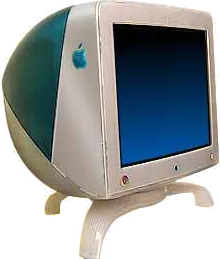
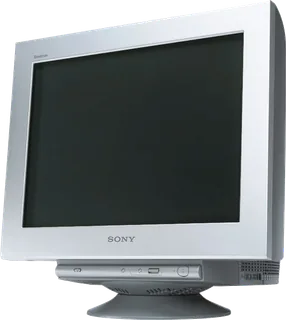
Apple Studio Display (21-inch CRT, 1999) vs Sony GDM-F520
Better figure, where one is clearly better
| AppleStudio Display (21-inch CRT, 1999) | SonyGDM-F520 | |
|---|---|---|
| Overview | ||
| Released | January 1999 | 2001 |
| Display | ||
| Screen size | 19.8″ | 19.8″ |
| Panel | CRT (Nominal 21-inch Sony Trinitron aperture-grille CRT with a 19.8-inch viewable image; 0.25–0.27 mm variable aperture grille pitch. Vertically flat screen, without a fixed native pixel matrix.) | CRT (Flat FD Trinitron aperture-grille CRT; marketed as a 21-inch tube with a 19.8-inch viewable image. No fixed pixel matrix or native refresh rate.) |
| Colour modes | – | PROFESSIONAL, STANDARD and DYNAMIC Picture Effect modes; EASY, PRESET, EXPERT and sRGB colour settings; 5000 K, 6500 K and 9300 K presets with 5000–11000 K adjustment in EASY |
| Pixel pitch | Variable 0.25–0.27 mm aperture grille pitch | Uniform 0.22 mm aperture-grille pitch across the screen; not an LCD pixel pitch |
| Supported signal modes | Supports 1600 × 1200, 1280 × 1024 and 1024 × 768 at up to 85 Hz; 1152 × 870 and 832 × 624 at up to 75 Hz. Horizontal scan 31–107 kHz; vertical scan 48–120 Hz. These are selectable CRT signal modes, not a fixed native matrix or one native refresh rate. | Sony specifies a maximum 2048 × 1536 at 85 Hz and recommends 1600 × 1200 at 85 Hz. Horizontal scan range 30–137 kHz; vertical scan range 48–170 Hz. These are supported timings, not native resolution or refresh. Maximum viewable area approximately 403.8 × 302.2 mm; standard image area 388 × 291 mm (4:3) or 364 × 291 mm (5:4). |
| Screen coating | Antireflective and antistatic screen coating | High Contrast AR screen coating |
| Calibration | Internal measurement system adjusts the electron beam to maintain factory calibration; stores ColorSync profiles. Includes an ambient-light tool, variable 4100–9300 K white-point selection and gamma-curve adjustment. | RGB gain/bias, horizontal/vertical convergence, top/bottom vertical convergence, corner landing, geometry and moiré controls; automatic/manual degaussing and Image Restoration after a 30-minute warm-up |
| Connections | ||
| Video inputs | VGA | VGA |
| USB-C charging | None | None |
| USB ports | 4 × USB-A | 4 × USB-A |
| Other connections | 15-pin mini D-Sub VGA video connector with supplied VGA-to-Macintosh adaptor | One HD15 VGA input and one analogue RGB video input comprising five BNC connectors (R, G, B, horizontal sync and vertical sync). Separate/composite sync and sync-on-green supported; DDC Plug & Play is available over HD15 only. |
| USB hub detail | – | One square USB-B upstream connector and four rectangular USB-A downstream connectors on the right side; hub operates while the monitor is on or in power-saving mode |
| Design | ||
| Stand adjusts | – | Tilt, swivel |
| Weight with stand | 35 kg | 30 kg |
| Tilt | – | 5° down to 15° up |
| Swivel | – | 90° left or right |
| Size with stand | 51.1 × 56.6 × 55 cm (width × height × depth), January 1999 Blueberry datasheet; later Graphite enclosure dimensions differ | Approximately 497 × 499 × 487 mm (W × H × D) |
| Weight detail | – | Approximately 30 kg for the complete monitor; Sony's instructions say not to remove the stand |
| Controls | Power, brightness and contrast; compatible Mac software supplies geometry, convergence, degauss, white-point and calibration adjustments | Front input selector, Picture Effect button, menu button and up/down/push control button; automatic sizing/centring, control lock and nine menu languages |
| Colours | Translucent Blueberry and white enclosure | – |
| Power and support | ||
| Power use | Maximum 180 W operating; less than 30 W standby; less than 5 W when the computer is in energy-saving mode | Up to 145 W in normal operation and up to 3 W in active-off deep sleep, without USB peripherals connected |
| Power supply | 90–264 V AC, single-phase 47–63 Hz; mains frequency is separate from display refresh | International operating instructions specify 100–240 V AC, 50–60 Hz, 2.0–1.0 A; Japanese archive specifies 100 V AC. Use the appropriate supplied regional mains lead. |
| Software | Maker announced the new Studio Display family on 5 January 1999; January retail precision is used because a distinct first-sale day is unconfirmed. January M6204LL/A datasheet requires the new Power Macintosh G3 with built-in USB and Mac OS 8.0 or later. Brightness and contrast ratio are unpublished and omitted; no pixel density is assigned to this CRT. | DDC2B/DDC2Bi over HD15, with stored preset/user timings and GTF support; exact signal support also depends on the graphics card |
| Certifications | – | ENERGY STAR, TCO'99 and MPR II in the international operating instructions; Japanese archive also lists VCCI Class B and FCC Class B |
| In the box | Display, Apple Displays software, VGA-to-Macintosh adaptor, power cord, ambient-light tool and setup guide | Power cord, HD15 video-signal cable, USB cable, Power Mac G3/G4 adapter and operating instructions (international manual; regional contents may vary) |
More comparisons
- Apple Studio Display (2026) vs Apple Studio Display (21-inch CRT, 1999)
- Apple Studio Display (21-inch CRT, 1999) vs Apple Studio Display XDR
- Apple Studio Display (2022) vs Apple Studio Display (21-inch CRT, 1999)
- Apple Cinema Display (20-inch, DVI) vs Sony GDM-F520
- Apple Cinema Display (20-inch, ADC) vs Sony GDM-F520
- Apple Studio Display (17-inch LCD, 2001) vs Apple Studio Display (21-inch CRT, 1999)
- Apple Multiple Scan 20 Display vs Sony GDM-F520
- Apple AppleVision 850 vs Sony GDM-F520
- Sony GDM-F520 vs Sony GDM-FW900
- Apple AppleVision 850AV vs Sony GDM-F520
- Apple Studio Display (15-inch ADC, 2000) vs Apple Studio Display (21-inch CRT, 1999)
- Apple Studio Display (17-inch CRT ADC, 2000) vs Apple Studio Display (21-inch CRT, 1999)
- Apple Studio Display (21-inch CRT, 1999) vs Sony GDM-FW900
- Apple Studio Display (15-inch DVI, 1999) vs Apple Studio Display (21-inch CRT, 1999)
- Apple Studio Display (17-inch CRT, 1999) vs Apple Studio Display (21-inch CRT, 1999)
- Apple Studio Display (15-inch LCD, 1999) vs Apple Studio Display (21-inch CRT, 1999)