Beurer BM 25 vs Omron M3
Better figure, where one is clearly better
| BeurerBM 25 | OmronM3 | |
|---|---|---|
| Overview | ||
| Released | – | – |
| Measuring | ||
| Type | Upper arm | Upper arm |
| Clinically validated | – | Yes |
| Irregular heartbeat detection | Yes | Yes |
| AFib detection or ECG | – | No |
| Method | Automatic oscillometric upper-arm measurement during deflation; first on-sale date not established | Automatic oscillometric upper-arm measurement; HEM-7154-E, distinct from M3 Comfort HEM-7155-E and M3 Comfort AFib HEM-7196-FLE. First on-sale date not established |
| Accuracy | Maker manual specifies display accuracy of ±3 mmHg for systolic and diastolic pressure and ±5% of the displayed pulse value; this specification is distinct from clinical validation | Maker's pressure accuracy ±3 mmHg and pulse accuracy ±5% of displayed reading; systolic range 60–260 mmHg, diastolic 40–215 mmHg and pulse 40–180 beats/minute |
| Clinical validation | Beurer states clinical testing to ISO 81060-2 in the manual; exact independent registry confirmation was not established | Maker manual states an 85-subject clinical investigation under EN ISO 81060-2:2014 and compliance with 2014 and 2019+A1:2020; K5 is used for diastolic pressure. No additional population validation is inferred, and blood pressure validation does not establish diagnostic accuracy of rhythm indicators |
| Features | Single start/stop button, cuff fit check, irregular heartbeat warning, classification scale and automatic switch-off; maker lists no resting indicator or calculated averages | Irregular-heartbeat, body-movement, cuff-wrap and high-blood-pressure indicators. No AFib detection or ECG recording; the manual supports displaying the average of the latest two or three readings taken within ten minutes, despite the UK web table marking averaging as absent. This is distinct from automatic consecutive three-reading measurement; the UK page's generic Upper Arm BPM & ECG category label does not describe an ECG capability on this model |
| Cuff | ||
| Cuff fits | 22–42 cm | 22–42 cm |
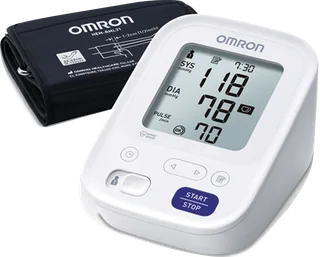
| Cuff | Supplied upper-arm cuff | Included HEM-RML31 Easy Cuff, 22–42 cm arm circumference; approximately 145 × 594 mm, 750 mm tube and 170 g |
| Connections and memory | ||
| Users | – | 2 |
| Readings stored | – | 60 per user |
| Bluetooth and app | No | No |
| Memory | – | Up to 60 readings per user for two users; guest mode takes a measurement without saving it |
| App | Scan & Save in beurer HealthManager Pro uses a smartphone camera to record the display; no Bluetooth connection | No Bluetooth or OMRON connect support |
| Power | Four 1.5 V LR03 AAA batteries or optional DC 5 V, 1 A mains adaptor through USB-C; USB-C is for mains operation, not charging the disposable batteries | Four AA batteries included, DC 6 V / 4 W; optional compatible AC adapter sold separately. Approximately 1000 measurements with new alkaline batteries and the included cuff, depending on batteries and cuff |
| Design | ||
| Display details | Non-illuminated LCD, 4.4 × 5.3 cm, with black digits; maker lists no date/time display | Digital LCD; monitor IP20 |
| Size | 12.00 × 9.00 × 4.00 cm (L × W × H) | Approximately 105 × 87 × 153 mm (W × H × L); approximately 310 g without batteries |
| In the box | Monitor, 22–42 cm cuff and four AAA batteries | Monitor, HEM-RML31 cuff, four AA batteries, storage case and instruction manuals 1/2 |

More comparisons
- Beurer BM 25 vs Beurer BM 85
- Beurer BM 25 vs Beurer BM 53
- Beurer BM 25 vs Rossmax AU941f
- Beurer BM 25 vs Rossmax AX356f
- A&D Medical UA-611 vs Beurer BM 25
- Beurer BM 25 vs Microlife BP 3AG1
- Beurer BM 25 vs Microlife BP 3AS1-2
- Beurer BM 25 vs Microlife BP A1 Easy
- Beurer BM 25 vs Microlife BP A2 Basic
- Beurer BM 25 vs Microlife BP A2 Classic
- Beurer BM 25 vs Microlife BP A2 Easy
- Beurer BM 25 vs Microlife BP A3 PC
- Beurer BM 25 vs Microlife BP A3 Plus
- Beurer BM 25 vs Microlife BP A3L Comfort
- Beurer BM 25 vs Microlife BP AG1-10
- Beurer BM 25 vs Microlife BP AG1-20