Beurer BM 25 vs Rossmax Z1
Better figure, where one is clearly better
| BeurerBM 25 | RossmaxZ1 | |
|---|---|---|
| Overview | ||
| Released | – | – |
| Measuring | ||
| Type | Upper arm | Upper arm |
| Irregular heartbeat detection | Yes | Yes |
| AFib detection or ECG | – | No |
| Method | Automatic oscillometric upper-arm measurement during deflation; first on-sale date not established | Automatic oscillometric upper-arm measurement during deflation, with semiconductor pressure sensor. First retail date unresolved |
| Accuracy | Maker manual specifies display accuracy of ±3 mmHg for systolic and diastolic pressure and ±5% of the displayed pulse value; this specification is distinct from clinical validation | Pressure range 30–260 mmHg and pulse 40–199 bpm. Maker accuracy ±3 mmHg pressure and ±5% pulse |
| Clinical validation | Beurer states clinical testing to ISO 81060-2 in the manual; exact independent registry confirmation was not established | Maker claims ESH approval. Medaval records equivalence to Rossmax CF175f rather than a published direct Z1 validation study, and notes unpublished equivalence evidence; headline validation omitted |
| Features | Single start/stop button, cuff fit check, irregular heartbeat warning, classification scale and automatic switch-off; maker lists no resting indicator or calculated averages | Cuff-fit and movement detection, hypertension risk indication and generic irregular-heartbeat warning. No AFib-specific screening or ECG |
| Cuff | ||
| Cuff fits | 22–42 cm | 24–40 cm |
| Cuff | Supplied upper-arm cuff | Latex-free Universal Cone Cuff, 24–40 cm |
| Connections and memory | ||
| Users | – | 1 |
| Readings stored | – | 90 |
| Bluetooth and app | No | No |
| Memory | – | One history of up to 90 readings with sequence numbers and an average of the last three. No user selector or dated reading history in current guide |
| App | Scan & Save in beurer HealthManager Pro uses a smartphone camera to record the display; no Bluetooth connection | No Bluetooth or data transfer; USB-C is a power connector |
| Power | Four 1.5 V LR03 AAA batteries or optional DC 5 V, 1 A mains adaptor through USB-C; USB-C is for mains operation, not charging the disposable batteries | Four AAA cells, DC 6 V. Optional USB-C DC 5 V supply rated at least 1000 mA; guide excludes USB PD chargers and battery charging. Automatic shutdown after one minute without key operation |
| Design | ||
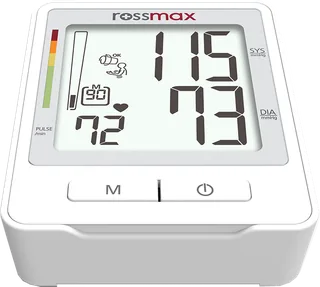
| Display details | Non-illuminated LCD, 4.4 × 5.3 cm, with black digits; maker lists no date/time display | 69 × 64.4 mm LCD in maker page. IP21 |
| Size | 12.00 × 9.00 × 4.00 cm (L × W × H) | 100 × 86 × 68 mm (L × W × H); 218 g without batteries |
| In the box | Monitor, 22–42 cm cuff and four AAA batteries | Maker lists batteries, Universal Cone Cuff, instruction manual and string bag. Power adaptor and USB cable optional |

More comparisons
- Beurer BM 25 vs Beurer BM 85
- Beurer BM 25 vs Beurer BM 53
- Beurer BM 25 vs Rossmax AU941f
- Beurer BM 25 vs Rossmax AX356f
- A&D Medical UA-611 vs Beurer BM 25
- Beurer BM 25 vs Microlife BP 3AG1
- Beurer BM 25 vs Microlife BP 3AS1-2
- Beurer BM 25 vs Microlife BP A1 Easy
- Beurer BM 25 vs Microlife BP A2 Basic
- Beurer BM 25 vs Microlife BP A2 Classic
- Beurer BM 25 vs Microlife BP A2 Easy
- Beurer BM 25 vs Microlife BP A3 PC
- Beurer BM 25 vs Microlife BP A3 Plus
- Beurer BM 25 vs Microlife BP A3L Comfort
- Beurer BM 25 vs Microlife BP AG1-10
- Beurer BM 25 vs Microlife BP AG1-20