Mercedes-Benz GLC vs Mercedes-Benz Electric GLC
Better figure, where one is clearly better
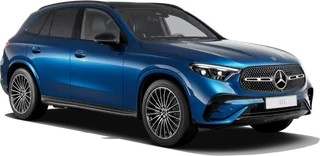
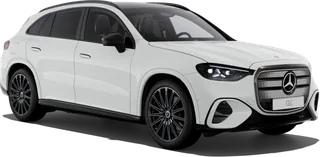
| Mercedes-BenzGLC | Mercedes-BenzElectric GLC | |
|---|---|---|
| Overview | ||
| Released | 2022 | 2026 |
| Performance | ||
| Powertrain | Mild hybrid, Plug-in hybrid | Electric |
| Power | 194–329 bhp | 349–483 bhp (better) |
| 0–62 mph | 6.2–8 s | 4.3–5.9 s (better) |
| Top speed | 135–151 mph (better) | 130 mph |
| Engine or motors | GLC 220 d: 1,993 cc four-cylinder diesel, 145 kW (197 hp) plus 17 kW mild-hybrid motor; GLC 300: 1,999 cc four-cylinder petrol, 190 kW (258 hp) plus 17 kW; GLC 300 d: 1,993 cc four-cylinder diesel, 198 kW (269 hp) plus 17 kW; GLC 300 e: 150 kW petrol plus 115 kW electric motor, 230 kW (313 hp) system; GLC 300 de: 145 kW diesel plus 115 kW motor, 245 kW (333 hp) system; bhp converted from Mercedes' kW figures | GLC 250: 260 kW (354 hp), rear-wheel drive; GLC 400 4MATIC: 360 kW (489 hp), dual motors; bhp converted from Mercedes' kW figures |
| Torque | 440 Nm (GLC 220 d), 400 Nm (GLC 300), 550 Nm (GLC 300 d), 550 Nm system (GLC 300 e), 750 Nm system (GLC 300 de) | 505 Nm (GLC 250), 800 Nm (GLC 400 4MATIC) |
| Gearbox | 9G-TRONIC 9-speed automatic | Two-speed transmission on the rear axle, with 11:1 first and 5:1 second gear ratios (Mercedes-Benz) |
| Drive | All-wheel drive (4MATIC) | Rear-wheel drive (GLC 250); all-wheel drive (GLC 400 4MATIC) |
| Range and charging | ||
| Zero-emission range (WLTP) | 74–75 miles | 389–405 miles (better) |
| Battery | 25.28 kWh | 85–94 kWh (better) |
| Fastest charging | 60 kW | 320–330 kW (better) |
| Economy (WLTP) | 38.7–166.2 mpg | – |
| Range detail | WLTP electric range 75 miles (GLC 300 e) or 74 miles (GLC 300 de); equivalent all-electric range 77 or 74 miles | WLTP range 389 miles (GLC 250) or 405 miles (GLC 400 4MATIC); 225–270 km or 240–305 km added in 10 minutes of DC charging |
| Charging | Plug-in hybrids: 25.28 kWh usable battery; 11 kW AC (0–100% in 2.75 hours); DC up to 60 kW (10–80% in 29 minutes) | Usable battery 85 kWh (GLC 250) or 94 kWh (GLC 400 4MATIC); DC up to 320 kW or 330 kW, 10–80% in 22 minutes; 11 kW AC, 0–100% in 9 or 10.5 hours |
| Efficiency | WLTP combined: 53.3 mpg (GLC 220 d), 38.7 mpg (GLC 300), 50.4 mpg (GLC 300 d), 128.4 mpg (GLC 300 e; earlier Mercedes UK figure 128.5 mpg), 166.2 mpg (GLC 300 de); plug-in hybrids 18.2 kWh/100 km | 15.7 kWh/100 km (GLC 250), 16.4 kWh/100 km (GLC 400 4MATIC), WLTP combined |
| CO2 emissions | 140 g/km (GLC 220 d), 165 g/km (GLC 300), 148 g/km (GLC 300 d), 50 g/km (GLC 300 e) and 44 g/km (GLC 300 de) weighted | 0 g/km |
| Practicality | ||
| Body | SUV | SUV |
| Seats | 5 | 5 |
| Boot | 620 litres (better) | 520 litres |
| Length | 4,716 mm | 4,845 mm |
| Width | 1,890 mm | 1,913 mm |
| Weight | From 1,965 kg | From 2,414 kg |
| Boot | 620 litres (mild hybrids); 470 litres (plug-in hybrids) | 520 litres |
| Towing | 2,500 kg (GLC 220 d), 2,400 kg (GLC 300) or 2,000 kg (plug-in hybrids) braked; 750 kg unbraked | 2,200 kg (GLC 250) or 2,400 kg (GLC 400 4MATIC) braked; 750 kg unbraked |
| Size | 4,716 mm long, 1,890 mm wide without mirrors (1,920 mm plug-in hybrids; 2,075 mm with mirrors), 1,640 mm high (1,647 mm plug-in hybrids); 11.8 m turning circle; kerb weight 1,965 kg (GLC 300) to 2,442 kg (GLC 300 de) | 4,845 mm long, 1,913 mm wide without mirrors (2,089 mm with), 1,644 mm high; 12.1 m turning circle; kerb weight 2,414 kg (GLC 250), 2,581 kg (GLC 400 4MATIC) |
More comparisons
- BMW iX5 vs Mercedes-Benz Electric GLC
- Mercedes-Benz Electric GLC vs Toyota bZ4X Touring
- BYD Atto 3 Evo vs Mercedes-Benz Electric GLC
- BMW iX3 vs Mercedes-Benz Electric GLC
- Mercedes-Benz Electric GLC vs Tesla Model Y (2025)
- Mercedes-Benz GLC Coupé vs Mercedes-Benz Electric GLC
- Mercedes-Benz GLC vs Mercedes-Benz GLC Coupé
- BMW X1 vs Mercedes-Benz GLC
- Land Rover Range Rover Sport vs Mercedes-Benz GLC
- Lexus NX vs Mercedes-Benz GLC