Sony Cyber-shot DSC-HX99 vs Sony Cyber-shot DSC-S75
Better figure, where one is clearly better
| SonyCyber-shot DSC-HX99 | SonyCyber-shot DSC-S75 | |
|---|---|---|
| Overview | ||
| Released | October 2018 | 2001 |
| Image and sensor | ||
| Camera type | Compact | Compact |
| Sensor format | 1/2.3-type | 1/1.8-type |
| Sensor type | Back-illuminated Exmor R CMOS | Super HAD CCD |
| Effective resolution | 18.2 MP | 3.24 MP |
| Largest image | 4896 × 3672 | 2048 × 1536 |
| RAW recording | Yes | No |
| Standard ISO range | 80–3200 | – |
| Sensor detail | 1/2.3-type Exmor R CMOS; approximately 21.1 million total photosites. Optical format is not physical sensor dimensions | Sony Japan specifies 3.34 million total and 3.24 million effective photosites, with primary-colour filter and interlaced scan. Optical 1/1.8-type format is not a physical sensor measurement; conflicting DPReview 3.14 MP and retrospective tables not preferred over maker |
| Image formats | Sony ARW 2.3 RAW, RAW+JPEG or JPEG Extra Fine/Fine/Standard; sRGB or Adobe RGB; 4:3, 3:2, 16:9 and square photographs plus Sweep Panorama | JPEG Fine/Standard, uncompressed TIFF, black-and-white GIF Text and animated GIF Clip Motion; no RAW. Maximum 2048×1536 or 2048×1360 3:2, with lower sizes. Voice mode adds mono MPEG-1 audio |
| ISO detail | Ordinary ISO 80–3200; extended single-frame ISO 6400. Multi-shot Noise Reduction offers ISO 6400 and 12800 using combined exposures | – |
| Image processor | BIONZ X with front-end LSI | 14-bit DXP analogue-to-digital conversion in exact Sony launch sheet; this does not make JPEG output 14-bit |
| Lens and shooting | ||
| Built-in lens | 24–720 mm equivalent | 34–102 mm equivalent |
| Maximum aperture | f/3.5–6.4 | f/2–2.5 |
| Optical zoom | 28× | 3× |
| Stabilisation | Optical lens stabilisation | – |
| Maximum continuous burst | 10 fps | – |
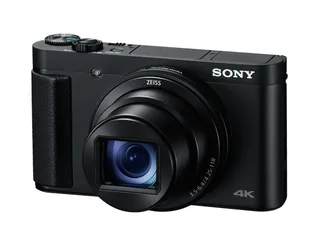
| Lens detail | ZEISS Vario-Sonnar T*, actual 4.25–118 mm, 11 elements in 10 groups with five aspherical elements; five-blade iris. Maker specifies 28× optical zoom, while 24–720 mm equivalent values are those displayed by the camera and recorded in Exif | Carl Zeiss Vario-Sonnar physical 7–21 mm F2.0–2.5, equivalent to 34–102 mm. Threefold optical zoom; additional digital enlargement up to 6× combined is not optical zoom. Optional VAD-S70 adaptor supports conversion lenses and filters |
| Autofocus | 25-point contrast autofocus, AF-S, Direct Manual Focus and manual focus; AF-C available for movies only. Eye AF, Lock-on AF and flexible spot areas; minimum focus approximately 5 cm wide or 250 cm telephoto | Autofocus from 0.5 m to infinity; macro from approximately 4 cm. AF illuminator and selectable focus-distance presets |
| Shutter | Mechanical shutter: Manual and shutter-priority 30–1/2000 second, aperture-priority 8–1/2000, Program 1–1/2000 and Intelligent Auto 1/4–1/2000 | Maker gives 8–1/1000 second; exposure mode and Burst 2 impose limitations |
| Burst detail | Full-resolution Speed Priority Continuous up to 10 fps, or ordinary Continuous approximately 3 fps. Up to 155 frames in Speed Priority with JPEG Fine; rate falls as buffer fills. Focus, exposure and white balance lock to first frame in either mode | Burst 2 records only two stills, with approximately 0.6-second interval in exact manual. Flash unavailable and shutter slower than one second cannot be selected; not a sustained continuous frame-rate claim |
| Stabilisation detail | Optical SteadyShot for stills; Intelligent Active movies combine optical and electronic correction | – |
| Flash | Built-in pop-up flash; ISO Auto range approximately 0.3–5.4 m wide or 2.5–3.0 m telephoto; no accessory shoe | Built-in flash with Auto, red-eye reduction, forced and off; recommended 0.3–3 m. Accessory shoe has no electrical contacts; optional HVL-F1000 connects through ACC minijack |
| Exposure controls | P/A/S/M and two Memory Recall modes; ±3 EV in 1/3 EV steps; multi-pattern, centre-weighted, spot, entire-screen average and highlight metering | Automatic, aperture priority, shutter priority and full manual exposure, with rear jog dial and AE Lock. ±2 EV exposure compensation; automatic, Indoor, Outdoor and One-push white balance |
| Video | ||
| Highest video resolution | 3840 × 2160 at 30 fps | 320 × 240 |
| Video detail | XAVC S 3840 × 2160 at 30p or 24p, 60/100 Mbps; PAL uses 25p. Full-pixel readout without pixel binning. Full HD up to 120p (100p PAL); 4K and 120p/100p HD sessions limited to approximately five minutes, with possible earlier thermal shutdown. Other modes approximately 29 minutes subject to temperature. UHS-I U3 microSDHC/XC required for 100 Mbps | Mono MPEG-1 at 320×240 HQ or standard and 160×112. DPReview measures 16 fps HQ with 15-second clip limit, versus 8 fps MPEG EX which records to card capacity. Maker 90-minute capacity claim is low-resolution 160×112 with 128 MB card, not HQ. Animated GIF Clip Motion is separate |
| Audio | Stereo recording: XAVC S Linear PCM or AVCHD Dolby Digital | – |
| Screen and viewfinder | ||
| Viewfinder | Electronic | Optical |
| Screen size | 3″ | 1.8″ |
| Screen dots | 921,600 | 123,200 |
| Touchscreen | Yes | No |
| Tilting screen | Yes | No |
| Display detail | 3.0-type 4:3 TFT LCD, 921600 dots; tilts up 180 degrees. Touch focus, touch shutter and touchpad focus while using viewfinder; menus are not touch controlled | Fixed 1.8-inch TFT, 123,200 dots (560×220) in exact manual; maker launch rounds to approximately 123,000. Separate rear status display. Dots are not image pixels |
| Viewfinder detail | Retractable 0.2-type OLED, 638400 dots; 100% coverage (97% during 4K recording), 0.50× equivalent magnification, −4 to +3 dioptres | Optical real-image finder with dioptre adjustment; rear LCD recommended for accurate close-up framing |
| Connections and design | ||
| Wi-Fi | Yes | – |
| Bluetooth | Yes | – |
| Battery life (maker's claim) | 370 photographs | – |
| Body weight | 216 g (better) | 352 g |
| Release detail | Sony Switzerland states availability from late October 2018; Sony Hong Kong specifies 26 October locally. October precision retained because the international first-sale day is not established | Sony Japan announced 15 February 2001 and planned 10 April 2001 sale. Contemporary production DPReview includes retail purchase link; actual first-sale month unconfirmed, so year precision retained. No inferred official predecessor link |
| Recording media | microSD, microSDHC, microSDXC and Memory Stick Micro/Mark2; no full-size SD slot | Original Memory Stick with 8 MB supplied; maker gives approximately five Fine or nine Standard maximum-size JPEGs on supplied card. Recording count depends on image format and capacity |
| Ports | Micro HDMI and Multi/Micro USB with USB 2.0 | USB mini-B, mono A/V OUT with NTSC/PAL setting, ACC accessory minijack and DC input. USB connection does not establish USB 2.0 Hi-Speed or USB charging. Optional remote-control tripod uses ACC |
| Wireless connections | 2.4 GHz IEEE 802.11 b/g/n Wi-Fi, NFC Type 3 and Bluetooth for location information from a compatible smartphone; no built-in GPS or compass | – |
| Battery life detail | NP-BX1; CIPA claim approximately 370 photographs with LCD or 300 with viewfinder. LCD claim rises to 460 with monitor auto-off set to two seconds | NP-FM50 InfoLITHIUM rechargeable pack. Exact guide claims approximately 2500 shots / 150 minutes LCD on or 3000 / 180 LCD off: continuous VGA 640×480 STANDARD NORMAL at 25°C, one shot about every four seconds with Memory Stick replacements as needed. Not CIPA or normal-use life. Playback 5000 / 270 minutes and 160×112 movie 170 minutes LCD on / 210 off are separate tests |
| Charging | In-camera USB charging and USB external power using supplied AC adapter with battery inserted | In-camera charging while switched off using supplied AC-L10A/B/C adaptor. Approximately 150 minutes full charge from fully discharged at 25°C; not USB charging |
| Dimensions | 102 × 58.1 × 35.5 mm (width × height × depth), CIPA | 117×71×64 mm width×height×depth in Sony launch sheet and shared English manual |
| Weight detail | Approximately 216 g body only, or 242 g including NP-BX1 and memory card | Approximately 352 g body only in Sony Japan launch. Approximately 462 g including NP-FM50, Memory Stick, shoulder strap and lens cap in launch and manual; loaded weight not used as body mass |
| Colours | Black | – |
| In the box | NP-BX1, AC-UB10C adapter, micro USB cable, wrist strap and instructions in Japan; regional mains fittings vary | NP-FM50 battery, AC-L10 adaptor and mains lead, 8 MB Memory Stick, USB and A/V cables, shoulder strap, lens cap/tether and software CD; exact regional contents vary |

More comparisons
- Sony Cyber-shot DSC-HX99 vs Sony Cyber-shot DSC-RX100 VII
- Sony Cyber-shot DSC-HX90V vs Sony Cyber-shot DSC-HX99
- Sony Cyber-shot DSC-HX80 vs Sony Cyber-shot DSC-HX99
- Sony Cyber-shot DSC-HX50V vs Sony Cyber-shot DSC-HX99
- Sony Cyber-shot DSC-HX99 vs Sony Cyber-shot DSC-WX500
- Sony Cyber-shot DSC-HX350 vs Sony Cyber-shot DSC-HX99
- Sony Cyber-shot DSC-HX400V vs Sony Cyber-shot DSC-HX99
- Sony Cyber-shot DSC-HX60V vs Sony Cyber-shot DSC-HX99
- Sony Cyber-shot DSC-H400 vs Sony Cyber-shot DSC-HX99
- Sony Cyber-shot DSC-HX99 vs Sony Cyber-shot DSC-W800
- Sony Cyber-shot DSC-HX99 vs Sony Cyber-shot DSC-W830
- Sony Cyber-shot DSC-HX99 vs Sony Cyber-shot DSC-WX350
- Sony Cyber-shot DSC-HX300 vs Sony Cyber-shot DSC-HX99
- Sony Cyber-shot DSC-H200 vs Sony Cyber-shot DSC-HX99
- Sony Cyber-shot DSC-HX99 vs Sony Cyber-shot DSC-WX200
- Sony Cyber-shot DSC-HX99 vs Sony Cyber-shot DSC-WX300